
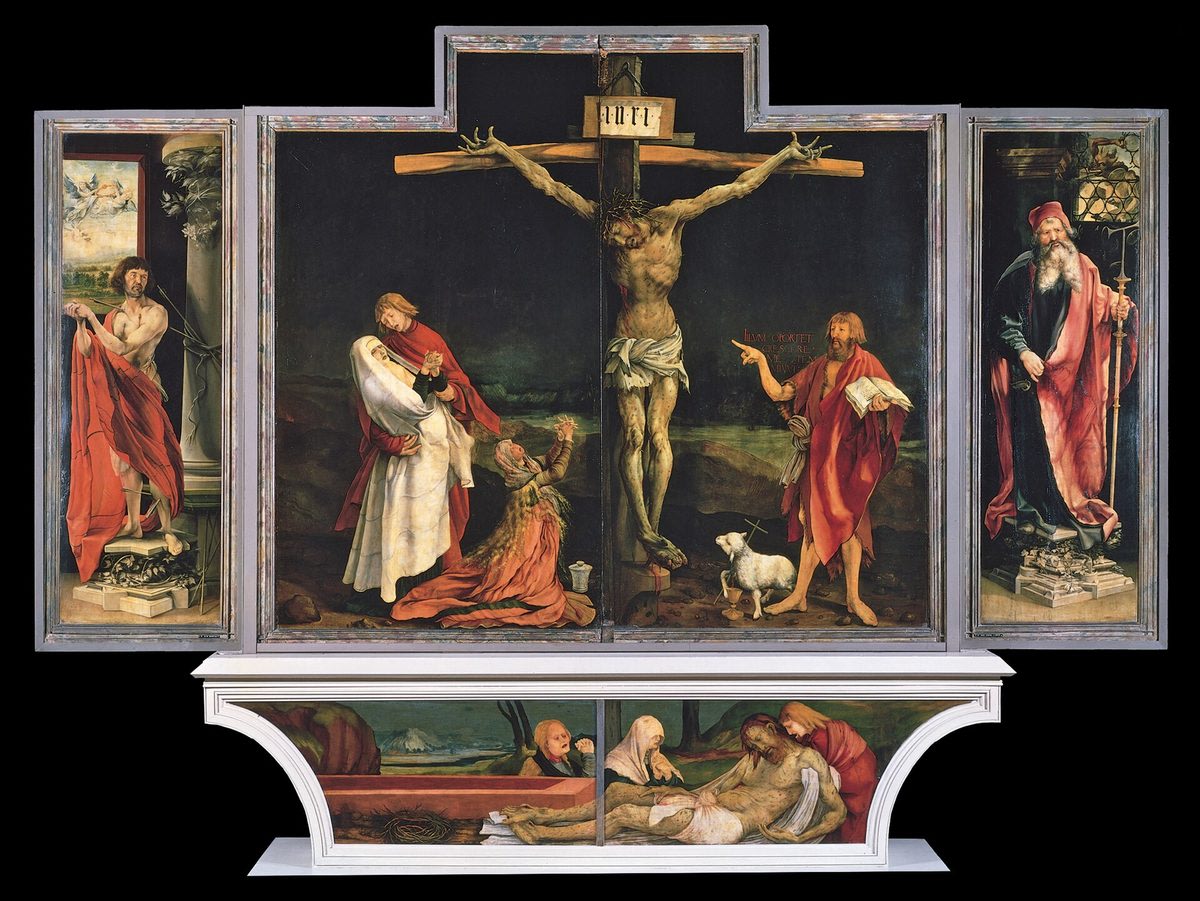
Isenheim Altarpiece
Isenheim Altarpiece — the Crucifixion panel
Matthias Grünewald, Public domain, via Wikimedia Commons
The Isenheim Altarpiece is the most agonizing and most transcendent representation of the Crucifixion ever painted — a polyptych altarpiece made for the hospital chapel of the Monastery of St Anthony in Isenheim, where patients suffering from ergotism (St Anthony's Fire — a fungal poisoning that caused pustulant skin lesions, gangrenous extremities, and excruciating pain) were cared for. The altarpiece was shown to these patients in different configurations as their condition changed.
The central Crucifixion panel shows a Christ whose body is covered with the same festering wounds as the patients — the message being that Christ had taken on their suffering. The Resurrection panel (in the second opening) shows a radiant Christ bursting from the tomb in an explosion of light, promising the patients' own resurrection.
Matthias Grünewald (c.1470-1528) was the great German contemporary of Albrecht Dürer — a painter of extraordinary expressive power working in the late Gothic tradition, untouched by the Italian Renaissance humanism that was transforming painting elsewhere. The Isenheim Altarpiece was painted for Guido Guersi, preceptor of the Monastery of St Anthony at Isenheim in Alsace, around 1512-1516.
The altarpiece has three configurations: closed (showing the Crucifixion and lamentation); first opening (showing the Annunciation, Concert of Angels, Nativity, and Resurrection); second opening (carved and painted figures of Sts Anthony, Augustine, and Jerome). The shift from the terrible suffering of the Crucifixion to the blazing Resurrection of the first opening is the altarpiece's great theological argument.
The Crucifixion panel is almost impossible to describe adequately. Christ's body hangs with a physical weight that pulls the crossbar into a downward arc; his hands are twisted in rigor, the fingers curled like claws; his skin is covered with thorns from the crown of thorns that have pierced the flesh all over his body; his lips and toes have turned green-black with gangrene. The pain is total, the scale enormous.
Look at Mary Magdalene below — she kneels and wrings her hands with an intensity of grief that is almost unbearable. Then look at St John the Baptist on the far right, pointing at Christ with one long finger: 'He must increase; I must decrease.' The contrast between the suffering body and John's composed acceptance is the altarpiece's first theological statement. To see the Resurrection panel after the Crucifixion is one of the most powerful experiences in Western art.
When standing before this work, look carefully: Isenheim Altarpiece — the Crucifixion panel. Give it time — what seems decorative often carries the central meaning.
When standing before this work, look carefully: The Resurrection — the first opening. Give it time — what seems decorative often carries the central meaning.
When standing before this work, look carefully: The full altarpiece in the Unterlinden Museum. Give it time — what seems decorative often carries the central meaning.
When standing before this work, look carefully: Detail — Christ's hands on the cross. Give it time — what seems decorative often carries the central meaning.
Unterlinden Museum, Rue d'Unterlinden, Colmar, Alsace, France. The altarpiece is the centrepiece of the museum, displayed in the former chapter house of the Dominican convent of Unterlinden. Colmar is easily reached from Strasbourg by train.