
Jusepe de Ribera, Public domain, via Wikimedia Commons
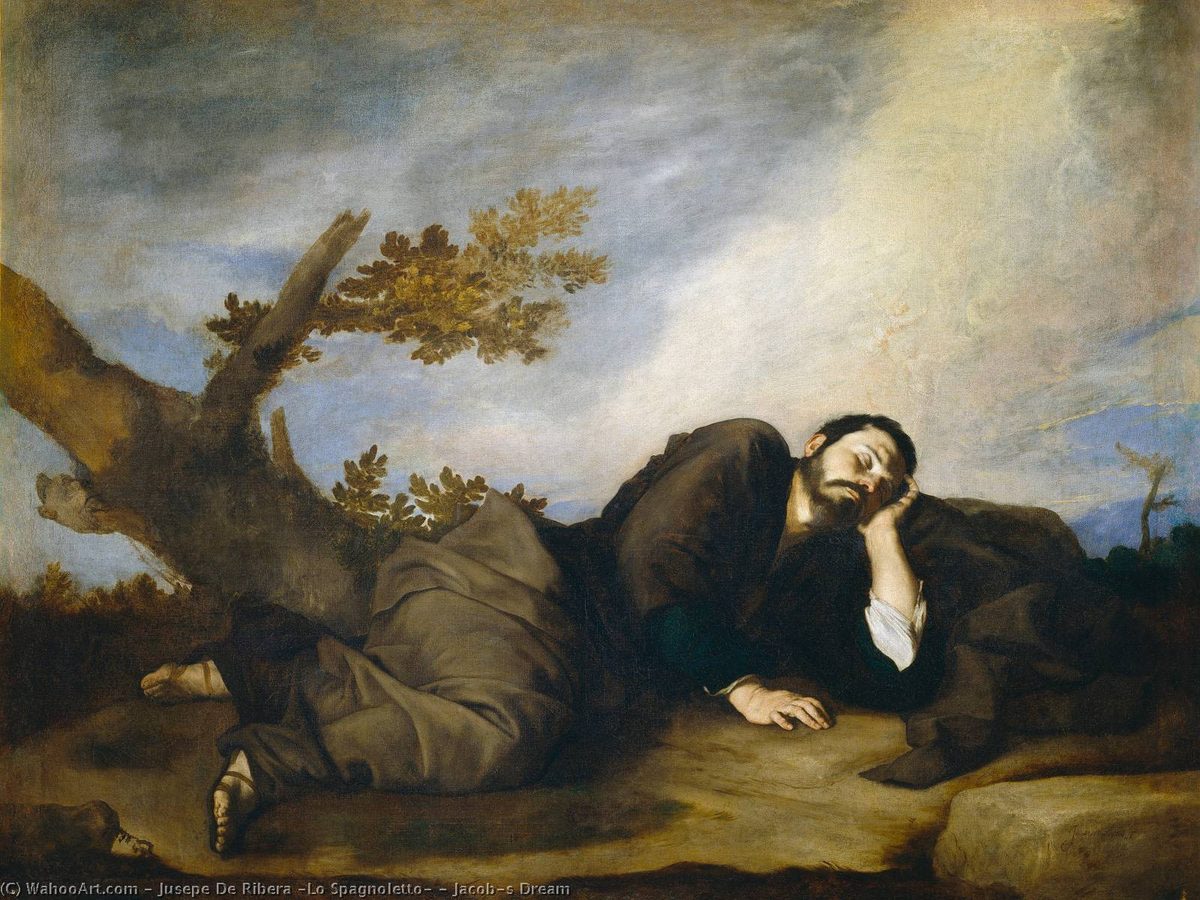
Ribera's Jacob's Dream depicts the Old Testament patriarch asleep on the ground, his body in a posture of abandoned, heavy sleep, while above him the ladder of Jacob's vision (Genesis 28:10-19) extends into an upper register of light and angels. Ribera's treatment is characteristically tenebristic — the sleeping body is painted with the same documentary naturalism he brought to his depictions of saints and martyrs: the worn clothing, the tired face, the physical weight of sleep.
The body could be any poor man sleeping on the road; only the angels in the upper portion identify it as a sacred event. This is Ribera's theological statement: the divine vision enters ordinary, exhausted, anonymous human life.
Jusepe de Ribera (1591-1652) was born in Spain but spent his entire career in Naples, then under Spanish rule. He was the principal Caravaggist in Spain and southern Italy — absorbing Caravaggio's tenebrism (dramatic dark-light contrast) and applying it systematically to religious subjects drawn from the Old Testament, martyrology, and philosophy.
The Jacob's Dream was painted for Philip IV and entered the Spanish royal collection. The subject — the bridge between earth and heaven in a poor man's sleep — suited Ribera's persistent interest in the divine intrusion into ordinary material existence. The angel's touch on Jacob's arm (above) and the sleeping body below are separated by the same dark space that Caravaggio used to divide the sacred from the natural.
The painting operates on two visual levels: the lower two-thirds (dark, earthbound, specific) and the upper third (lit, airy, angelic). The transition between them is abrupt — a sudden light that breaks the dark of the lower composition.
Jacob's face in sleep is completely relaxed; there is no indication from the body's position that anything supernatural is occurring. The angel's light hand on his arm (barely visible at the top of the sleeping figure) is the connecting point between the two registers. Look at the quality of the stone on which Jacob sleeps — rougher and more physical than any classical model; a real Middle Eastern stone.
When standing before this work, look carefully: Jacob's Dream — Ribera, 1639. Give it time — what seems decorative often carries the central meaning.
When standing before this work, look carefully: The sleeping Jacob — documentary realism. Give it time — what seems decorative often carries the central meaning.
When standing before this work, look carefully: The angels in the upper register. Give it time — what seems decorative often carries the central meaning.
When standing before this work, look carefully: The ladder extending to heaven. Give it time — what seems decorative often carries the central meaning.
Museo Nacional del Prado, Madrid. Room 9 (Spanish Golden Age). The Prado's collection of Ribera is the most important in the world.