
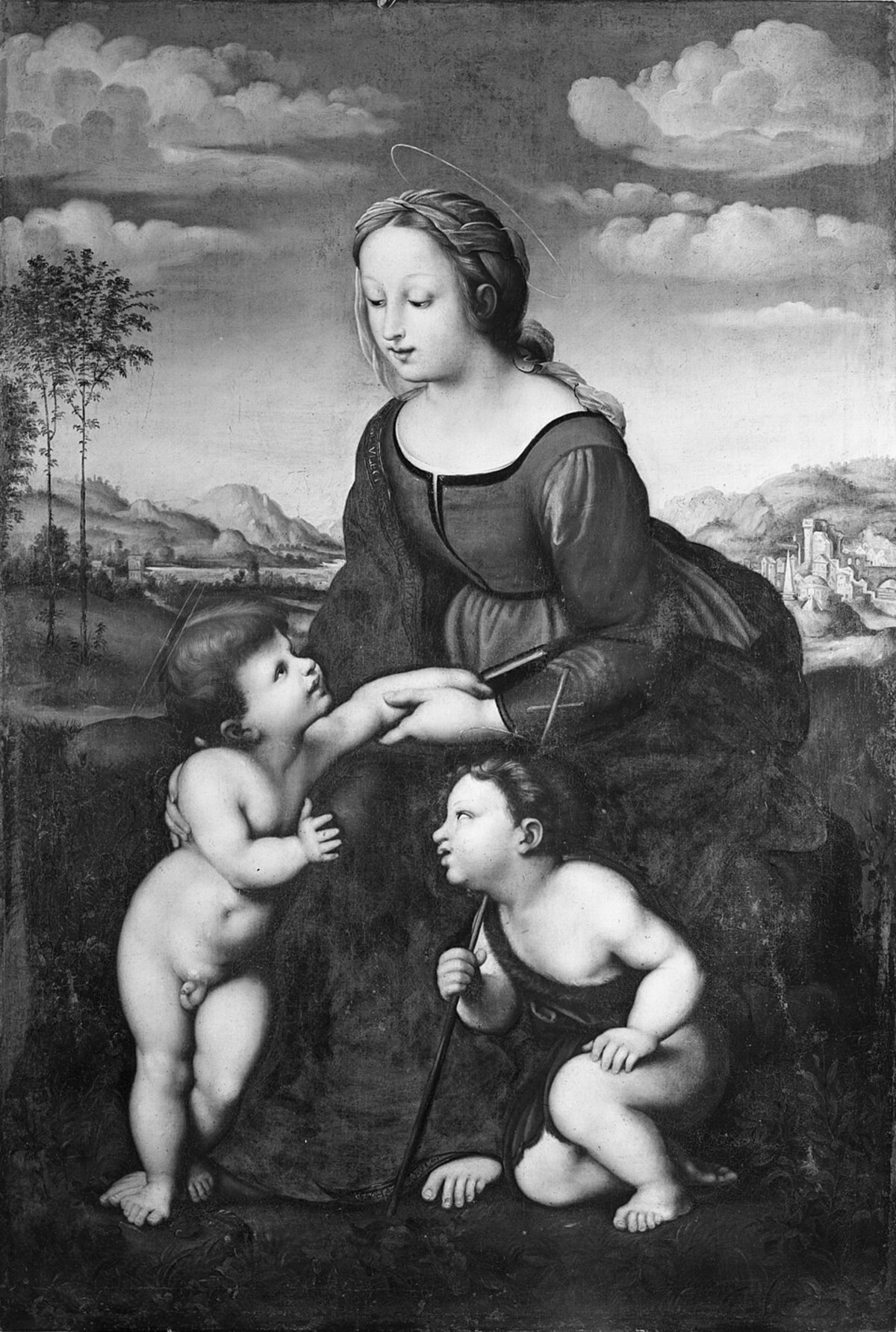
La Belle Jardinière (The Beautiful Gardener)
La Belle Jardinière — Raphael, 1507-1508, Louvre
Raphael, Public domain, via Wikimedia Commons
La Belle Jardinière is Raphael's most harmonious treatment of the Virgin and Child with the young St John the Baptist — a pyramidal group set in a wide Umbrian landscape. The Virgin sits on the ground (a Madonna of Humility), the Christ Child stands before her, and the young John kneels at the left.
The painting was made during Raphael's Florentine period (1504-1508), when he was absorbing the influence of Leonardo and Michelangelo while developing his own synthesis of ideal beauty and human warmth. The Virgin's face is Raphael's most beautiful surviving female portrait from this period.
Raphael (Raffaello Sanzio, 1483-1520) arrived in Florence in 1504, just after Leonardo had returned from Milan and just as Michelangelo was finishing the David. The young Raphael studied both intensively, learning Leonardo's sfumato and pyramidal composition and Michelangelo's sculptural mass.
La Belle Jardinière absorbs both influences: the pyramidal Madonna group with landscape background is Leonardesque; the physical solidity of the Christ Child shows the influence of the Bruges Madonna Michelangelo had just completed. The painting was purchased by Francis I of France and entered the Louvre collection.
The Virgin's face is a masterpiece of Raphael's female portraiture from the Florentine years — the sfumato modelling is subtler than Leonardo's but present, and the expression combines intelligence, tenderness, and a slight forward tilt of the head that makes her look as if she is listening. The Christ Child stands with confidence and physical strength; the young John kneels in adoration, his camel-hair garment already indicated. The landscape behind the group — wide, light, Umbrian — is a standard Raphael backdrop from this period.
When standing before this work, look carefully: La Belle Jardinière — Raphael, 1507-1508, Louvre. Give it time — what seems decorative often carries the central meaning.
When standing before this work, look carefully: The Virgin's face — sfumato and tenderness. Give it time — what seems decorative often carries the central meaning.
When standing before this work, look carefully: The standing Christ Child — sculptural solidity. Give it time — what seems decorative often carries the central meaning.
When standing before this work, look carefully: The Umbrian landscape — pyramidal composition. Give it time — what seems decorative often carries the central meaning.
Musée du Louvre, Denon Wing, Room 710 (Italian paintings). Open Wednesday-Monday 9:00-18:00. Admission fee applies.