
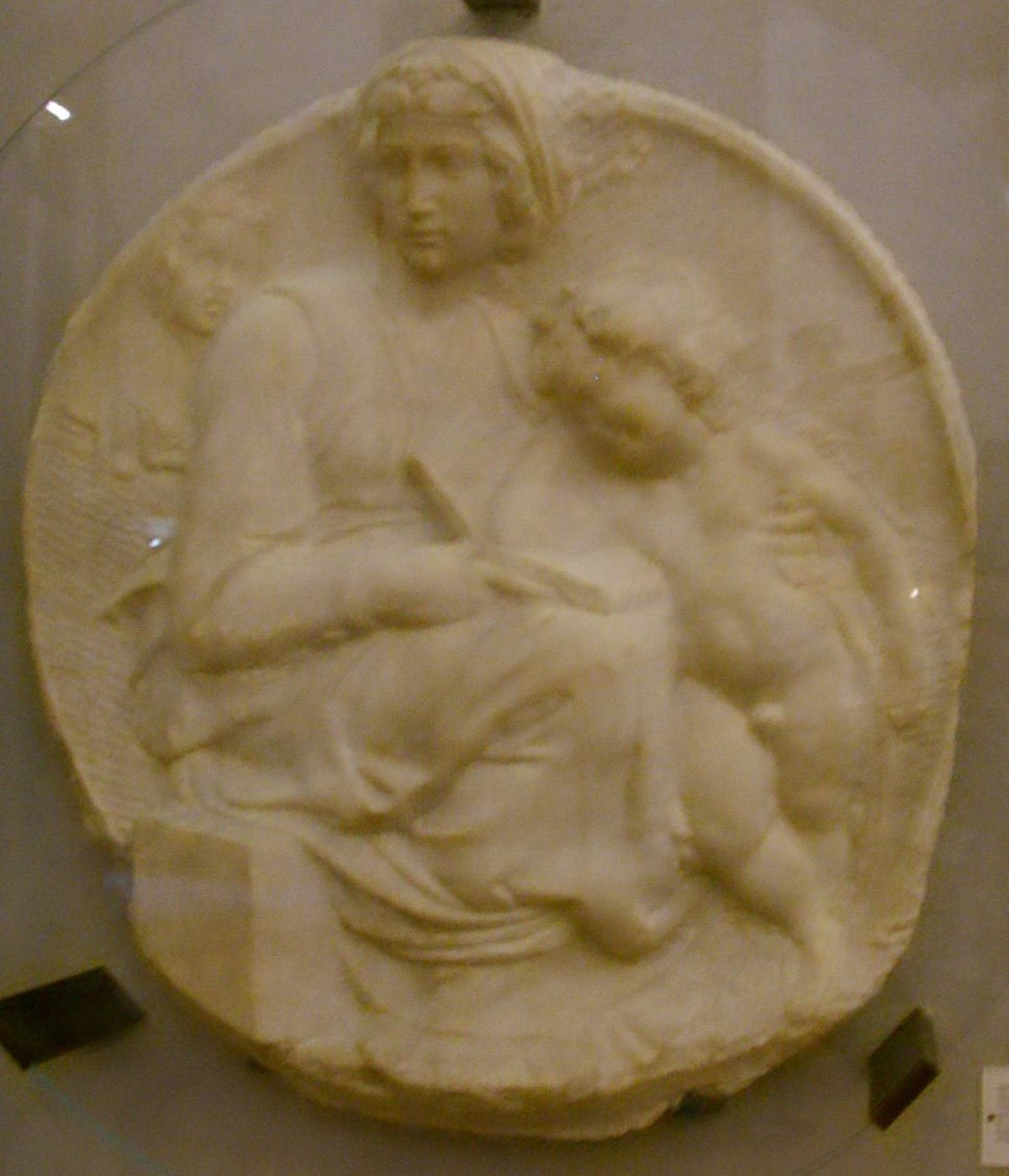
Lamentation of Christ (Bargello Tondo)
Madonna of the Steps — Michelangelo's earliest known work
Michelangelo, Public domain, via Wikimedia Commons
Michelangelo carved his first major sculptural works during his teenage years in the Medici household, where he had access to the Medici sculpture collection in the garden of San Marco. The Madonna of the Steps and the Battle of the Centaurs, both in the Casa Buonarroti (Michelangelo's family house, now a museum), are the earliest surviving works by his hand — he was between 15 and 16 when he made them.
The Madonna of the Steps is a stiacciato (very shallow) relief in the tradition of Donatello, showing the Virgin and Child with attendant figures on steps behind; the Battle of the Centaurs is a seething mass of intertwined male bodies in the manner of classical relief sculpture. Together they represent Michelangelo's first engagement with the two traditions — the Christian devotional and the antique mythological — that would define his career.
The Medici garden of San Marco functioned as an informal academy under the supervision of Bertoldo di Giovanni, a sculptor who had trained with Donatello. Lorenzo de' Medici allowed promising young Florentines to study the collection and receive instruction.
Michelangelo entered the garden around 1489-1490 at the suggestion of Ghirlandaio, in whose workshop he had trained. The Madonna of the Steps shows his immediate assimilation of Donatello's technique of shallow relief (stiacciato, meaning 'flattened') to create atmospheric depth through subtle undercutting. The Battle of the Centaurs, which Michelangelo later said he regretted abandoning (it is unfinished), was apparently inspired by a passage from Poliziano's poetry about the centaur battle.
The Madonna of the Steps is Michelangelo's earliest known surviving work — probably carved when he was 15 or 16. The quality of observation is already beyond the ordinary: the Virgin's profile is noble and melancholy, the Christ child sleeps with a slightly awkward weight, and the background figures on the steps are depicted in Donatello's atmospheric stiacciato with considerable sophistication.
The Battle of the Centaurs, still rougher, shows his response to ancient Roman relief sarcophagi: the interlocked bodies fill the panel with turbulent energy. Vasari reports that Michelangelo kept the Battle in his possession all his life, regarding it as the work that had established his direction.
When standing before this work, look carefully: Madonna of the Steps — Michelangelo's earliest known work. Give it time — what seems decorative often carries the central meaning.
When standing before this work, look carefully: Battle of the Centaurs — the antique tradition. Give it time — what seems decorative often carries the central meaning.
When standing before this work, look carefully: Casa Buonarroti — Michelangelo's family house. Give it time — what seems decorative often carries the central meaning.
When standing before this work, look carefully: Madonna and Child — detail of the Virgin's face. Give it time — what seems decorative often carries the central meaning.
Casa Buonarroti, Via Ghibellina 70, Florence. This is Michelangelo's family house, bought by Michelangelo in 1508 and later converted to a museum by his nephew. Both the Madonna of the Steps and the Battle of the Centaurs are displayed on the upper floor.