
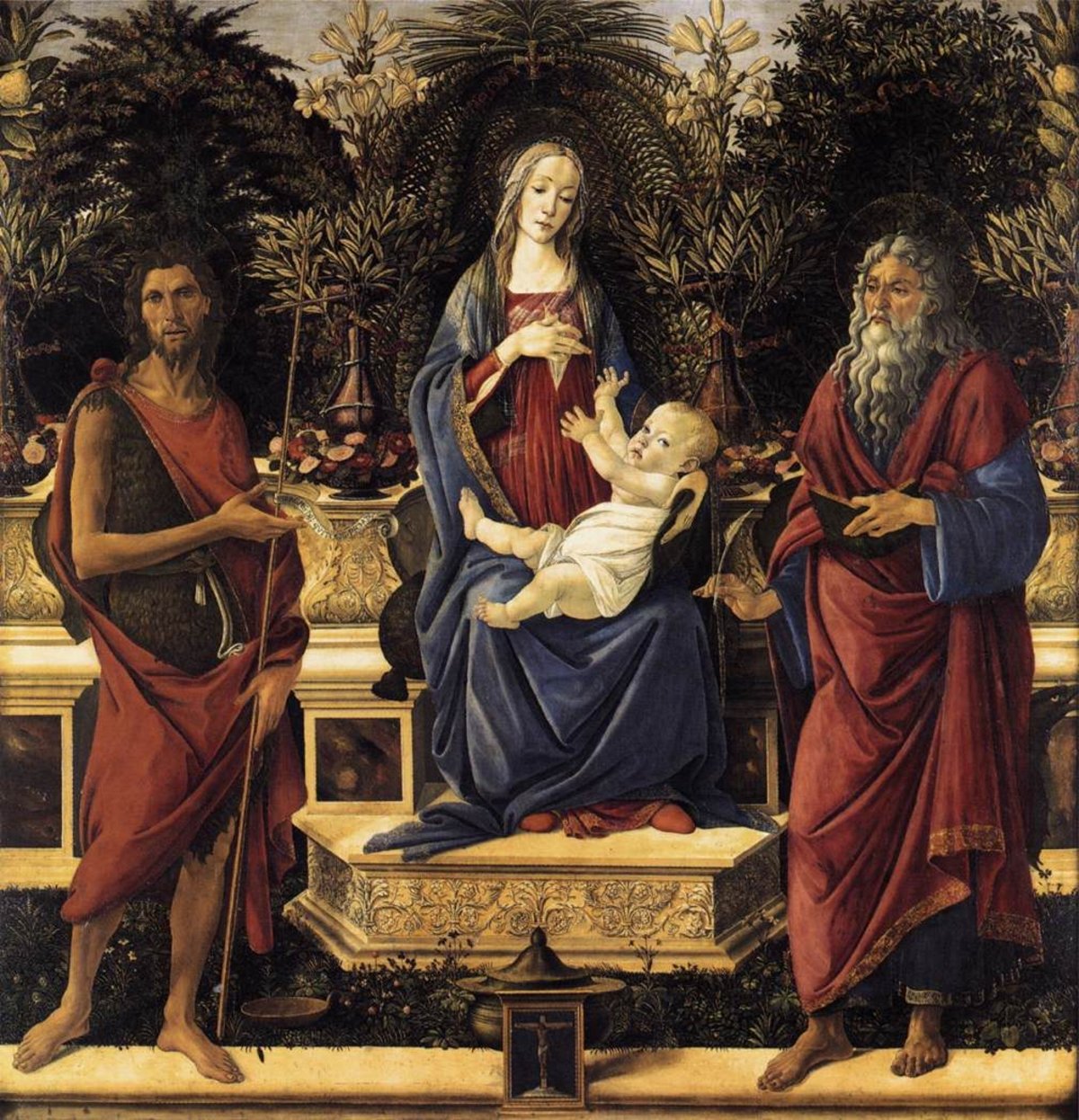
Madonna and Child (Bardi Altarpiece)
Bardi Altarpiece — Botticelli, c.1484-1485
Sandro Botticelli, Public domain, via Wikimedia Commons
Botticelli's Madonna and Child with St John the Baptist and Angels (the 'Bardi Altarpiece') in Dresden is one of the most beautiful of his Madonna compositions — an altarpiece made for the Bardi family chapel in Santo Spirito, Florence, around 1484-1485. The Virgin, enthroned against a hedge of roses (the Hortus Conclusus — the enclosed garden of the Song of Songs, a symbol of the Virgin's purity), holds the Christ Child on her lap; the infant St John the Baptist kneels to the left; four angels in rose-coloured robes attend on either side.
The rose hedge behind the Virgin is painted with botanical specificity: individual rose species (including Rosa canina, the wild dog-rose, identified by botanists) are depicted with the precise observation of a naturalist. The Botticelli line — sinuous, continuous, defining form through its quality rather than through light and shadow — is fully present in the Virgin's profile and the angels' draperies.
Sandro Botticelli (1444/45-1510) was the most important Florentine painter of the generation between Verrocchio and Leonardo — his career spanning the 1470s to the late 1490s, the period of the great Medici patronage. The Dresden altarpiece was made for the Bardi family and is related in style to the slightly later Annunciation (Uffizi) and the Venus and Mars (National Gallery, London). The rose hedge (Hortus Conclusus) background is a motif Botticelli uses in several Madonna compositions: the garden enclosed by a wall symbolises the Virgin's purity and inaccessibility, and the roses (associated with the Virgin since the medieval period) carry their Marian symbolism.
Dresden's Gemäldegalerie Alte Meister is one of the greatest art museums in Germany, and the Botticelli is among its finest Italian paintings. The specific quality of the Dresden altarpiece is the botanical observation of the rose hedge: compare Botticelli's rendering of individual rose species with the simplified symbolic roses of earlier Italian Madonnas — the difference represents a generation of Florentine naturalistic observation. The Virgin's profile is among Botticelli's finest — the characteristic slightly elongated face, the high forehead, the serene downward gaze.
When standing before this work, look carefully: Bardi Altarpiece — Botticelli, c.1484-1485. Give it time — what seems decorative often carries the central meaning.
When standing before this work, look carefully: The Virgin's profile — Botticelli's characteristic line. Give it time — what seems decorative often carries the central meaning.
When standing before this work, look carefully: The rose hedge — botanical observation. Give it time — what seems decorative often carries the central meaning.
When standing before this work, look carefully: Angels and St John the Baptist. Give it time — what seems decorative often carries the central meaning.
Gemäldegalerie Alte Meister, Theaterplatz 1, Dresden. Open Tuesday-Sunday; admission fee. The gallery houses one of the finest collections of Old Masters in Europe, including Raphael's Sistine Madonna.