
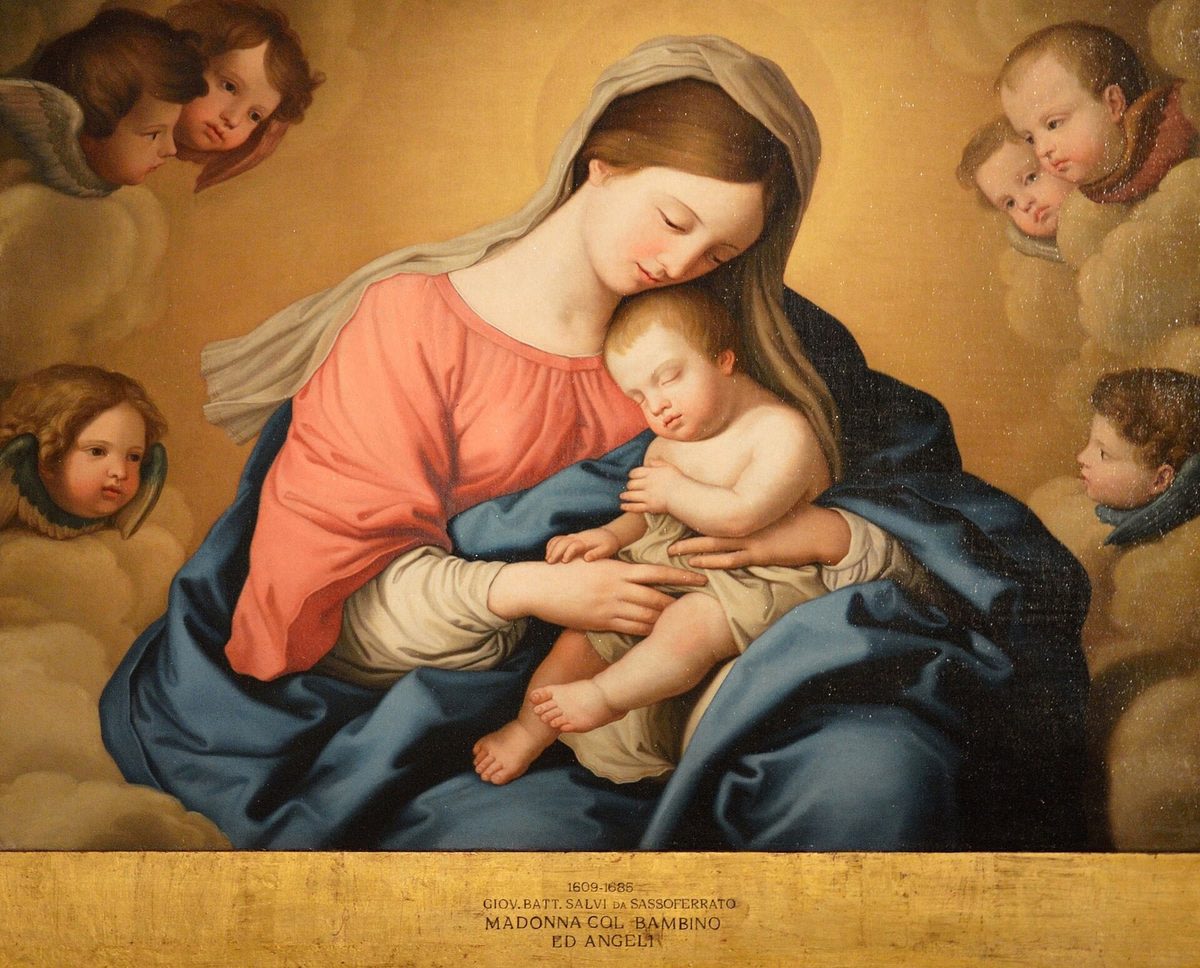
Madonna and Child (Stroganoff Madonna)
Stroganoff Madonna — Duccio, c.1300
Duccio di Buoninsegna, Public domain, via Wikimedia Commons
The Stroganoff Madonna at the Metropolitan Museum is a small panel (approximately 27.9 by 21 cm) depicting the Virgin and Child in the Hodegetria type (the Virgin as 'She Who Points the Way', indicating the Christ Child as the Way to salvation) — attributed to Duccio di Buoninsegna and dated to approximately 1300, near the time of his Maestà. The panel takes its name from the Stroganoff family collection in St Petersburg from which it was acquired. Despite its small size, the quality of the painting is consistent with Duccio's finest work: the modelling of the faces, the gold tooling of the halos and decorative borders, and the emotional tenderness of the Child's gesture (reaching for the Virgin's veil) demonstrate the master's hand.
For Duccio's biographical context, see entry 138 (Metropolitan Museum Madonna and Child). The Stroganoff Madonna and the entry 138 panel together represent two different Duccio Madonnas in the Metropolitan's collection — the entry 138 panel (the Badia Polyptych panel) is larger and earlier; the Stroganoff is smaller and from the period of the Maestà. The two panels allow direct comparison of Duccio's style at different moments of his career within the same museum.
Compare this panel with entry 138 in the same museum: the differences in scale, in the specific type of Madonna (Hodegetria vs. enthroned hieratic), and in the handling of the paint allow a nuanced understanding of Duccio's range. The Stroganoff's intimate scale and the specific warmth of the Child's gesture make it a more personal devotional object than the larger enthroned composition.
When standing before this work, look carefully: Stroganoff Madonna — Duccio, c.1300. Give it time — what seems decorative often carries the central meaning.
When standing before this work, look carefully: Hodegetria type — Virgin pointing the Way. Give it time — what seems decorative often carries the central meaning.
When standing before this work, look carefully: The Christ Child reaching for the Virgin's veil. Give it time — what seems decorative often carries the central meaning.
When standing before this work, look carefully: Gold halo tooling detail. Give it time — what seems decorative often carries the central meaning.
Metropolitan Museum of Art, Gallery 602, Fifth Avenue and 82nd Street, New York. See entry 138 for details.