
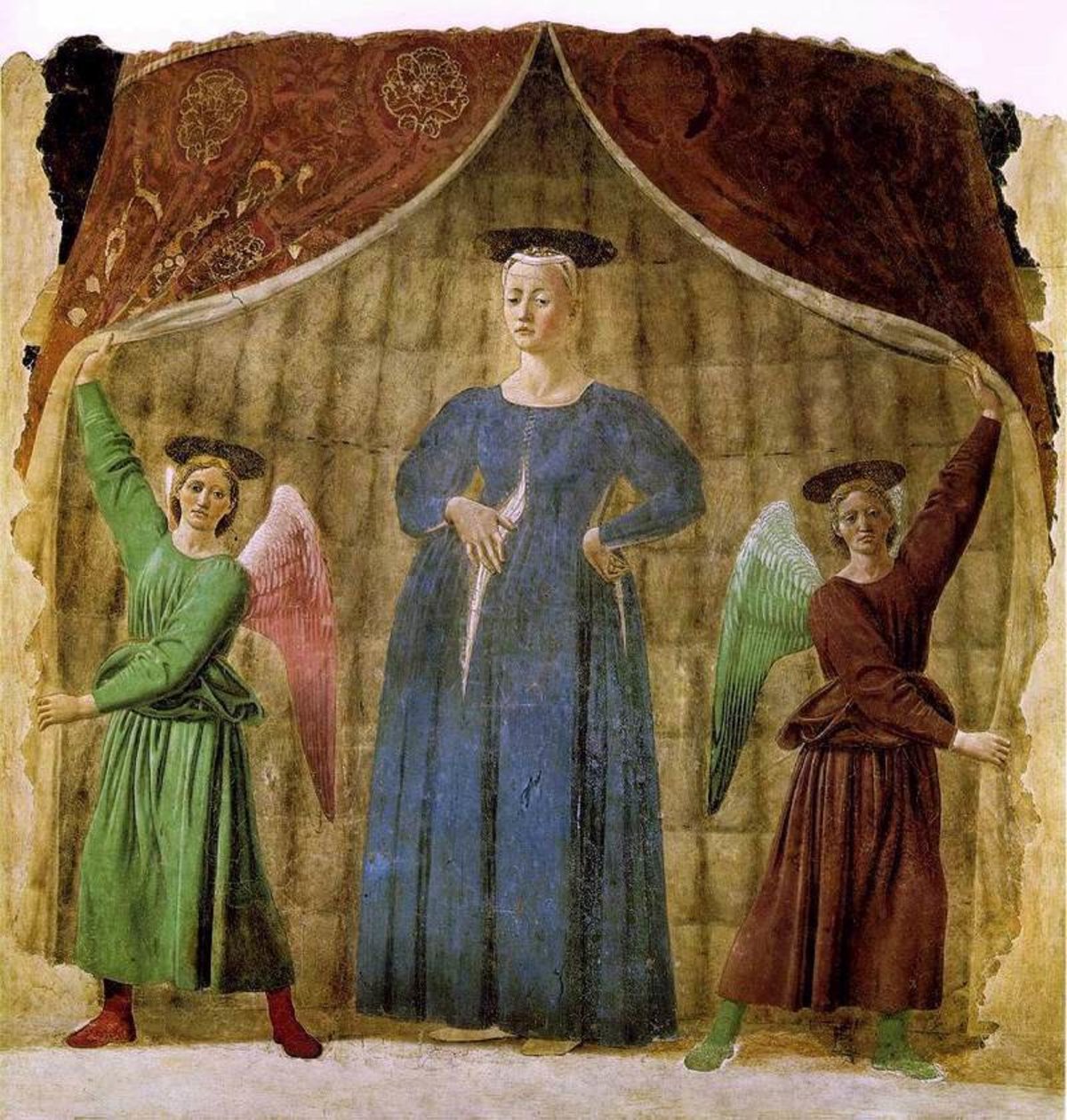
Madonna del Parto
Madonna del Parto — Piero della Francesca, c.1455-1465, Monterchi
Piero della Francesca, Public domain, via Wikimedia Commons
Piero della Francesca's Madonna del Parto ('Madonna of Childbirth') in the small museum of Monterchi is one of the most unusual and moving images in Italian Renaissance art. The Virgin stands within a tent held open by two mirror-image angels; she is visibly pregnant, her right hand resting on her distended belly, her left hand at her hip in a posture of physical weariness.
The image was painted as a fresco in a cemetery chapel near Monterchi — the village where Piero's mother was born — and was believed to have miraculous powers to protect pregnant women. Unlike most Italian Marian images, which show the Virgin after the birth of Christ, this image shows her before, in the fullness of her pregnancy.
Piero della Francesca (c.1415/1420-1492) is one of the most individual artists of the Italian Renaissance — a mathematician and geometrician as well as a painter, whose works combine perfect formal order with a profound stillness and spiritual depth. The Madonna del Parto is exceptional in his work: smaller in scale than his great fresco cycles (Arezzo Legend of the True Cross), more intimate in emotional register.
The two angels are painted from the same cartoon reversed — an example of Piero's geometrical economy. The fresco was moved from its original chapel location to a purpose-built museum in Monterchi to protect it.
The Virgin's posture — the hand on the belly, the slight forward tilt, the expression of withdrawn contemplation — is the key to the image's emotional power. She looks downward and inward, toward the child she carries.
Her expression is not joy or triumph but a quality of serious, foreknowing gravity — she knows what the child she carries will become. The tent (a motif of the tabernacle/canopy) connects the image to Old Testament imagery of divine presence.
When standing before this work, look carefully: Madonna del Parto — Piero della Francesca, c.1455-1465, Monterchi. Give it time — what seems decorative often carries the central meaning.
When standing before this work, look carefully: The Virgin's face — foreknowing gravity. Give it time — what seems decorative often carries the central meaning.
When standing before this work, look carefully: Mirror-image angels holding the tent. Give it time — what seems decorative often carries the central meaning.
When standing before this work, look carefully: The hand on the belly — unique iconography. Give it time — what seems decorative often carries the central meaning.
Museo della Madonna del Parto, Via Reglia, 52038 Monterchi (Arezzo province). Open daily (hours vary by season). A small dedicated museum in the village of Monterchi, approximately 30 km from Arezzo and 25 km from Sansepolcro.