
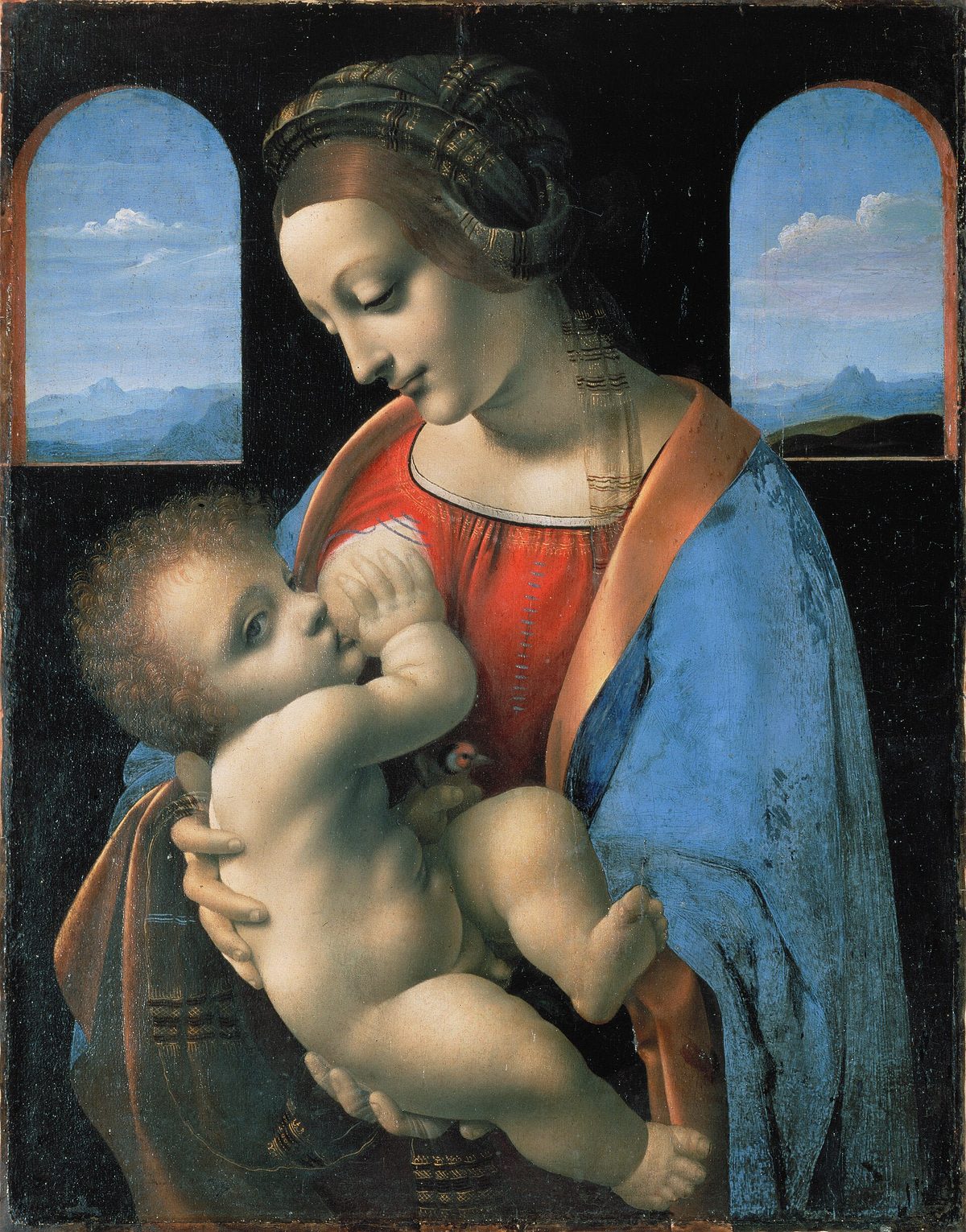
Madonna Litta
Madonna Litta — Leonardo (attributed), c.1490
Leonardo da Vinci (attrib.), Public domain, via Wikimedia Commons
The Madonna Litta is one of two Leonardesque Madonna compositions associated with the Milanese period (c.1483-1499) that have been extensively debated in terms of attribution. It shows the Virgin nursing the Christ child in a frontal, intimate composition set against a background with two arched windows opening onto a landscape.
The quality of the Virgin's face — the downcast eyes, the slightly asymmetric smile, the sfumato modelling — is clearly Leonardesque, and the composition type (the nursing Madonna, or Maria Lactans) is documented in Leonardo's Milanese circle. The Christ child's posture and the quality of the drapery suggest workshop involvement; the current consensus attributes the design to Leonardo with significant execution by one or more Milanese workshop members (possibly Giovanni Antonio Boltraffio).
The painting was in the collection of the Litta family of Milan (hence the name) before being purchased for the Hermitage in 1865. The attribution controversy is ongoing: some scholars give it entirely to Leonardo, others to Boltraffio or another workshop member working from a Leonardo design.
The infrared reflectography has revealed an underdrawing of considerable quality, consistent with Leonardo's hand; the painted surface is uneven in quality, suggesting workshop intervention. The landscape through the two windows — rocky mountains, lake, and pale sky — is pure Leonardo. The composition type appears in a Leonardo drawing in the Louvre (the Madonna with the Yarnwinder study) and in the Burlington House Cartoon (entry 50 notes).
The Virgin's face is the key to the attribution question: its softness, the slightly open mouth, the downcast eyes, and the quality of the sfumato around the contours are all consistent with Leonardo's technique. The Christ child nursing is less convincing in quality: the anatomy of the infant's body, while Leonardesque in conception, has a surface finish that many scholars find inconsistent with Leonardo's usual paint handling.
The two landscape windows are pure Leonardo: the rocky geological formations, the water, and the atmospheric haze are identical to the backgrounds of the Louvre Virgin of the Rocks (entry 10). The painting should be read as a collaborative work in which Leonardo's design and vision are pervasive, whatever the degree of workshop execution.
When standing before this work, look carefully: Madonna Litta — Leonardo (attributed), c.1490. Give it time — what seems decorative often carries the central meaning.
When standing before this work, look carefully: The Virgin's face — the Leonardesque sfumato. Give it time — what seems decorative often carries the central meaning.
When standing before this work, look carefully: The landscape windows — Leonardo's rocky backgrounds. Give it time — what seems decorative often carries the central meaning.
When standing before this work, look carefully: The nursing Christ child. Give it time — what seems decorative often carries the central meaning.
State Hermitage Museum, St Petersburg. The Italian paintings galleries. The Hermitage's collection of Italian Renaissance paintings includes several important works from the Milanese Leonardesque tradition.