
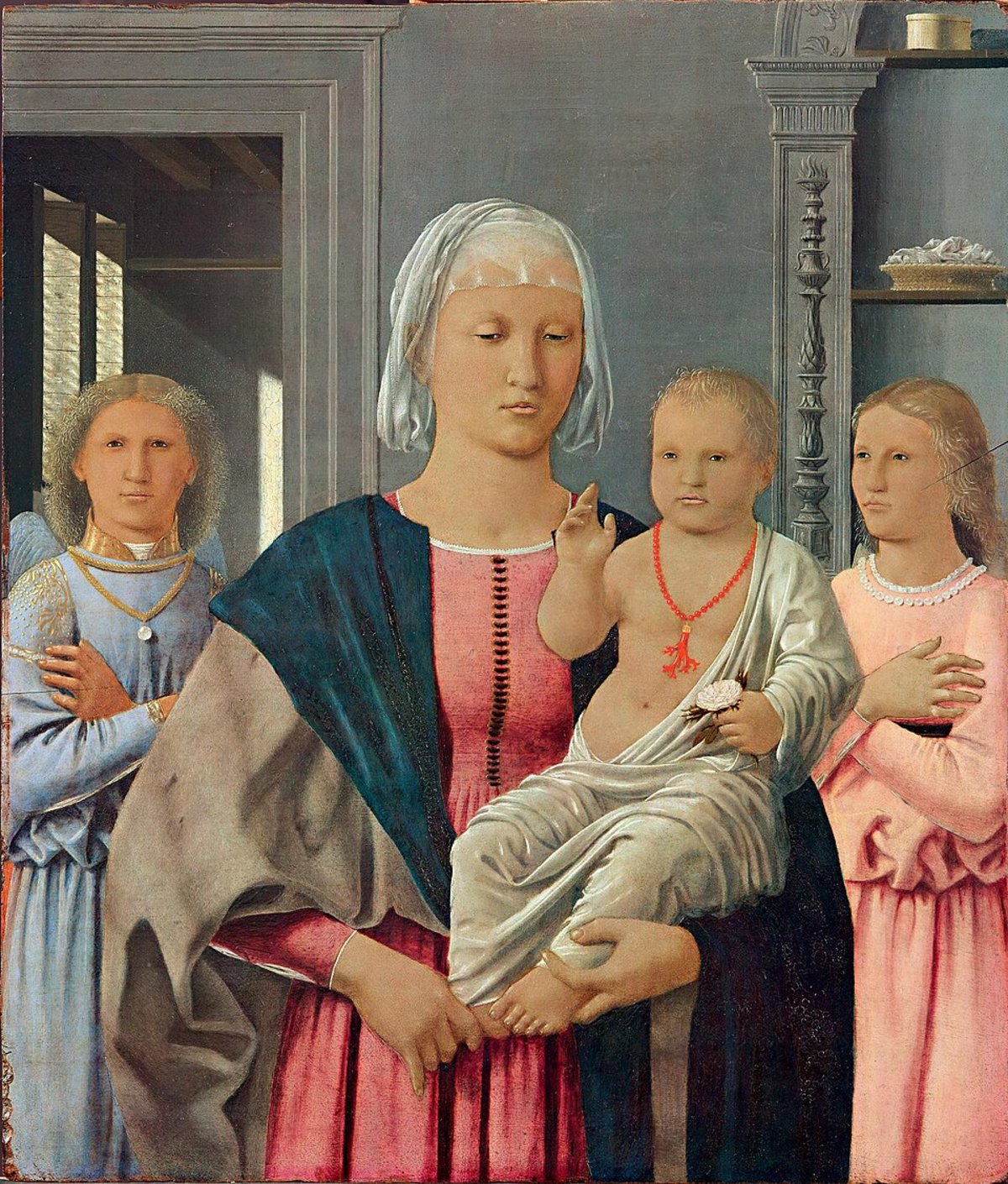
Madonna of Senigallia
Madonna of Senigallia — Piero della Francesca, c.1470-1478, Urbino
Piero della Francesca, Public domain, via Wikimedia Commons
Piero della Francesca's Madonna of Senigallia in the Galleria Nazionale delle Marche, Urbino, is a small, intimate devotional panel (approximately 61 by 53 cm) of extraordinary quality — the Virgin holding the Christ Child, flanked by two angels, in a domestic interior. The painting is characteristic of Piero's mature style: the geometric formal structure (faces as spheres, drapery as geometrical solids), the extraordinary handling of light (a window to the right admits a specific quality of afternoon light that falls on the figures and casts precise shadows), and the quality of contained spiritual presence. The Madonna of Senigallia is named for the town of Senigallia in the Marche where it was found; it was probably made for the ducal court of Urbino (Federico da Montefeltro, Piero's great patron).
Piero della Francesca's mathematical approach to painting — he also wrote two treatises on mathematics and perspective — is visible in every element of the Madonna of Senigallia: the perfect spherical shape of the Child's head, the precisely calculated fall of light, the architectural space behind the figures. Yet these formal qualities do not produce coldness — the painting has a quality of meditative spiritual warmth that is Piero's unique achievement. The light through the window is perhaps the most discussed single technical passage in the painting: it falls across the back wall and the figures with a precision that anticipates Vermeer.
The two flanking angels in the Madonna of Senigallia are among the most beautiful figures in 15th-century Italian painting: their youth, the quality of their attention, and the formal perfection of their faces place them in the series of Piero's angelic figures (the best-known is the angel in the Baptism of Christ at the National Gallery London). The coral necklace around the Christ Child's neck is an amulet — coral was believed to protect against the evil eye.
When standing before this work, look carefully: Madonna of Senigallia — Piero della Francesca, c.1470-1478, Urbino. Give it time — what seems decorative often carries the central meaning.
When standing before this work, look carefully: Light from the right window — Piero's mathematical illumination. Give it time — what seems decorative often carries the central meaning.
When standing before this work, look carefully: The two flanking angels — formal perfection. Give it time — what seems decorative often carries the central meaning.
When standing before this work, look carefully: Christ Child — spherical head and coral necklace. Give it time — what seems decorative often carries the central meaning.
Galleria Nazionale delle Marche, Palazzo Ducale, Piazza Duca Federico 13, 61029 Urbino. Open Tuesday-Sunday 8:30-19:15. Admission fee applies.