
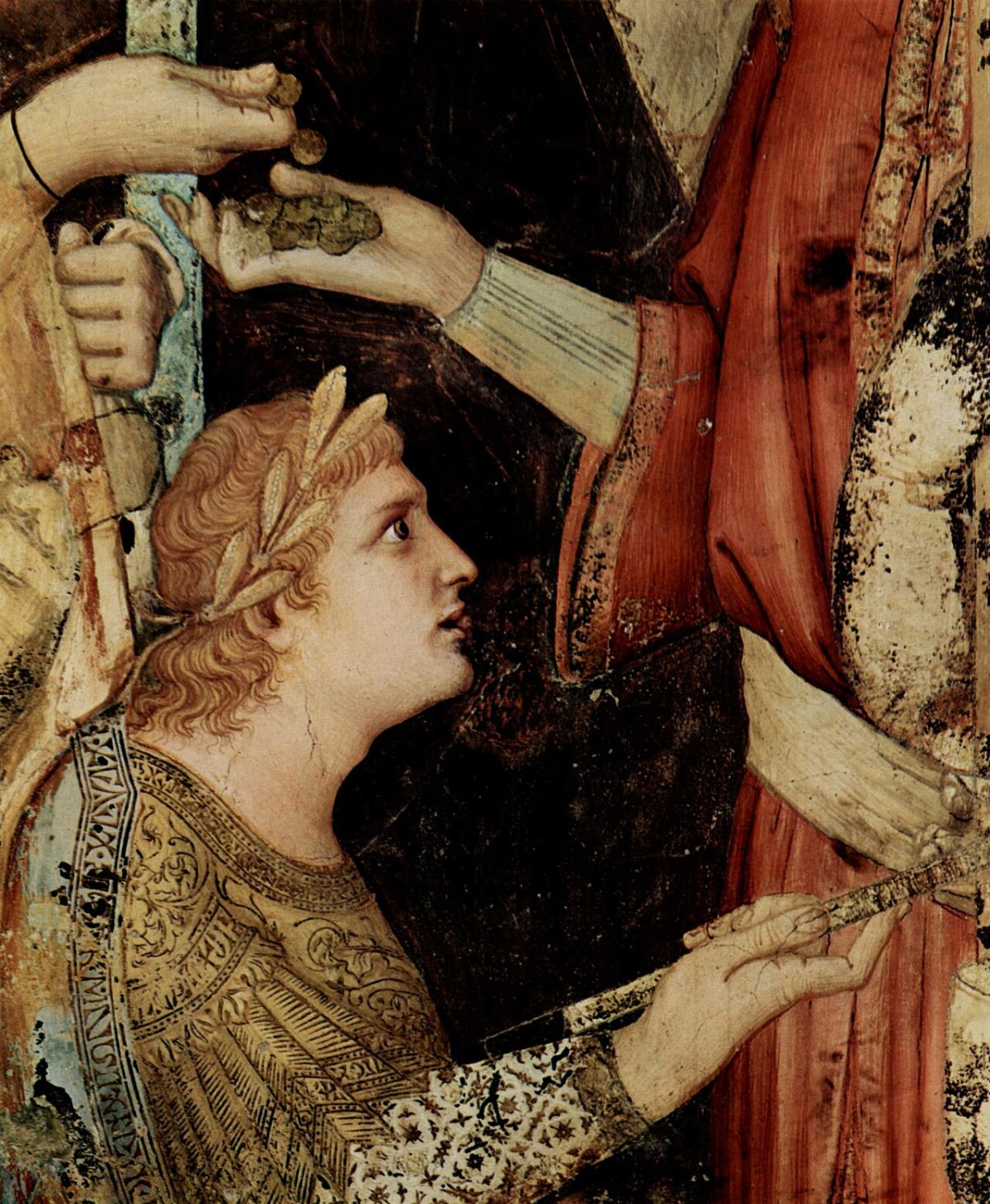
Maestà and Crucifixion Frescoes
Last Judgment fresco — Cavallini, c.1291, Santa Cecilia
Pietro Cavallini, Public domain, via Wikimedia Commons
Pietro Cavallini's Last Judgment fresco cycle in Santa Cecilia in Trastevere is the most important surviving fresco cycle in Rome before Giotto and one of the founding documents of the proto-Renaissance — painted around 1291, approximately twelve years before Giotto's Arena Chapel frescoes. The main surviving section shows the Last Judgment: Christ in Majesty at the centre, flanked by the Virgin and apostles, with angels and the saved and damned below.
The figures have a sculptural three-dimensionality and a psychological specificity unprecedented in contemporary Roman painting — Cavallini's faces, with their specific modelling in light and shade, represent a break from the flat Byzantine tradition comparable to (and contemporary with) Cimabue's revolution in Florence. The fresco is partially obscured (the nuns' choir was built in front of it in the 16th century) but the surviving section is fully visible from the gallery above the choir.
Pietro Cavallini (c.1240/50-c.1330) worked in Rome in the late 13th century — contemporary with Cimabue (Florence) and approximately a generation before Giotto (whose Arena Chapel, c.1303-1305, is the next great monument of the proto-Renaissance). The relationship between Cavallini and Giotto is debated: Vasari claimed Cavallini was Giotto's teacher; modern scholarship considers them parallel independent developments. Cavallini's other important surviving works include the mosaic of the Life of the Virgin in Santa Maria in Trastevere (c.1291), which is publicly accessible in the main church.
The fresco is accessible via a guided tour of the enclosed Benedictine convent of Santa Cecilia — visitors must ring the bell at the convent entrance to request access. The surviving section (the upper half of the original composition) shows the figures at approximately life-size. The apostles flanking Christ are depicted as specific portrait types — their faces, modelled with light and shadow in the Roman painting tradition, have an individuality comparable to any coeval Italian painting.
When standing before this work, look carefully: Last Judgment fresco — Cavallini, c.1291, Santa Cecilia. Give it time — what seems decorative often carries the central meaning.
When standing before this work, look carefully: Christ in Majesty — sculptural three-dimensionality. Give it time — what seems decorative often carries the central meaning.
When standing before this work, look carefully: The apostles — specific portrait types. Give it time — what seems decorative often carries the central meaning.
When standing before this work, look carefully: Santa Cecilia in Trastevere, Rome. Give it time — what seems decorative often carries the central meaning.
Santa Cecilia in Trastevere, Piazza di Santa Cecilia 22, Rome. The fresco is accessible by guided visit through the convent (ring the bell at the convent entrance).
Hours vary; check locally. A small donation is requested.