
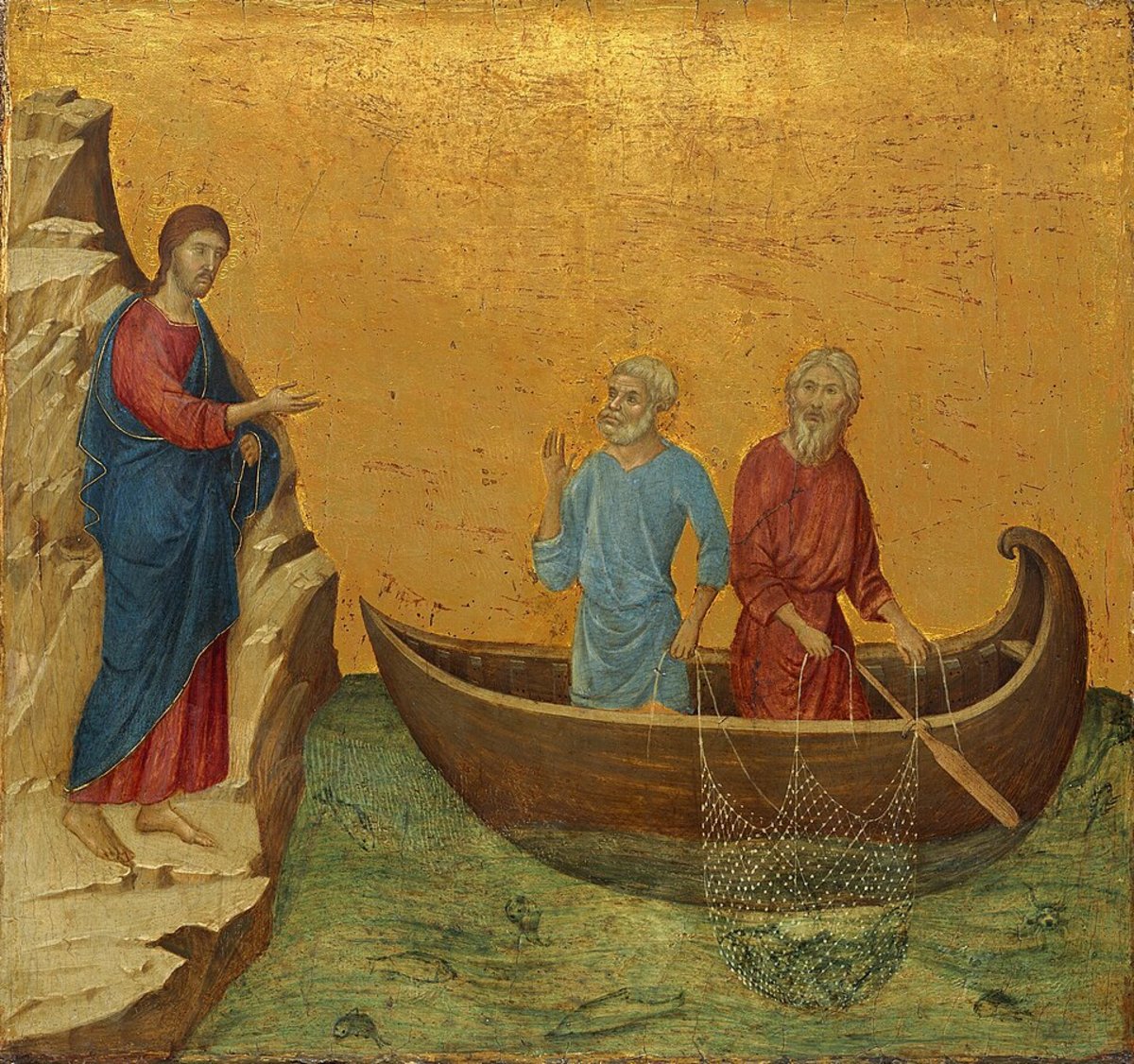
Maesta of Duccio di Buoninsegna (Sienese Maesta tradition)
Maesta — Duccio di Buoninsegna, 1308-1311, Siena
Duccio di Buoninsegna, Public domain, via Wikimedia Commons
The Maesta ('Majesty') tradition in Sienese painting centres on Duccio di Buoninsegna's monumental altarpiece for Siena Cathedral (1308-1311), now in the Museo dell'Opera del Duomo in Siena, which is the foundational document of Sienese painting and one of the most important works in the history of Italian art. The Maesta shows the enthroned Virgin with the Christ Child, surrounded by saints and angels — the front side a formal Maesta, the back side a cycle of Passion scenes in approximately forty panels.
The altarpiece was processed through the streets of Siena on June 9, 1311 when it was installed — one of the earliest documented public celebrations of a work of art. Duccio's followers (Simone Martini, the Lorenzetti brothers, Lippo Memmi) developed the Sienese altarpiece tradition through the 14th century. Entry 282 represents the broad Sienese Maesta tradition, of which Duccio's original is the supreme example.
Duccio di Buoninsegna (c.1255/60-c.1318/19) is the founder of Sienese painting as a distinct school — a school that developed simultaneously with Giotto's Florentine tradition but in a different direction: where Giotto moved toward spatial realism and physical mass, Duccio and his Sienese followers maintained the Byzantine gold-background tradition while enriching it with a narrative and emotional intensity that was their own contribution. The Sienese Maesta tradition — the formal image of the Virgin enthroned as Queen of Heaven — expressed the specific civic identity of Siena, which was dedicated to the Virgin as its patron.
Duccio's Maesta is displayed in the Museo dell'Opera del Duomo in Siena in a large room where both the front (Maesta) and back (Passion cycle) are visible. The back panels are among the first narrative sequences in Italian painting to show a real attempt at spatial depth and architectural setting — Duccio anticipates Giotto in some passages while maintaining the Byzantine tradition in others. This dialogue between tradition and innovation is the central drama of his art.
When standing before this work, look carefully: Maesta — Duccio di Buoninsegna, 1308-1311, Siena. Give it time — what seems decorative often carries the central meaning.
When standing before this work, look carefully: Enthroned Virgin and Child — front face. Give it time — what seems decorative often carries the central meaning.
When standing before this work, look carefully: Passion cycle panels — back face. Give it time — what seems decorative often carries the central meaning.
When standing before this work, look carefully: Museum installation — front and back visible. Give it time — what seems decorative often carries the central meaning.
Museo dell'Opera del Duomo, Piazza del Duomo 8, 53100 Siena. Open daily (hours vary by season).
Admission fee applies. The Duccio Maesta room is the museum's central attraction.