
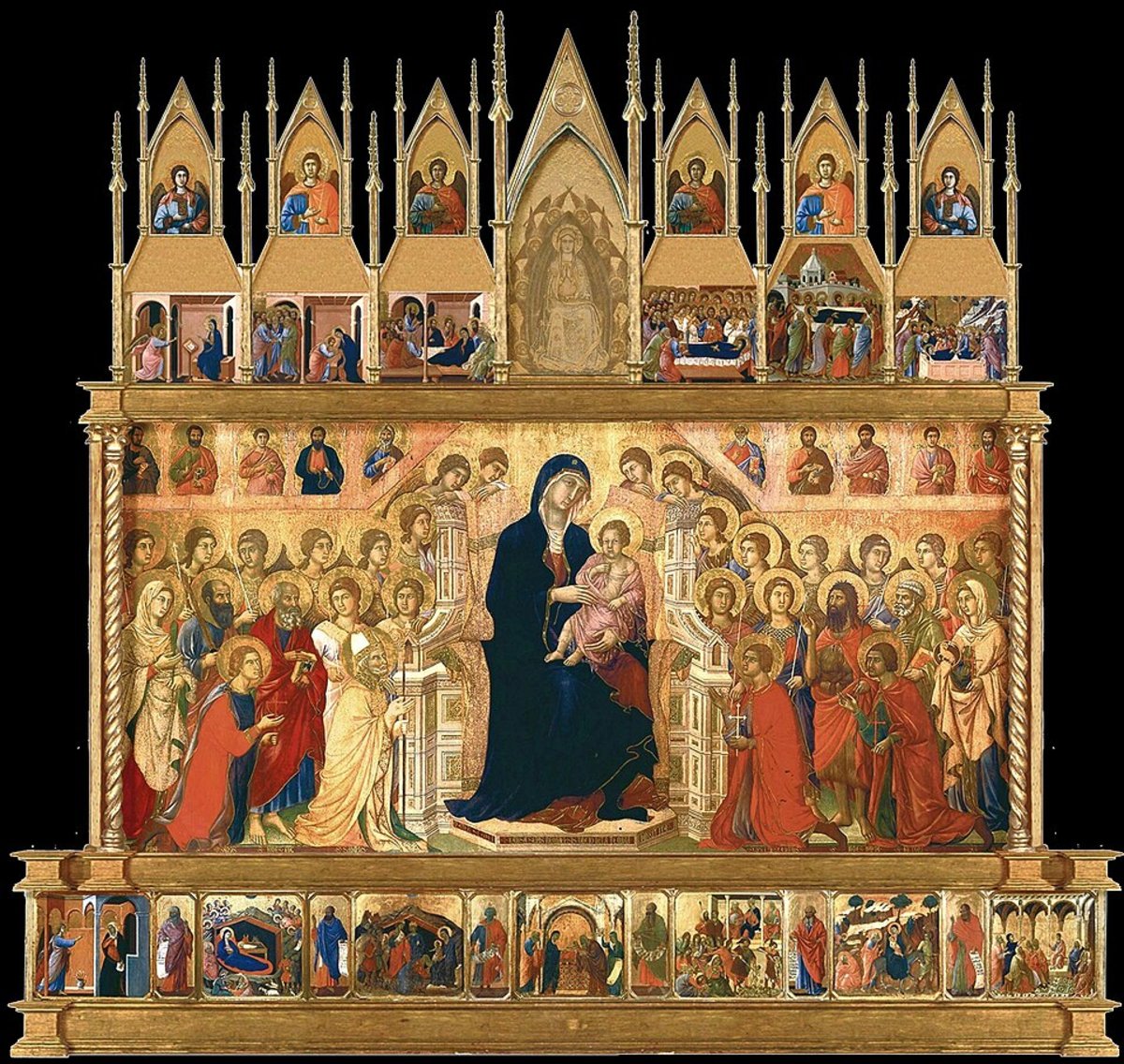
Maestà (Siena Cathedral Altarpiece)
Duccio's Maestà — the front face (Virgin in Majesty)
Duccio di Buoninsegna, Public domain, via Wikimedia Commons
Duccio's Maestà is the supreme achievement of Sienese medieval painting and the most important altarpiece in the history of Italian art before the Renaissance. Made for the high altar of Siena Cathedral between 1308 and 1311, it is a double-sided altarpiece: the front (showing the Virgin in Majesty, the Maestà proper, surrounded by angels, saints, and the four patron saints of Siena) was visible to the congregation; the back (a continuous narrative cycle of scenes from the Passion of Christ) was visible to the clergy in the choir.
The procession that carried the completed altarpiece from Duccio's workshop to the cathedral on 9 June 1311 was described by a contemporary chronicler as a civic triumph: the whole city followed the altarpiece through the streets, the bells of the city rang all day, and businesses closed in celebration. No other panel painting in medieval Italy received a reception of comparable civic intensity.
Duccio di Buoninsegna completed the Maestà with a large workshop over three years. The front Maestà face alone contains approximately forty figures: the central Madonna and Child are surrounded by angels and the twenty kneeling saints, with the four Sienese patron saints (Ansanus, Savinus, Crescentius, and Victor) kneeling in the foreground.
The back narrative cycle contained originally 26 scenes (plus predella and pinnacle panels) from the Passion, beginning with the Entry into Jerusalem and ending with the Apparitions of the Risen Christ. Much of the original altarpiece survives; some panels have been dispersed to other collections (the National Gallery in Washington, the Frick in New York, and others).
The Maestà front is the finest example of Duccio's mature style: the gold ground, the lapis-lazuli blue of the Virgin's cloak, the intricate throne architecture, the individual differentiation of the forty figures in the crowd. The back narrative panels demonstrate his ability to compress complex events into small spaces with narrative clarity.
The Entry into Jerusalem is particularly remarkable: the crowd of citizens rushing out from Jerusalem to meet Christ, some climbing trees to see over the crowd, is one of the most vivid crowd scenes in medieval art. The panel sequence has a filmic quality — each scene advances the story in a single image.
When standing before this work, look carefully: Duccio's Maestà — the front face (Virgin in Majesty). Give it time — what seems decorative often carries the central meaning.
When standing before this work, look carefully: Entry into Jerusalem — back panel narrative. Give it time — what seems decorative often carries the central meaning.
When standing before this work, look carefully: The back face — the Passion cycle. Give it time — what seems decorative often carries the central meaning.
When standing before this work, look carefully: Museo dell'Opera del Duomo, Siena. Give it time — what seems decorative often carries the central meaning.
Museo dell'Opera del Duomo (Museo dell'Opera della Metropolitana), Piazza del Duomo 8, Siena. The Maestà is displayed in its own room on the first floor — one of the great art-historical rooms in Italy, containing the complete surviving panels of the original altarpiece displayed at approximately eye level.