
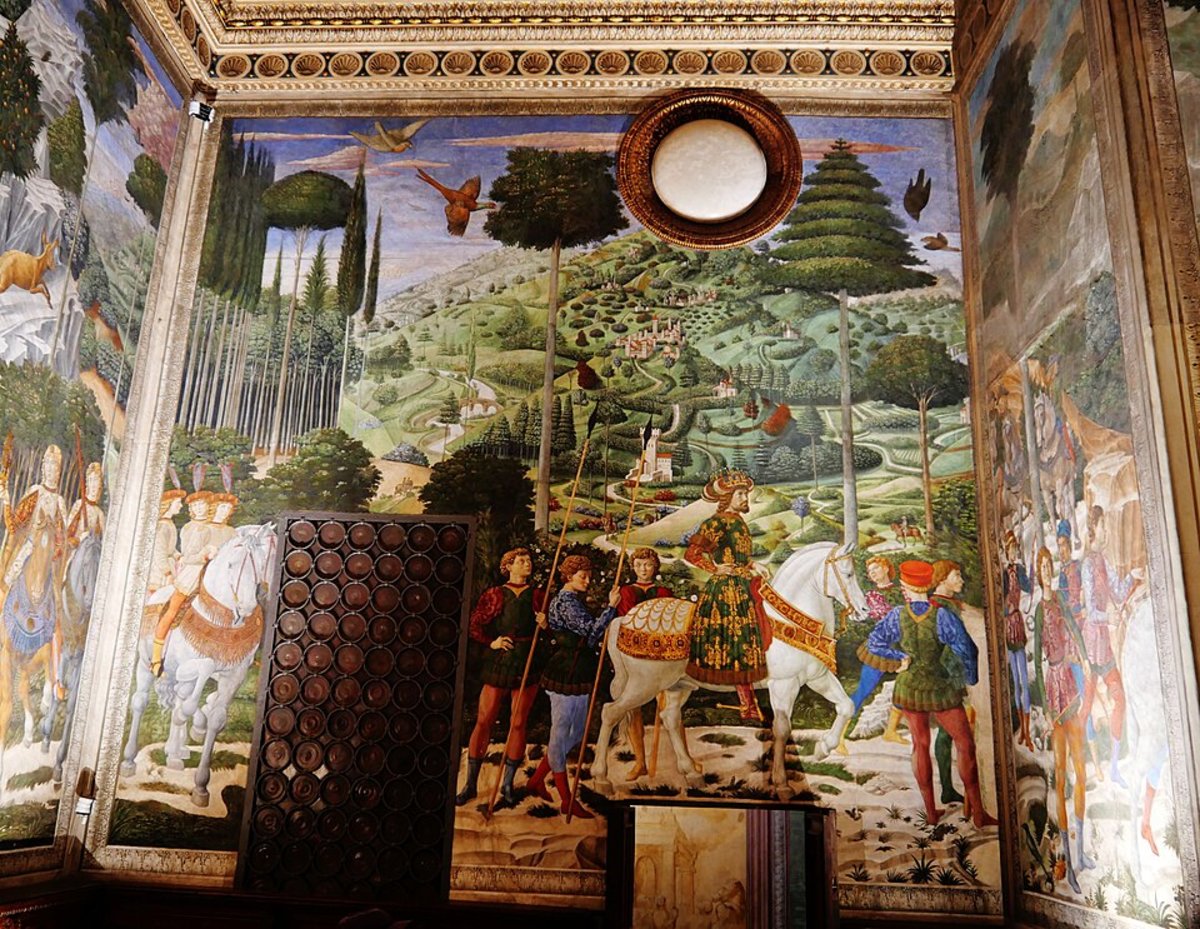
Magi Chapel Frescoes (Procession of the Magi)
Procession of the Magi — Gozzoli, 1459-1461
Benozzo Gozzoli, Public domain, via Wikimedia Commons
Benozzo Gozzoli's fresco of the Procession of the Magi in the Palazzo Medici-Riccardi is the most luxurious and politically eloquent fresco in 15th-century Florence — painted for the private chapel of Cosimo de' Medici between 1459 and 1461, covering three walls of the tiny chapel with a continuous panoramic procession of the three Magi making their way through a Florentine hill landscape toward the Virgin and Child (depicted on the fourth wall in an altarpiece by Filippo Lippi). The three Magi are depicted as members of the Medici family and their allies: the youngest Magus (traditionally identified as Lorenzo de' Medici, age approximately 10-11 at the time) rides a white horse at the head of the procession; behind him, Cosimo and Piero de' Medici ride in the retinue. The landscape is a specific vision of Tuscany in spring, filled with specific plants, exotic animals (giraffe, leopard), and approximately 250 individual portrait figures.
Benozzo Gozzoli (c.1420-1497) was a pupil of Fra Angelico — he worked with Fra Angelico in Rome and in Orvieto before establishing himself as an independent painter in Florence. His Medici commission was the defining work of his career: the combination of his teacher's meticulous detail with a worldly delight in surface description, portraiture, and processional spectacle is entirely characteristic of his approach. The fresco was made immediately after the Council of Florence (1439-1445), at which the Byzantine Emperor John VIII Palaeologus visited Florence — the Young Magus (Lorenzo) and his horse may be based on the Emperor's appearance, whose exotic dress and white horse were celebrated in the city.
The chapel is very small (approximately 7 by 7.5 metres) and access is limited to a small number of visitors at a time. The three walls of the procession are continuous — begin at the wall to the left of the altar and follow the procession clockwise. Look for: the portrait of Gozzoli himself (holding a red cap inscribed 'Opus Benotii', at the left side of the second register); the exotic animals including a giraffe and a cheetah on a lead; and the specific landscape, which has been identified as a view from the Florentine hills toward the Mugello valley.
When standing before this work, look carefully: Procession of the Magi — Gozzoli, 1459-1461. Give it time — what seems decorative often carries the central meaning.
When standing before this work, look carefully: The young Lorenzo de' Medici on his white horse. Give it time — what seems decorative often carries the central meaning.
When standing before this work, look carefully: The Tuscan hill landscape — spring with exotic animals. Give it time — what seems decorative often carries the central meaning.
When standing before this work, look carefully: Gozzoli's self-portrait — holding the red cap. Give it time — what seems decorative often carries the central meaning.
Palazzo Medici-Riccardi, Via Cavour 3, Florence. The Magi Chapel is on the first floor; admission is limited and timed. Open Monday-Sunday except Wednesday; admission fee.