
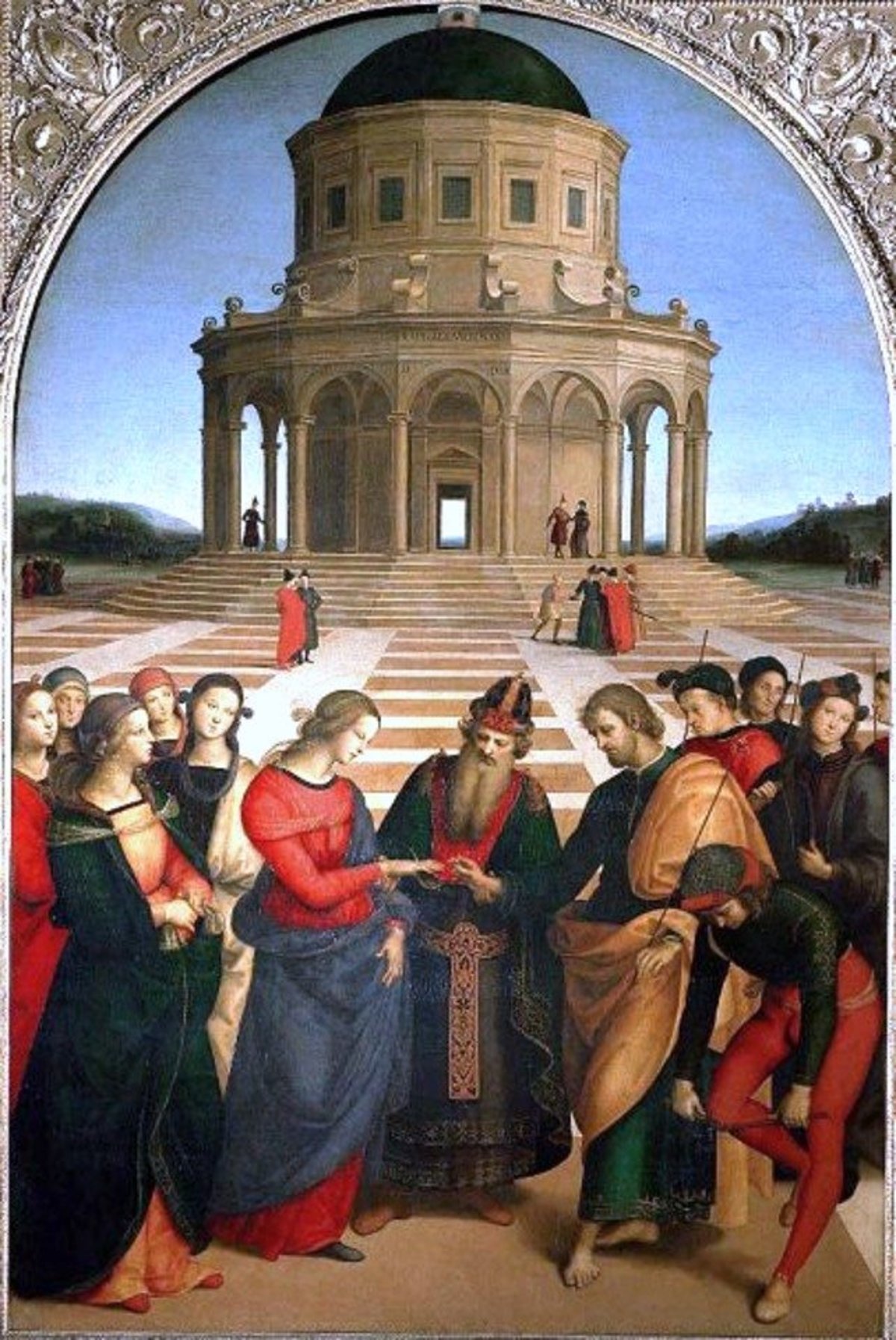
Marriage of the Virgin (Sposalizio della Vergine)
Marriage of the Virgin — Raphael, 1504
Raphael, Public domain, via Wikimedia Commons
Raphael's Marriage of the Virgin, painted in 1504 for the Franciscan church in Città di Castello, is the final work of his Umbrian apprenticeship and the first demonstration of his mature genius. It depicts the ceremony of Mary's betrothal to Joseph, with the High Priest joining their hands while a crowd of suitors (whose rods, according to legend, would bloom only for the chosen man) stand on either side.
The central panel shows a perfectly proportioned circular temple in the distance, a circular piazza, and a triangular figure grouping in the foreground. The composition is indebted to Perugino's Christ Delivering the Keys to St Peter in the Sistine Chapel (which Raphael would have studied on his first visit to Rome), but the geometry is more rigorous, the figures more naturalistically posed, and the spatial recession more convincing than anything Perugino achieved.
The Sposalizio was Raphael's immediate predecessor to his Roman career — he arrived in Florence later in 1504 and encountered Leonardo and Michelangelo. The painting already shows Raphael's characteristic qualities: the balance and harmony of the composition, the gentle beauty of the figures, the clarity of the narrative, and the mastery of perspectival architecture.
The circular temple in the background — clearly inspired by Bramante's Tempietto (recently built in Rome) — demonstrates Raphael's awareness of the most advanced architectural thinking of the moment. He was 21 when he painted it and had already surpassed his master Perugino in every formal quality.
The composition's triangular figure arrangement — the High Priest at the apex, Mary on the left, Joseph on the right, the crowd extending behind each — is the first fully Raphaelesque composition: balanced, clear, narrative, elegant. The ring being placed on Mary's finger is the central action; the crowd's reactions range from attention to surprise to emotional intensity.
Look at the floor of the piazza — the geometrically patterned pavement creates a perspectival grid that anchors the figures in space. The circular temple at the end draws the eye, recedes convincingly, and provides the devotional centre of the image. Raphael signed and dated the painting on the temple's frieze: 'RAPHAEL VRBINAS MDIIII.'
When standing before this work, look carefully: Marriage of the Virgin — Raphael, 1504. Give it time — what seems decorative often carries the central meaning.
When standing before this work, look carefully: The circular temple — Raphael's Bramantesque background. Give it time — what seems decorative often carries the central meaning.
When standing before this work, look carefully: The ring ceremony — Joseph and Mary's hands. Give it time — what seems decorative often carries the central meaning.
When standing before this work, look carefully: Raphael's signature on the temple frieze. Give it time — what seems decorative often carries the central meaning.
Pinacoteca di Brera, Milan. Room XXIV — the same room as the Piero della Francesca Brera Madonna. The juxtaposition of Piero and Raphael — two masters of perspective and compositional geometry, one from the generation before the High Renaissance and one announcing it — is instructive.