
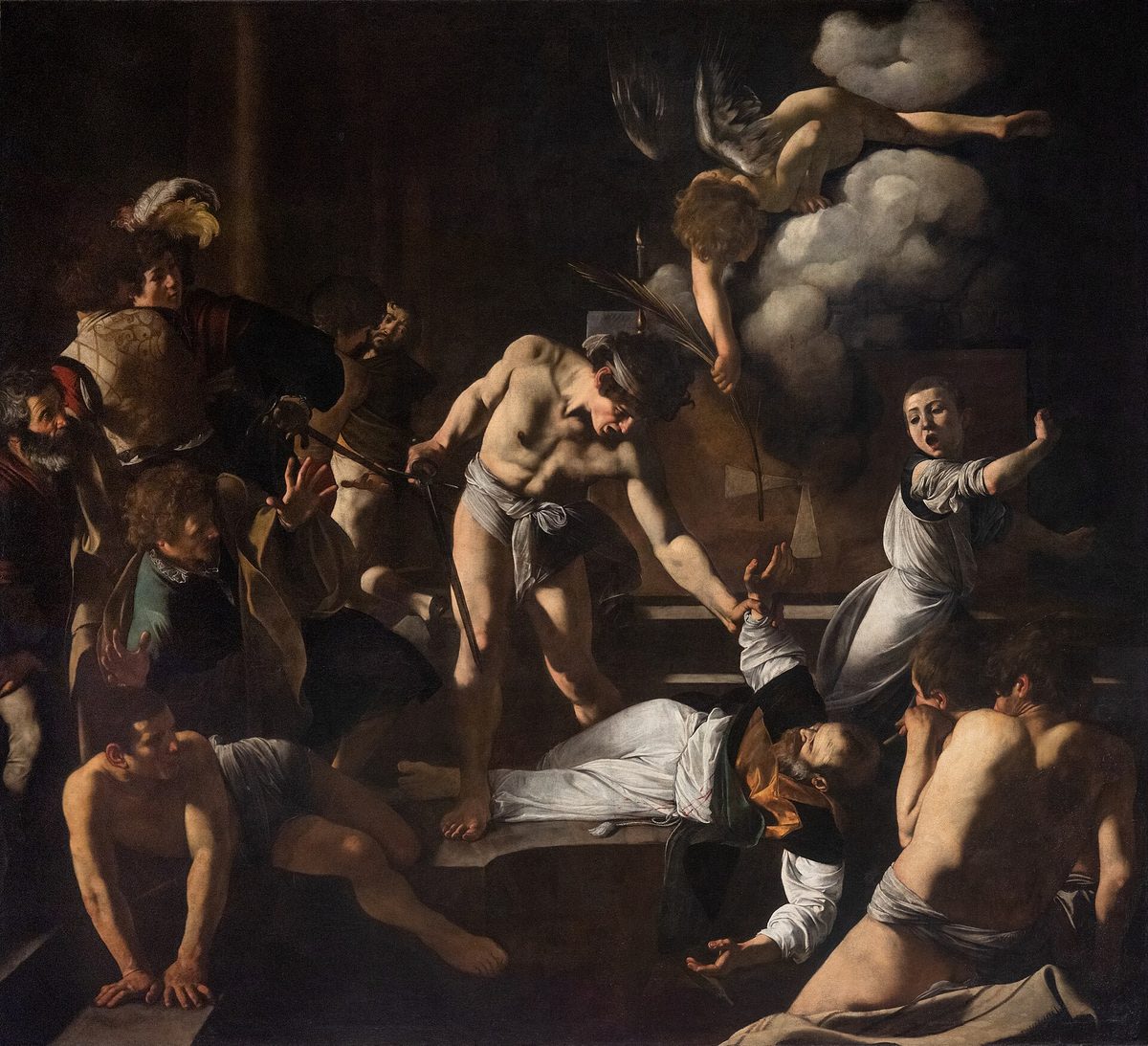
Martyrdom of St Matthew
Martyrdom of St Matthew — full composition
Caravaggio, Public domain, via Wikimedia Commons
The Martyrdom of St Matthew faces the Calling across the Contarelli Chapel — together they are among the most important painting pairs in Western art. In the Martyrdom, Matthew has been struck down at the altar by a half-naked executioner (an athlete, almost nude, leaning over the fallen apostle with a sword raised).
The crowd scatters in terror; a young angel descends from above offering a palm of martyrdom. Caravaggio himself appears among the fleeing figures — a young man in the background looking directly at the viewer, the only figure in the entire chaotic composition who is not reacting to the violence. His self-portrait in a scene of religious martyrdom is one of the most psychologically loaded insertions in art history.
The Martyrdom is more conventionally composed than the Calling — with its circular arrangement of figures around the fallen Matthew — but the chiaroscuro is equally revolutionary. The executioner's white body catches the light in the same way as Matthew's face in the Calling; the angel descends from the same light source.
Caravaggio revised the composition significantly during execution (the underdrawing, revealed by X-ray, shows a quite different arrangement). The self-portrait is in the upper left: a young man with dark curly hair, his face turned toward the viewer while the scene of violence occurs around him. It is an intrusion of the artist's consciousness into sacred history.
The figures in the painting divide into those fleeing from the violence (the crowd) and the three who remain: the executioner, the fallen Matthew, and the angel. Matthew reaches toward the angel's offered palm even as the sword descends — the martyr's gesture of acceptance.
The executioner's pose — athletic, almost indifferent to the crowd's terror — gives the murder the quality of a professional act, which makes it more disturbing than if he were depicted as monstrous. Look for Caravaggio's self-portrait in the upper left — one of the earliest artist self-portraits inserted into a religious narrative.
When standing before this work, look carefully: Martyrdom of St Matthew — full composition. Give it time — what seems decorative often carries the central meaning.
When standing before this work, look carefully: Caravaggio's self-portrait in the upper left. Give it time — what seems decorative often carries the central meaning.
When standing before this work, look carefully: The executioner and the fallen Matthew. Give it time — what seems decorative often carries the central meaning.
When standing before this work, look carefully: The angel descending with the palm of martyrdom. Give it time — what seems decorative often carries the central meaning.
Same chapel as the Calling. The three Caravaggio paintings here — Calling, Martyrdom, and Inspiration of St Matthew (over the altar) — should be seen together as a unified programme. The chapel's dimensions and the coin-operated lighting make it one of Rome's most atmospheric viewing experiences.