
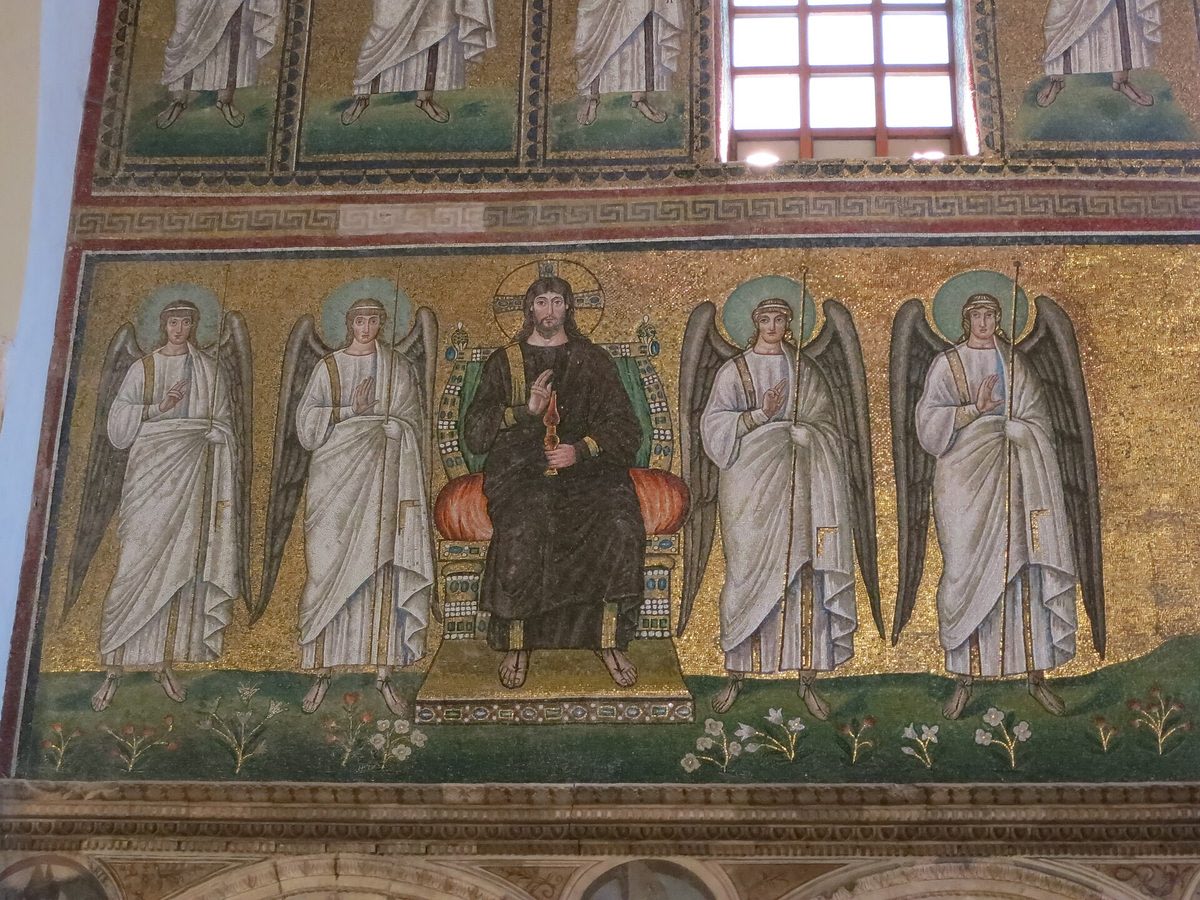
Mausoleum of Galla Placidia Mosaics
Mausoleum of Galla Placidia — the dome and barrel vaults
Public domain, via Wikimedia Commons
The Mausoleum of Galla Placidia contains the oldest and most jewel-like mosaics in Ravenna — a small, low building (approximately 12.5 by 10.5 metres) whose entire interior is covered in mosaic that transforms the space into a midnight-blue and gold vision of celestial light. The building was probably not actually Galla Placidia's mausoleum (she died in Rome, 450 AD); it may have been an oratory dedicated to St Lawrence. The mosaics cover the barrel-vaulted lunettes, the arched niches, and the dome: the dome mosaic shows an intense midnight-blue sky with the Cross in the centre and golden stars arranged in eight spiral rings; the lunette mosaics include the Good Shepherd (Christ as a young shepherd in a gold landscape, tending six sheep), St Lawrence going to his martyrdom, and Deer at the Fountain (a symbolic image from Psalm 42).
Galla Placidia (388/392-450) was the daughter of Emperor Theodosius I, the wife of the Visigothic king Ataulf, and later the regent of the Western Empire for her son Valentinian III. Ravenna became the capital of the Western Empire in 402, and she ruled it from approximately 424-437.
The mausoleum is the oldest of Ravenna's surviving decorative monuments — predating San Vitale by approximately 80 years — and shows Late Roman mosaic technique at its most accomplished: the figures are still classical in their plasticity, the colour range more varied than in the later Byzantine work, the spatial settings more illusionistic. The deer at the fountain mosaic is particularly distinguished by the quality of naturalistic observation in the animal figures.
The space of the mausoleum is designed for a single overwhelming experience: when you enter from bright Italian sunlight, the interior is at first nearly dark. As your eyes adjust, the mosaic surfaces begin to reveal themselves — the midnight blue deepens, the gold stars accumulate, the lunette mosaics emerge from the darkness with a warmth that seems to generate its own light.
The Good Shepherd lunette (above the entrance) shows Christ as a young man (not yet the bearded Christ of mature Byzantine iconography) seated in a golden landscape with his sheep — the pastoral simplicity of the early Church, before the imperial iconography of San Vitale. The single dome window (alabaster, not glass) diffuses warm natural light into the space: even on a grey day, the interior glows.
When standing before this work, look carefully: Mausoleum of Galla Placidia — the dome and barrel vaults. Give it time — what seems decorative often carries the central meaning.
When standing before this work, look carefully: The Good Shepherd lunette — Christ as a young shepherd. Give it time — what seems decorative often carries the central meaning.
When standing before this work, look carefully: Deer at the Fountain — Psalm 42 mosaic. Give it time — what seems decorative often carries the central meaning.
When standing before this work, look carefully: The Mausoleum of Galla Placidia — exterior. Give it time — what seems decorative often carries the central meaning.
Adjacent to the Basilica di San Vitale, Ravenna. Part of the same UNESCO site and covered by the same combination ticket.
Relatively small; visits should be unhurried. The change from outdoor light to interior darkness is itself an artwork.