
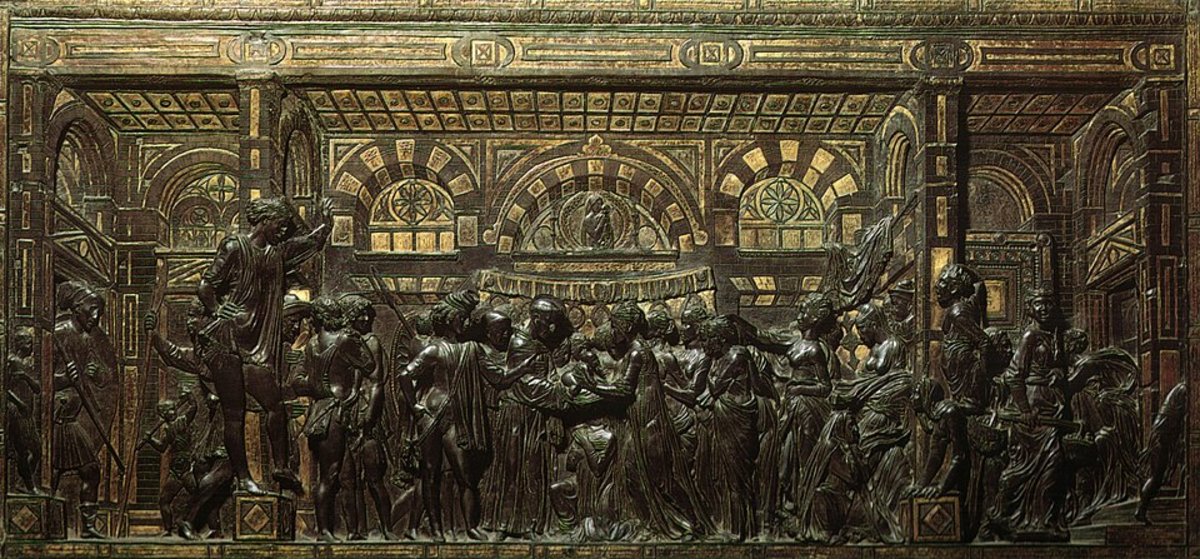
Miracles of St Anthony reliefs (High Altar of the Basilica del Santo)
Miracle of the Speaking Infant — Donatello, 1444-1450, Padua
Donatello, Public domain, via Wikimedia Commons
Donatello's bronze reliefs for the high altar of the Basilica di Sant'Antonio (Il Santo) in Padua are among the most important sculptural works of the Italian Renaissance — a complex of freestanding bronzes, relief panels, and architectural elements that was Donatello's major project during his Paduan decade (1443-1453). The altar (reconstructed several times after its original dismantling) includes four large relief panels showing miracles of St Anthony: the Miracle of the Speaking Infant (the infant speaks to exonerate its unjustly accused mother), the Miracle of the Repentant Son (the youth who cut off his leg to punish himself for kicking his mother is healed by the saint), the Miracle of the Mule (a mule kneels before the consecrated Host), and the Miracle of the Irascible Son. The large Entombment of Christ panel (the Pietà) is also part of the altar complex.
The high altar bronzes represent Donatello's most concentrated treatment of relief sculpture — a form he had been developing since his work for the Florentine Baptistery and the Orsanmichele. The Paduan reliefs show Donatello at the height of his mature powers: the composition of the large miracle panels is complex and spatially deep (achieved through low relief, schiacciato, technique), the individual figures have the psychological specificity of his best work, and the architecture of the depicted spaces — Roman barrel vaults, classical loggias — creates a sense of formal grandeur that elevates the miraculous events to the scale of history.
The Miracle of the Speaking Infant is the most formally ambitious of the four panels: a crowd fills a deep architectural space, the saint holds the infant who speaks, and the accused mother and her husband respond. The crowd's variety — figures at different distances, in different postures, with different responses to the miracle — is the fullest expression of Donatello's narrative range.
The Pietà panel (Entombment) is the most emotionally concentrated: the dead Christ is held by mourning figures in a composition of compressed grief. These are the works that Mantegna and the next generation of Paduan and Venetian artists studied as they developed the Renaissance figure style.
When standing before this work, look carefully: Miracle of the Speaking Infant — Donatello, 1444-1450, Padua. Give it time — what seems decorative often carries the central meaning.
When standing before this work, look carefully: High altar complex — bronzes and architectural setting. Give it time — what seems decorative often carries the central meaning.
When standing before this work, look carefully: Entombment (Pietà) panel — compressed grief. Give it time — what seems decorative often carries the central meaning.
When standing before this work, look carefully: Miracle of the Mule — the mule kneels before the Host. Give it time — what seems decorative often carries the central meaning.
Basilica di Sant'Antonio (Il Santo), Piazza del Santo, Padua. Open daily 6:20-19:45 (shorter hours in winter).
Free admission to the basilica; the high altar with Donatello's bronzes is in the crossing of the basilica. Padua is approximately 40 km west of Venice.