
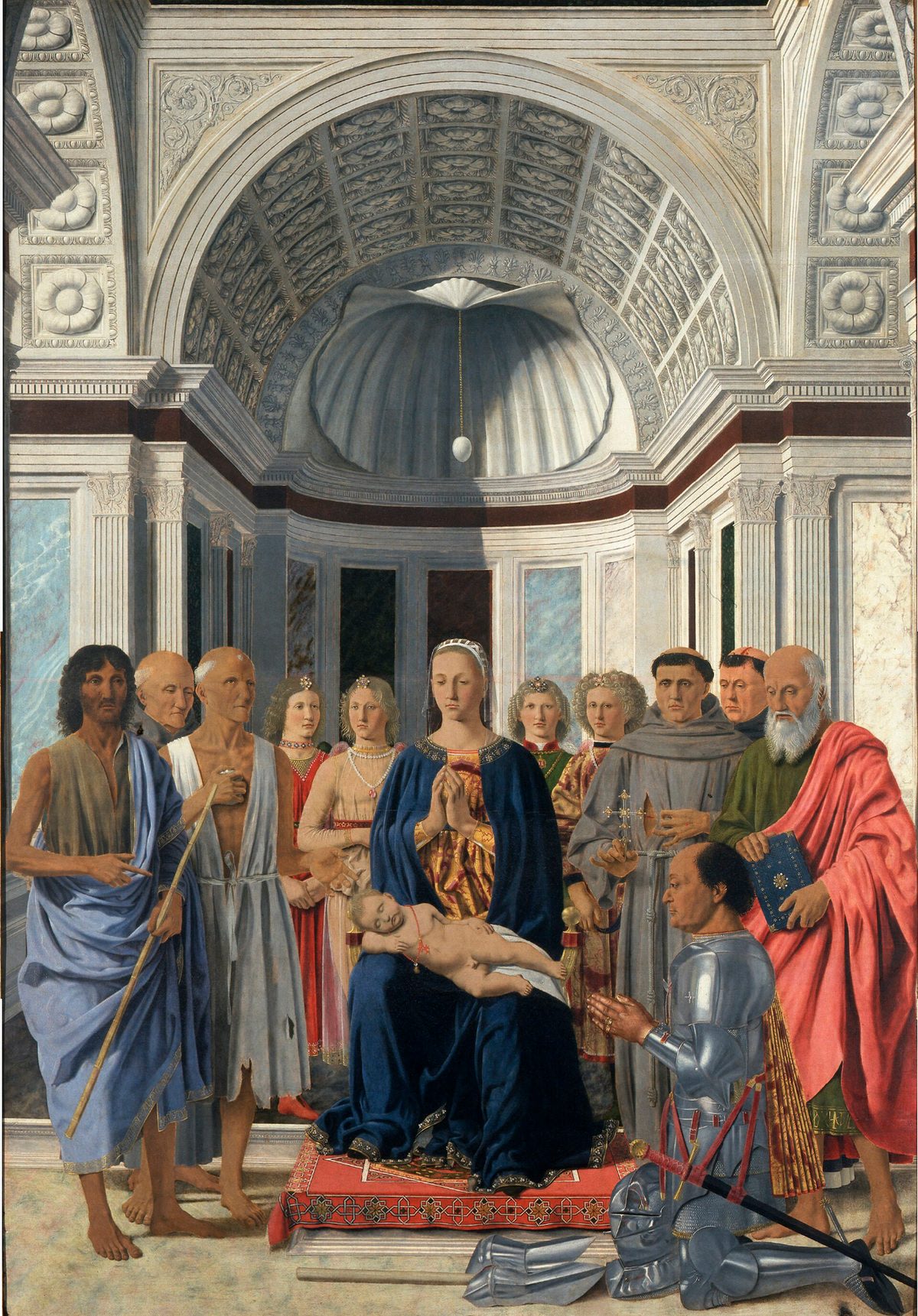
Montefeltro Altarpiece (Brera Madonna)
Brera Madonna — Piero della Francesca, c.1472-1474
Piero della Francesca, Public domain, via Wikimedia Commons
Piero della Francesca's Brera Madonna — also called the Montefeltro Altarpiece or the Sacra Conversazione — is among the most serene and intellectually powerful altarpieces of the Italian Renaissance. It depicts the Virgin and Child seated in a semi-circular apse with six angels, four saints (John the Baptist, Bernardino of Siena, Jerome, and Francis), and the kneeling donor Federico da Montefeltro, Duke of Urbino, in full armour.
Suspended from the centre of the apse above the Virgin's head is a large ostrich egg on a golden chain — a symbol of the miraculous virginal birth (the ostrich was believed to hatch its eggs by gazing at them, without physical contact). The Christ child sleeps in the Virgin's arms with the absolute stillness of a baby in deep sleep. The entire composition has a quality of suspended breath, a divine pause before the Annunciation's consequence unfolds.
The Brera Madonna was probably commissioned around 1472-1474 — the same period as the Urbino Diptych (entry 39) — as a memorial altarpiece for Battista Sforza, who had died in 1472. Federico's armour, his kneeling position (the most prominent position in the painting), and the painting's grave atmosphere all suggest a commemorative purpose.
The architectural setting is an elaborately detailed barrel-vaulted apse with classical pilasters and coffers that demonstrates Piero's mastery of architectural perspective — the space is precisely calculable from the painted evidence. The large egg has attracted encyclopaedic interpretation: ostrich egg (miraculous birth), pearl (purity), cosmic sphere (the divine creation) are among the proposed readings.
Stand in front of the painting and allow the architectural space to settle. Piero's apse is a real space — the recession of the barrel vault, the coffers in perspective, the shadow beneath the arch — painted with a precision that makes it feel architectural rather than painted.
The figures within this space are arranged with absolute symmetry and balance: the saints, three on each side; the angels, three on each side; the Virgin and Child at the centre, the kneeling Federico at the lower right as the asymmetric element that breaks the formal balance with human supplication. The sleeping child is the composition's emotional centre; the egg above him is its theological key.
When standing before this work, look carefully: Brera Madonna — Piero della Francesca, c.1472-1474. Give it time — what seems decorative often carries the central meaning.
When standing before this work, look carefully: The ostrich egg — symbol of miraculous birth. Give it time — what seems decorative often carries the central meaning.
When standing before this work, look carefully: Federico da Montefeltro kneeling in armour. Give it time — what seems decorative often carries the central meaning.
When standing before this work, look carefully: The sleeping Christ child. Give it time — what seems decorative often carries the central meaning.
Pinacoteca di Brera, Milan. Room XXIV. The Brera also contains Raphael's Marriage of the Virgin (entry 61) and the Mantegna Lamentation (entry 59) — three of the most important altarpieces in Northern Italy in the same museum.