
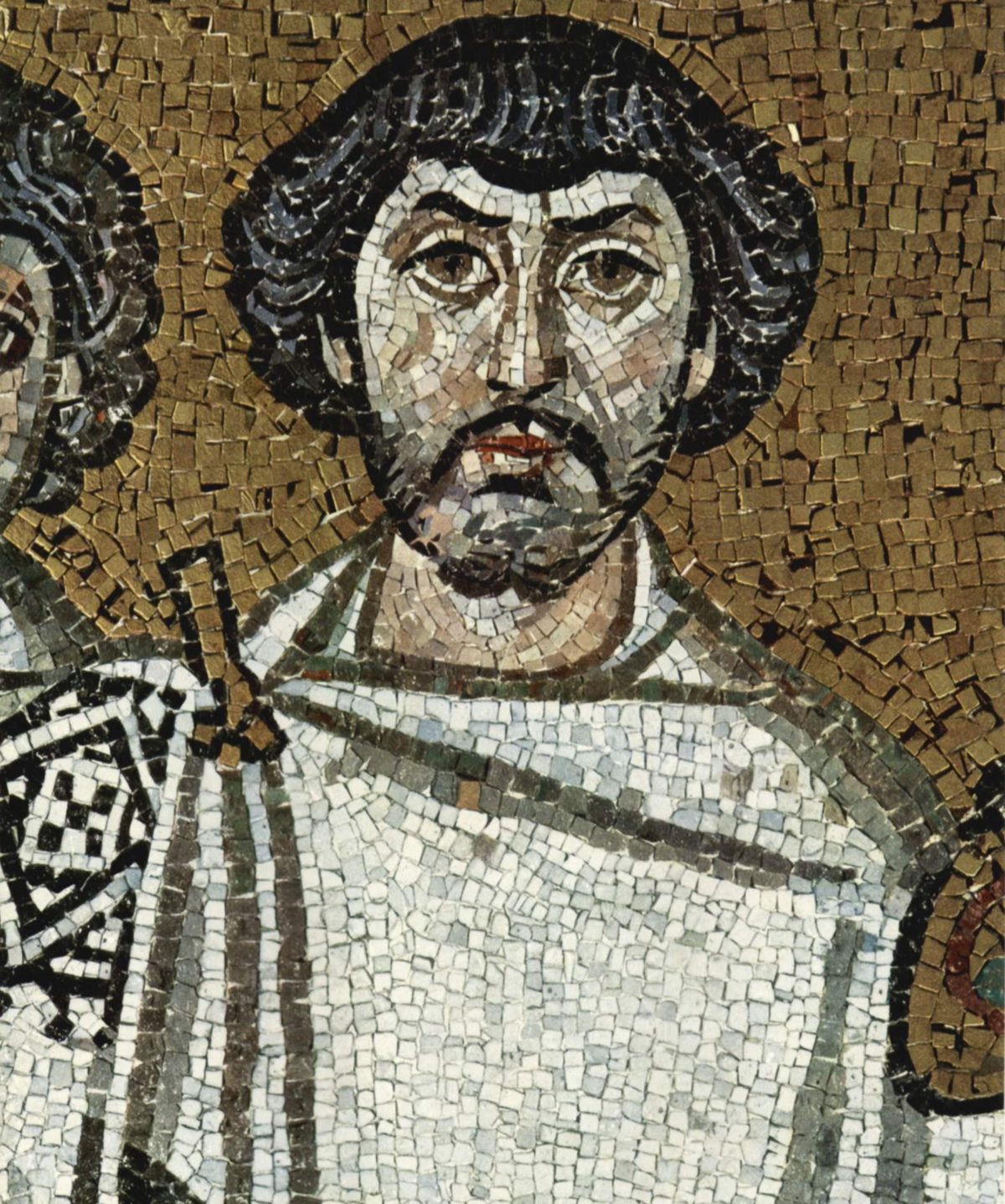
Mosaics of San Vitale
San Vitale apse mosaics — Justinian and Theodora panels
Public domain, via Wikimedia Commons
The mosaics of San Vitale in Ravenna are the most important surviving Byzantine mosaics in the Western world outside Constantinople — a complete programme covering the apse, chancel arch, and chancel walls of the octagonal church built under the Emperor Justinian I between 526 and 547. The two most celebrated compositions are the facing apse panels: the Emperor Justinian I with his court and retinue offering a paten to the church on the north wall, and the Empress Theodora with her ladies offering a chalice on the south wall.
These are state documents as much as religious images: the figures are identified by their position and attributes, the court hierarchy is encoded in the spatial arrangement, and the purple garments and gold halos of the imperial pair place them within a scheme of sacred kingship. They are among the finest portraits in early medieval art.
Justinian built San Vitale (dedicated 548) as a statement of Byzantine imperial authority in Ravenna — the western capital of the Byzantine exarchate. The mosaic programme celebrates the theology of the Incarnation (the apse vault shows Christ enthroned, offering the crown of martyrdom to St Vitalis) and the political theology of the Byzantine emperor as God's vicegerent on earth (the Justinian and Theodora panels).
The figures in these panels are not depicted in space but in an abstract golden field — the Byzantine rejection of illusionistic perspective in favour of a sacred hierarchical arrangement. Every figure faces forward; the gold ground is sacred light; the feet stand on or just above the ground plane without casting shadows.
The Justinian panel shows the emperor in the centre, holding the paten, flanked by clerics (Bishop Maximianus, clearly identified by his inscription, on the left) and soldiers (holding a shield with the Chi-Rho symbol on the right). The arrangement encodes church, state, and military authority around the imperial figure.
Theodora is shown in her panel with court ladies and two male attendants (eunuchs), holding the chalice; the hem of her garment is embroidered with the Three Magi bringing gifts — a deliberate visual rhyme between the Empress bearing a chalice to the altar and the Magi bearing gifts to Christ. Look at the quality of the individual faces in both panels — each mosaic tile is a decision about colour and light that contributes to the aggregate impression of a real face.
When standing before this work, look carefully: San Vitale apse mosaics — Justinian and Theodora panels. Give it time — what seems decorative often carries the central meaning.
When standing before this work, look carefully: Emperor Justinian with his court — south wall mosaic. Give it time — what seems decorative often carries the central meaning.
When standing before this work, look carefully: Empress Theodora with her ladies — north wall mosaic. Give it time — what seems decorative often carries the central meaning.
When standing before this work, look carefully: Christ enthroned on the globe — the apse vault. Give it time — what seems decorative often carries the central meaning.
Basilica di San Vitale, Via Fabbri 17, Ravenna. Open daily. Part of the UNESCO World Heritage Site 'Early Christian Monuments of Ravenna.' A single ticket covers San Vitale, the Mausoleum of Galla Placidia (entry 76), the Battistero Neoniano, the Battistero degli Ariani, and the Cappella Arcivescovile.