
Moses
Moses — Michelangelo, c.1513-1545
Michelangelo, Public domain, via Wikimedia Commons
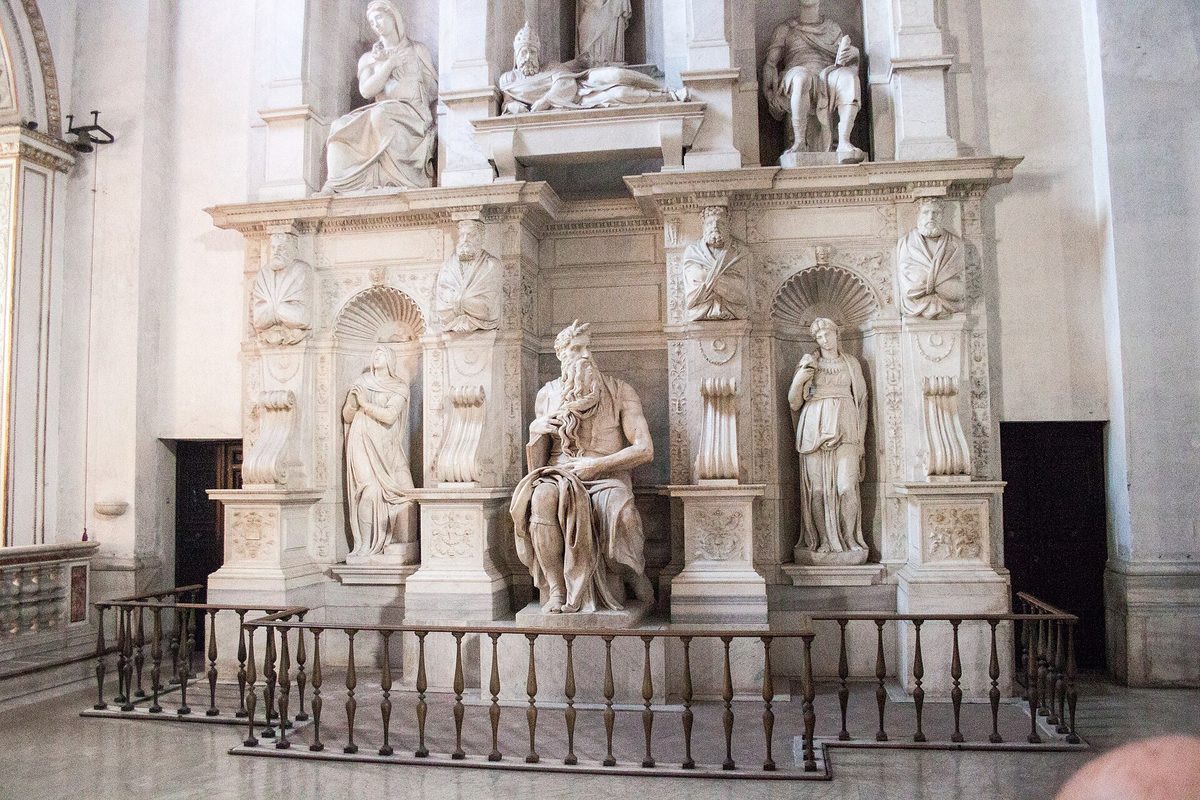
Michelangelo's Moses is the commanding central figure of the tomb of Pope Julius II in the church of San Pietro in Vincoli — a tomb that became the great tragedy of Michelangelo's career, reduced from a monumental multi-figure structure planned to stand in St Peter's Basilica to a modest wall monument in a side church. But Moses, despite his diminished context, is one of the most powerful figures in all sculpture. He is seated, holding the tablets of the Law under his right arm, his left hand gripping his flowing beard, his face turned to the right with an expression of barely contained wrath — it is Moses returning from Sinai, seeing the Israelites worshipping the golden calf, about to rise and shatter the tablets.
Julius II commissioned the tomb in 1505; Michelangelo worked on it intermittently for forty years. The original plan called for a free-standing structure with over forty figures; successive contracts reduced it until the final 1542 agreement produced the wall monument we see today.
Of the planned large figures, only Moses was completed for the final tomb (the two enslaved figures — the Dying Slave and the Rebellious Slave, now in the Louvre — were made for an earlier phase). Vasari and contemporaries reported that when Michelangelo finished Moses, he struck it on the knee with his hammer and said 'Now speak!' — a perhaps apocryphal story that nevertheless captures the extraordinary life-force the figure projects.
The figure is seated on a throne-like chair, massive in scale (approximately 2.35 metres). The two horns on Moses's head are a famous iconographic feature — they derive from Jerome's Vulgate translation of the Hebrew word qaran (which means 'radiant' or 'to shine') as 'cornuta' (horned).
Countless medieval and Renaissance depictions of Moses include these horns; Michelangelo embraced the convention. The drapery over Moses's legs is among the finest fabric carving in sculpture — the weight and material quality of cloth made tangible. The veins on his right arm and the tension in his hands are among Michelangelo's most detailed anatomical passages.
When standing before this work, look carefully: Moses — Michelangelo, c.1513-1545. Give it time — what seems decorative often carries the central meaning.
When standing before this work, look carefully: Moses's face — the wrath of God's prophet. Give it time — what seems decorative often carries the central meaning.
When standing before this work, look carefully: The right arm — Michelangelo's anatomical genius. Give it time — what seems decorative often carries the central meaning.
When standing before this work, look carefully: San Pietro in Vincoli — the tomb in context. Give it time — what seems decorative often carries the central meaning.
San Pietro in Vincoli ('St Peter in Chains') is a short walk from the Colosseum, up the Borghi steps. The church also houses the relic of Peter's chains (the vincoli of the name). Moses is in a prominent position; the modest scale of the church makes the figure more overwhelming, not less.