
Nativity and Passion Facades
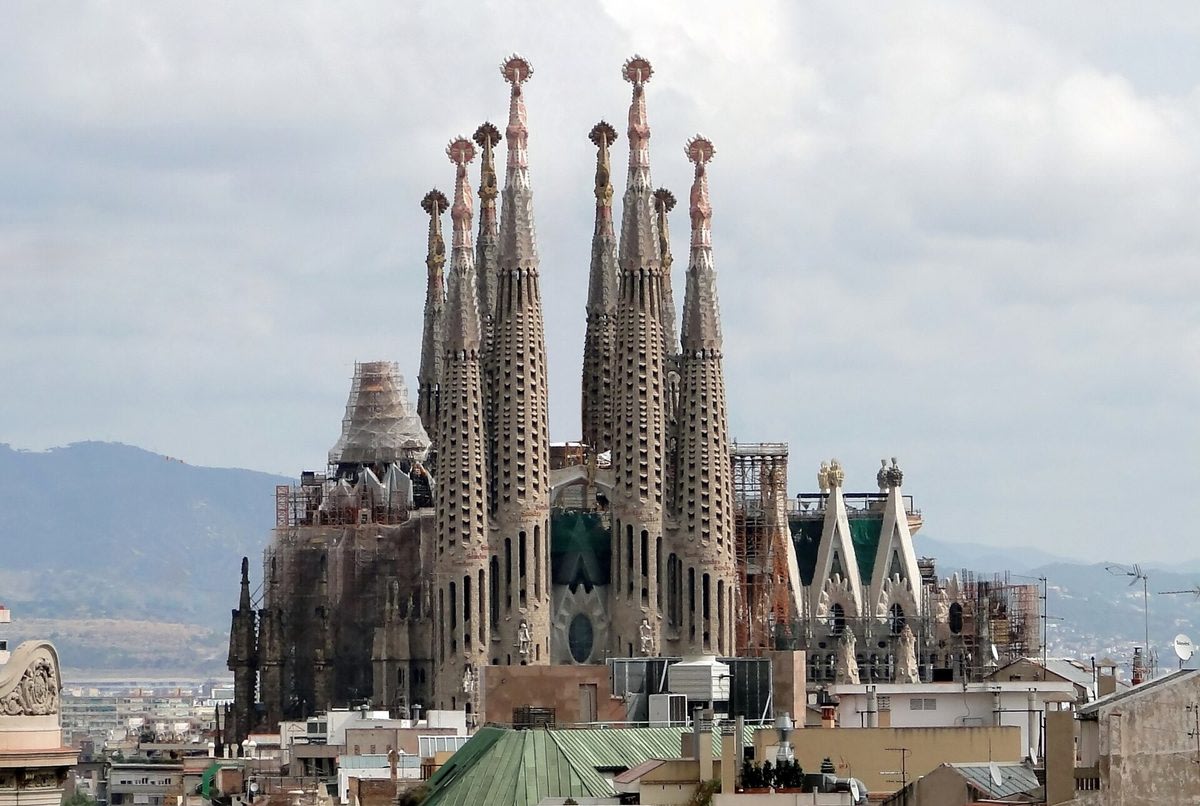
Sagrada Família — the Nativity Facade
Public domain, via Wikimedia Commons
Antoni Gaudí's Sagrada Família is the most ambitious and most complex work of religious architecture under construction in the modern world — a large Catalan Gothic-inspired basilica that has been under continuous construction since 1882 and is projected for completion in 2026. The two completed facades — the Nativity Facade (1894-1930, the only portion Gaudí saw built to significant completion) and the Passion Facade (1954-2005, by Josep Maria Subirachs following Gaudí's designs) — are the figurative programmes that give the building its extraordinary identity.
The Nativity Facade is an explosion of naturalistic stone carving: hundreds of figures of people, animals, and plants in a Gothic portal programme saturated with naturalistic detail. The Passion Facade, by contrast, is austere and angular — Subirachs's cubic figures and reduced forms create a tone of grief and severity that deliberately contrasts with the Nativity's exuberance.
Antoni Gaudí (1852-1926) devoted the last 43 years of his life entirely to the Sagrada Família, living in the workshop on-site for much of this time. He died in 1926 (struck by a tram in Barcelona) with only the crypt and the Nativity facade towers substantially complete.
He had, however, designed the entire building and left a detailed programme of models and drawings (partly destroyed in the Spanish Civil War). The continuation of the work after his death — and particularly the question of whether 21st-century additions are faithful to his vision — is a matter of intense architectural debate. The Sagrada Família was consecrated as a minor basilica by Pope Benedict XVI in 2010.
The Nativity Facade (east-facing, therefore catches the morning light) has three portals: Faith (right), Hope (left), and Charity (centre, surmounted by the Nativity scene). The central tympanum shows the Nativity with the Star of Bethlehem in the centre; above, the Coronation of the Virgin; the towers above carry the names of the evangelists.
Every surface is covered with naturalistic carving — animals of all species, flora of every Mediterranean type, human figures in contemporary Catalan dress. The Passion Facade (west-facing) is entirely different: Subirachs's cubic angular figures depict the Passion narrative in a deliberate anti-naturalistic style intended to communicate the severity of the Crucifixion. The cryptographic magic square on the Passion Facade sums to 33 (Christ's age at his death) in every direction.
When standing before this work, look carefully: Sagrada Família — the Nativity Facade. Give it time — what seems decorative often carries the central meaning.
When standing before this work, look carefully: The Passion Facade — Subirachs's angular style. Give it time — what seems decorative often carries the central meaning.
When standing before this work, look carefully: The interior — Gaudí's forest of columns and coloured light. Give it time — what seems decorative often carries the central meaning.
When standing before this work, look carefully: Aerial view — the basilica under construction. Give it time — what seems decorative often carries the central meaning.
Sagrada Família, Carrer de Mallorca 401, Barcelona. Advance booking essential — timed entry, often weeks ahead.
The towers can be visited by lift. The interior (completed in recent decades) is spectacularly lit by multicoloured glass windows; the full effect of Gaudí's colour system for the interior is now visible for the first time.