
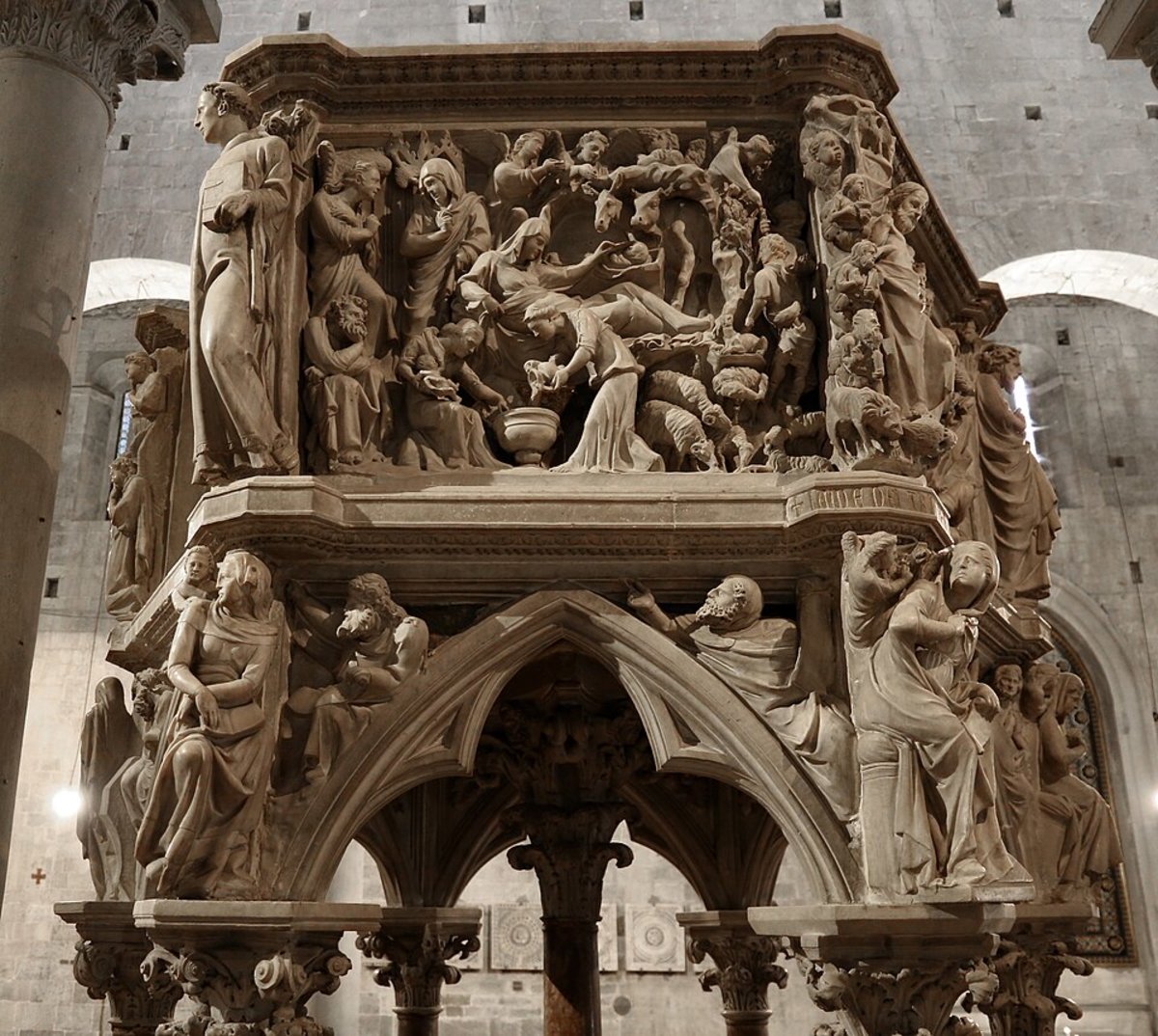
Nativity Pulpit (Pulpit of Sant'Andrea)
Pulpit of Sant'Andrea — Giovanni Pisano, 1298-1301, Pistoia
Giovanni Pisano, Public domain, via Wikimedia Commons
Giovanni Pisano's pulpit in the church of Sant'Andrea, Pistoia (1298-1301) is the supreme example of Italian Gothic sculpture from the late 13th century — a work in which the classical solidity his father Nicola introduced into Italian sculpture is transformed by a new emotional intensity and formal dynamism. The hexagonal pulpit has five relief panels: the Annunciation and Nativity, the Adoration of the Magi, the Massacre of the Innocents, the Crucifixion, and the Last Judgment.
The Nativity panel shows the Virgin reclining in the classical position (derived from Nicola's Pisa treatment) but now surrounded by an unprecedented density and urgency of figures — the scene presses forward, the figures crowd and overlap, the emotional temperature is high. Giovanni Pisano's figures have an expressive violence quite different from his father's serene classicism.
Giovanni Pisano (c.1248-c.1314/1319) was the son and principal collaborator of Nicola Pisano. He also executed the façade sculptures of Siena Cathedral (c.1285-1296) and the pulpit of Pisa Cathedral (1302-1310).
His stylistic development from his father's classicism to his own Gothic emotionalism parallels the development from Cimabue to Giotto in painting: a movement from formal order toward expressive immediacy. The Pistoia pulpit precedes the Pisa Cathedral pulpit by a decade and represents the full maturity of his early style.
The Massacre of the Innocents panel in the Pistoia pulpit is Giovanni's most emotionally concentrated relief: mothers clutch dying children, soldiers thrust with swords, the crying faces of women and dying children create a dense, tormented field of grief. This is a completely different approach to narrative sculpture from Nicola's calm, spacious compositions — Giovanni packs the relief field with figures in order to maximise emotional impact. The comparison with Nicola's Pisa Baptistery panels is the most instructive available exercise in understanding the development of Italian Gothic sculpture.
When standing before this work, look carefully: Pulpit of Sant'Andrea — Giovanni Pisano, 1298-1301, Pistoia. Give it time — what seems decorative often carries the central meaning.
When standing before this work, look carefully: Nativity relief — emotional intensity. Give it time — what seems decorative often carries the central meaning.
When standing before this work, look carefully: Massacre of the Innocents — Gothic expressionism. Give it time — what seems decorative often carries the central meaning.
When standing before this work, look carefully: Full pulpit — hexagonal form with support figures. Give it time — what seems decorative often carries the central meaning.
Sant'Andrea, Via Sant'Andrea, Pistoia. Open daily (church hours).
The pulpit is in the nave of the church. Pistoia is approximately 35 km west of Florence, easily reached by train.