
Noli Me Tangere
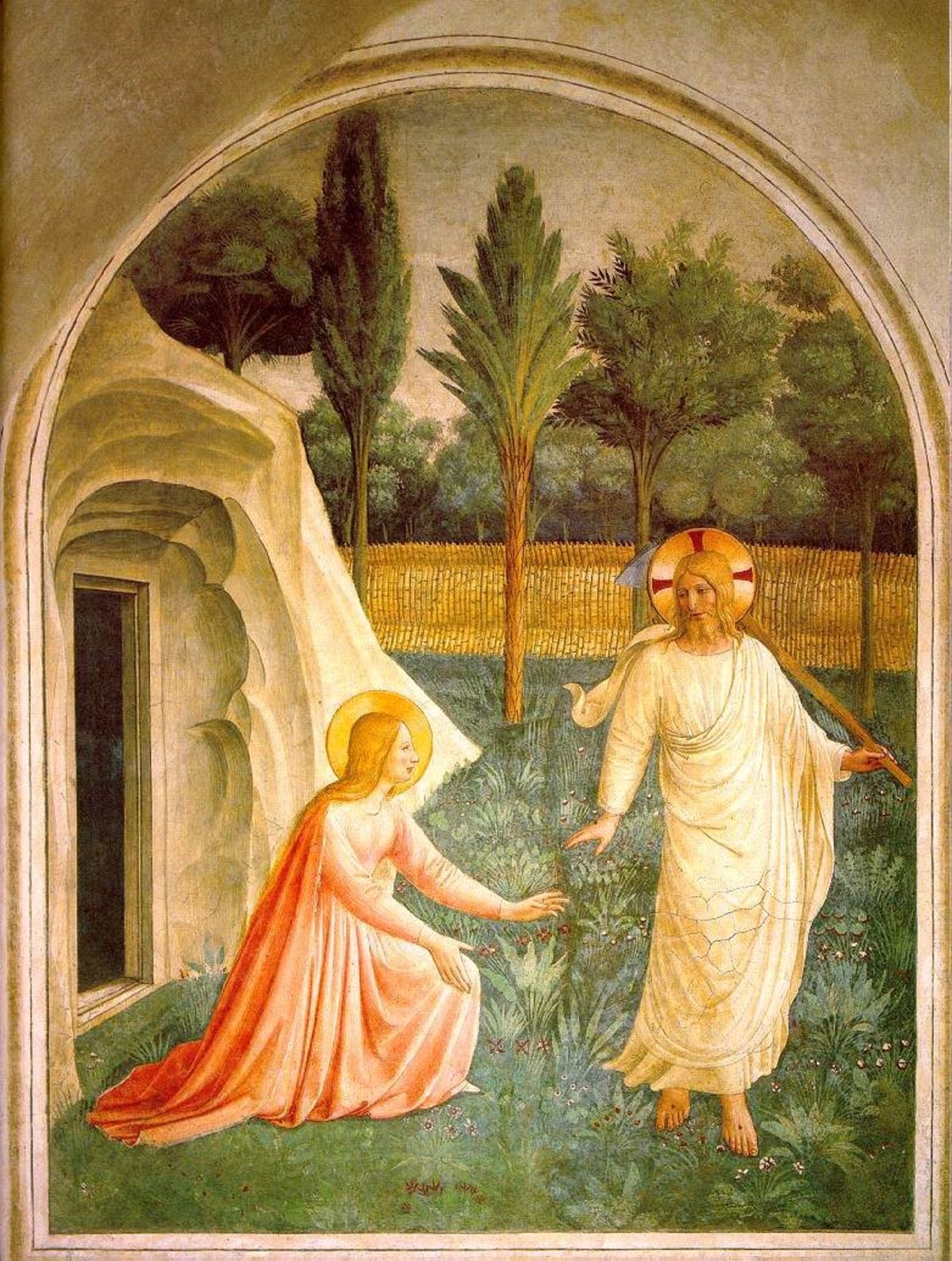
Noli Me Tangere — Fra Angelico, Cell 1, San Marco, c.1440
Fra Angelico, Public domain, via Wikimedia Commons
Fra Angelico's Noli Me Tangere (Cell 1, Dormitory of San Marco) is the most intimate and moving of all his cell frescoes — a small fresco (approximately 166 by 125 cm) painted for the individual meditation of a Dominican friar in the dormitory of the Convent of San Marco in Florence. The subject is the encounter between the Risen Christ and Mary Magdalene in the garden of the sepulchre (John 20:11-18): Christ, carrying a gardening hoe over his shoulder as if he has just risen from the ground and been mistaken for the gardener, extends one hand to prevent Mary Magdalene from touching him ('Touch me not, for I am not yet ascended to the Father').
The garden is depicted as a real Florentine garden — flowers in bloom, a white fence, cypress trees — of an absolute morning freshness. The quality of the light and the psychological tenderness of the encounter make this one of the most beautiful small-scale religious paintings in Florence.
The cell frescoes of San Marco (c.1438-1445) represent Fra Angelico's most intimate and theologically sustained achievement — 43 individual frescoes painted in the individual cells of the Dominican friars for their personal meditation. Each cell fresco shows a scene from the life of Christ, distilled to its essential figures and set in an abstract or simplified space. The Cell 1 Noli Me Tangere is the first fresco encountered in the dormitory; its garden setting and the specific quality of the morning light have made it the most frequently reproduced of the cell frescoes.
The white fence, the cypress trees, and the flowers are from a real Florentine garden: Fra Angelico's direct observation of the natural world is a consistent feature of the cell frescoes. Christ's posture — striding away, one hand raised in the gesture of gentle prohibition — and Mary Magdalene's posture — kneeling, reaching forward, her hands cupped below Christ's hand without touching — create a dialogue of presence and distance, touch and withholding, that is one of the most psychologically subtle representations in Italian Renaissance painting.
When standing before this work, look carefully: Noli Me Tangere — Fra Angelico, Cell 1, San Marco, c.1440. Give it time — what seems decorative often carries the central meaning.
When standing before this work, look carefully: The Florentine garden — white fence and morning flowers. Give it time — what seems decorative often carries the central meaning.
When standing before this work, look carefully: Christ striding away — the gesture of gentle prohibition. Give it time — what seems decorative often carries the central meaning.
When standing before this work, look carefully: The dormitory corridor — 43 individual cells. Give it time — what seems decorative often carries the central meaning.
Museo di San Marco, Piazza San Marco 3, Florence. Open Tuesday-Friday and alternate weekends; admission fee.
The dormitory cells are accessible on the upper floor. Silence is requested in the dormitory.