
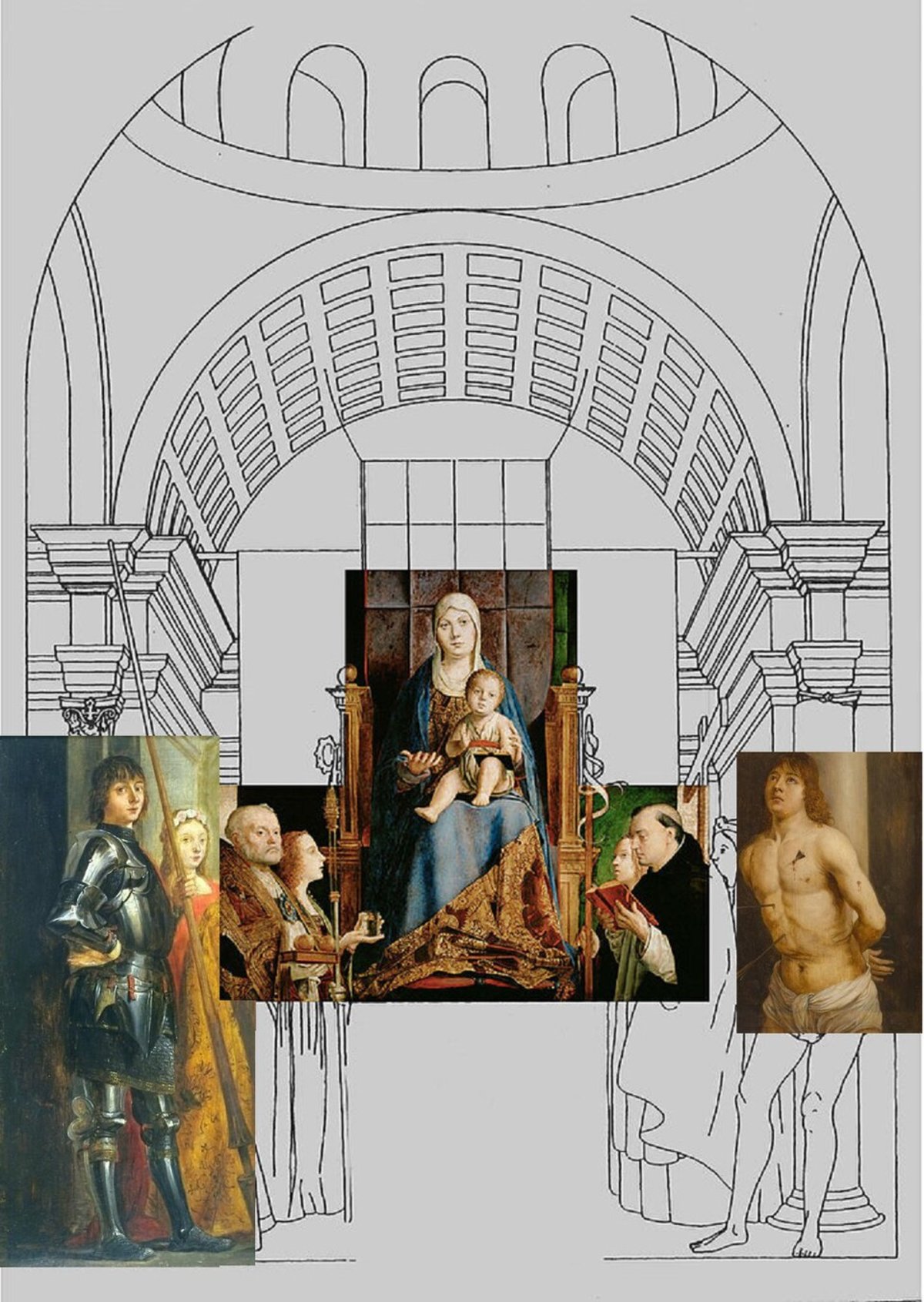
Pala di San Cassiano (fragments)
Pala di San Cassiano fragments — Antonello, c.1475-1476, Vienna
Antonello da Messina, Public domain, via Wikimedia Commons
The Pala di San Cassiano was an altarpiece commissioned by Pietro Bon for the church of San Cassiano in Venice, painted by Antonello da Messina during his crucial Venetian visit of 1475-1476 — the visit that introduced the Flemish oil technique (and the 'sacra conversazione' altarpiece format) to Venice and directly influenced Giovanni Bellini. The original altarpiece is lost; surviving fragments in the Kunsthistorisches Museum Vienna include the upper half of the Virgin enthroned and fragments of several flanking saints. From these fragments and the visual record left by its influence on Venetian altarpiece painting, the Pala di San Cassiano can be reconstructed as a revolutionary work: it introduced to Venice the unified space of the 'sacra conversazione' (the sacred conversation — saints arrayed around the enthroned Virgin in a unified architectural space, as if present together rather than in separate panels).
Antonello da Messina (c.1430-1479) was the pivotal figure in the transmission of Flemish oil painting technique to Italy. Born in Messina, Sicily, he learned the Flemish technique (through direct contact with Flemish works in Naples and possibly through direct study in the Netherlands — the exact mechanism is debated) and brought it to Venice in 1475-1476. His Venetian altarpiece for San Cassiano transformed Venetian painting: Giovanni Bellini, who was working in Venice at the same time, immediately absorbed the technique and the compositional format, and from Bellini the tradition passed to Giorgione and Titian.
The surviving fragments in Vienna — principally the upper torso and face of the Virgin with the throne above, and several saint fragments — show Antonello's mastery of the Flemish technique applied to Venetian monumental painting. The Virgin's face combines a Flemish precision of surface with a quality of contained expression that is Antonello's own contribution. The painting's influence on Bellini's San Giobbe Altarpiece (c.1487) is direct and transformative.
When standing before this work, look carefully: Pala di San Cassiano fragments — Antonello, c.1475-1476, Vienna. Give it time — what seems decorative often carries the central meaning.
When standing before this work, look carefully: Virgin fragment — Flemish technique in Venice. Give it time — what seems decorative often carries the central meaning.
When standing before this work, look carefully: Saint fragments — from the original altarpiece. Give it time — what seems decorative often carries the central meaning.
When standing before this work, look carefully: Reconstruction diagram — the original format. Give it time — what seems decorative often carries the central meaning.
Kunsthistorisches Museum, Maria-Theresien-Platz, 1010 Vienna. Open Tuesday-Sunday 10:00-18:00 (21:00 Thursdays).
Admission fee applies. The Antonello fragments are in the Italian painting galleries.