
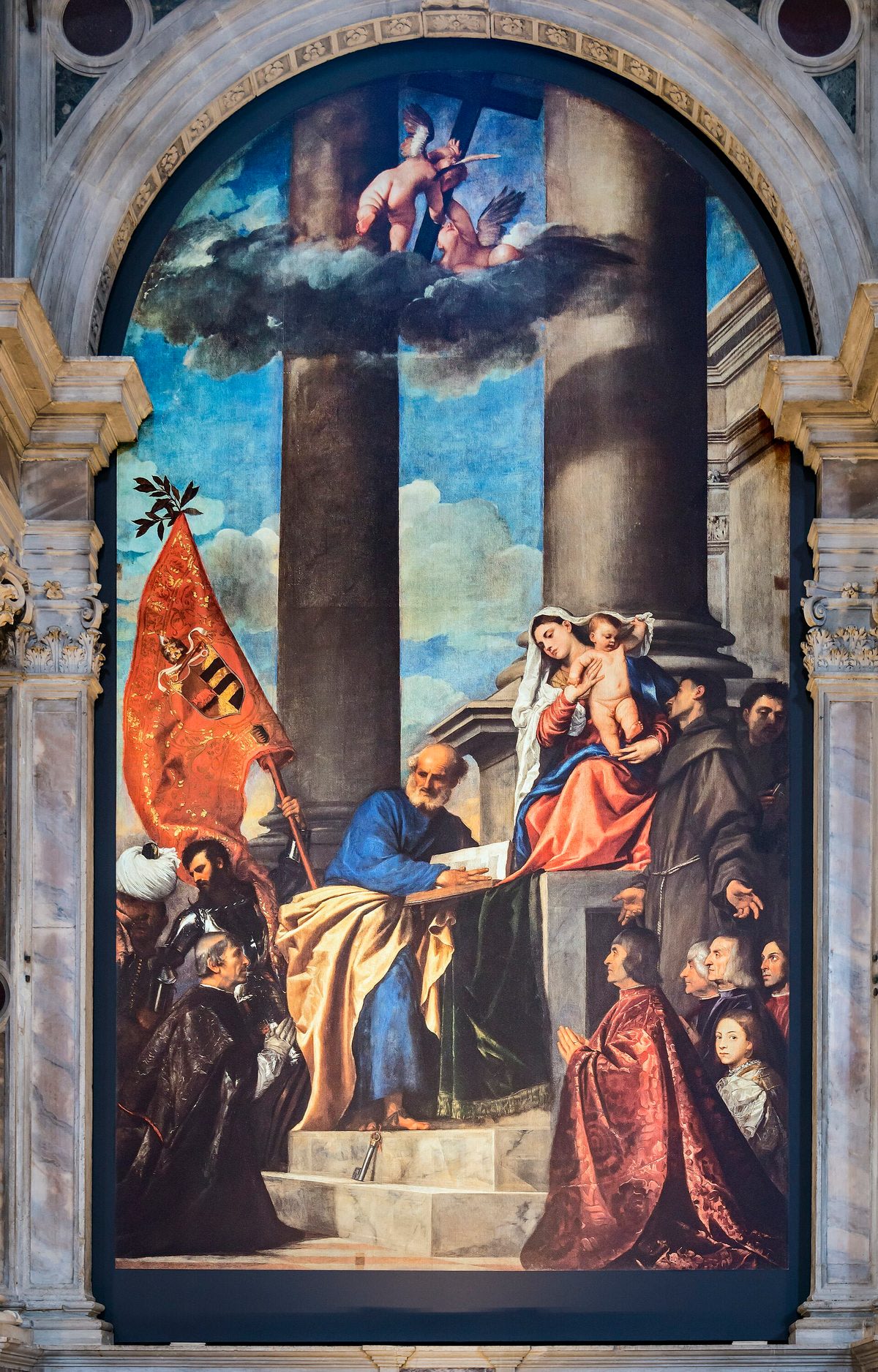
Titian, Public domain, via Wikimedia Commons
Titian's Pesaro Madonna, unveiled in the Frari in 1526, is as revolutionary as the Assunta — but in a different way. Where the Assunta took the conventional altarpiece format and exploded it with dynamism, the Pesaro Madonna took the conventional Sacra Conversazione (Virgin and saints grouped symmetrically around a central Madonna) and shattered its symmetry.
The Virgin and Child are moved dramatically to the upper right of the composition; two enormous columns rise behind, supporting clouds with angels on which putti play. Bishop Jacopo Pesaro, who commissioned the painting after his naval victory over the Turks in 1502 (as a votive thank-offering), kneels on the left with a Turkish prisoner and a soldier bearing the Pesaro and papal banners; members of the Pesaro family kneel on the right. St Peter sits on the steps between them; St Francis and St Anthony stand on either side of the Virgin.
The Pesaro Madonna's asymmetrical composition — the Virgin off-centre, the columns creating a dynamic diagonal rather than a stable horizontal — was a fundamental innovation in altarpiece design. Every major Venetian altarpiece from Veronese through Tintoretto absorbed its compositional lessons. The painting was made over seven years (Titian worked slowly and carefully on major commissions), and the quality shows: the portraits of the Pesaro family are among the finest he ever painted, the handling of the columns and the cloudy sky behind them demonstrates his mastery of atmospheric colour, and the Christ child — turning toward the viewer with a gesture that simultaneously acknowledges the donor kneeling below and blesses him — is one of the most psychologically alert child figures in Venetian painting.
The painting occupies the altar of the Pesaro Chapel (the first chapel on the left nave) in the Frari. Stand back from it and observe the asymmetry: the Virgin is at upper right; the composition's visual centre of gravity is to the left, where Bishop Jacopo kneels.
The tall columns draw the eye upward and back into depth; the space of the painting is three-dimensional and dynamic. Look at the smallest Pesaro family member (a young boy in the right group) who looks out directly at the viewer — a charming piece of portraiture and a direct address to the viewer within the altarpiece's devotional space.
When standing before this work, look carefully: Pesaro Madonna — Titian, 1519-1526. Give it time — what seems decorative often carries the central meaning.
When standing before this work, look carefully: The off-centre Virgin with the great columns. Give it time — what seems decorative often carries the central meaning.
When standing before this work, look carefully: Bishop Jacopo Pesaro kneeling — the donor. Give it time — what seems decorative often carries the central meaning.
When standing before this work, look carefully: The young Pesaro looking at the viewer. Give it time — what seems decorative often carries the central meaning.
Same church as the Assunta — Basilica dei Frari, Venice. The Pesaro Madonna is in the Pesaro Chapel on the left nave wall, about halfway down the nave.