
Pietà of Villeneuve-lès-Avignon
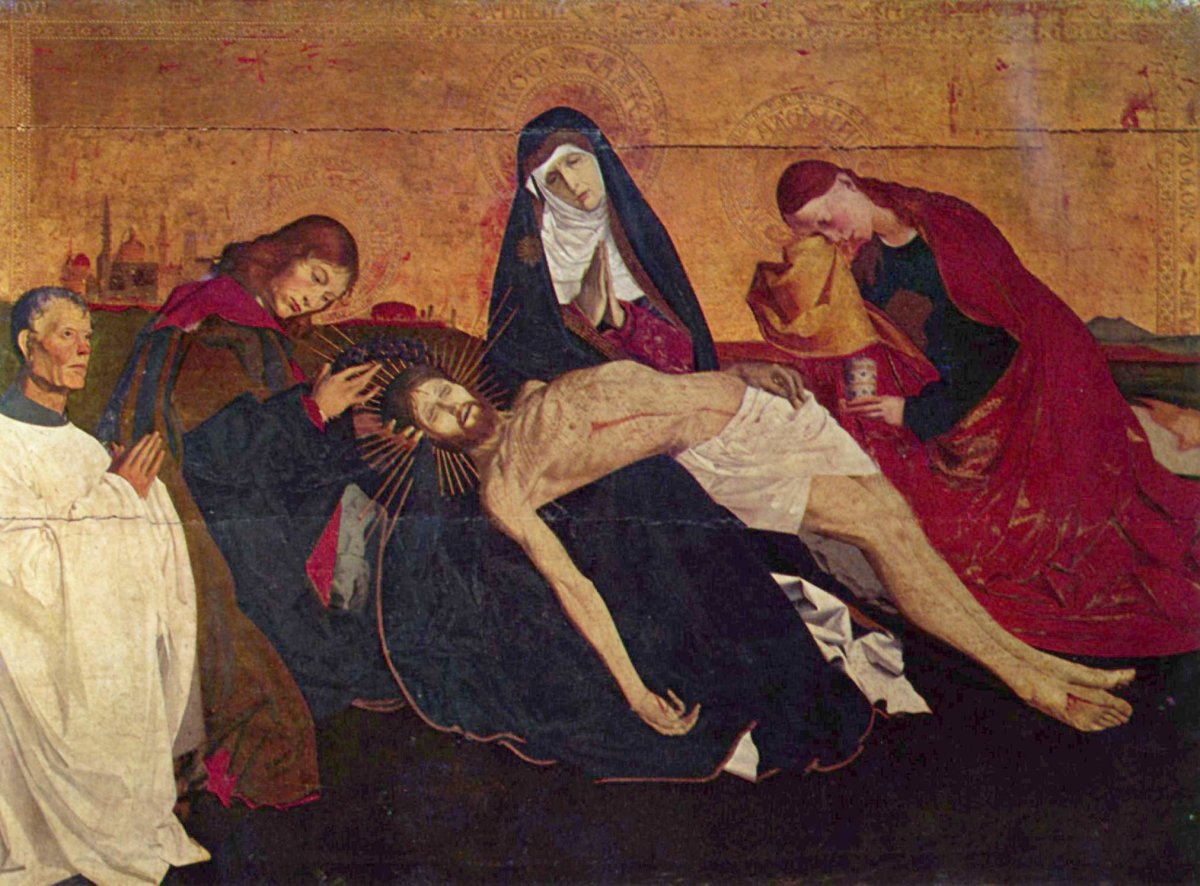
Pietà of Villeneuve-lès-Avignon — Quarton (attrib.), c.1455
Enguerrand Quarton (attrib.), Public domain, via Wikimedia Commons
The Pietà of Villeneuve-lès-Avignon is the greatest French medieval painting and one of the supreme achievements of 15th-century European art. It depicts the lamentation over Christ's body: the dead Christ is held by the Virgin in the centre, while St John supports Christ's left side and Mary Magdalene cradles the head and raises it with both hands.
At the left, a donor figure (Jehan de Montagnac, canon of Notre-Dame-de-Villeneuve) kneels in prayer; at the right, a Mary in prayer (possibly Mary of Clopas). The background is a gold field — absolute, not spatial — with the silhouette of Jerusalem visible at the upper left. The painting's power comes from the extraordinary quality of the expressions: the Virgin's face is carved in grief with an intensity of observation that places it alongside Rogier van der Weyden's work in emotional force.
The Pietà was attributed to Enguerrand Quarton in the 19th century and this attribution has been generally accepted, though not documented. Quarton was a painter from Picardy who worked in Provence in the 1440s and 1450s; a documented Coronation of the Virgin by him (Villeneuve-lès-Avignon, 1453-54) confirms his style and chronology.
The Pietà's technique and quality place it at the intersection of Flemish panel painting (the quality of faces and surfaces) and French Gothic pictorial tradition (the gold background, the simplified space). The Christ figure — white, limp, his wounds visible — is one of the most powerful representations of the dead Christ in 15th-century art, comparable to Mantegna's Lamentation (entry 59) in its physical frankness.
The gold background removes the painting from natural space and places it in devotional space: the figures are not in a garden or interior but in a sacred field. The Virgin's face at the centre is the painting's emotional core — a face of such controlled, dignified grief that it contains everything the painting has to say about the event.
Look at the arrangement of hands: the Virgin's supporting Christ's torso, St John's holding his left arm, Magdalene's raising his head — each position is specific and functional, the physical care of the dead body observed with documentary precision. The donor at the left is painted in the same scale as the holy figures — an unusual equality that suggests his spiritual proximity to the scene.
When standing before this work, look carefully: Pietà of Villeneuve-lès-Avignon — Quarton (attrib.), c.1455. Give it time — what seems decorative often carries the central meaning.
When standing before this work, look carefully: The Virgin's face — controlled dignity in grief. Give it time — what seems decorative often carries the central meaning.
When standing before this work, look carefully: Mary Magdalene raising Christ's head. Give it time — what seems decorative often carries the central meaning.
When standing before this work, look carefully: The donor at the left — equal scale with the holy figures. Give it time — what seems decorative often carries the central meaning.
Musée du Louvre, Room 5, Denon Wing. One of the highlights of the Louvre's medieval collection.