
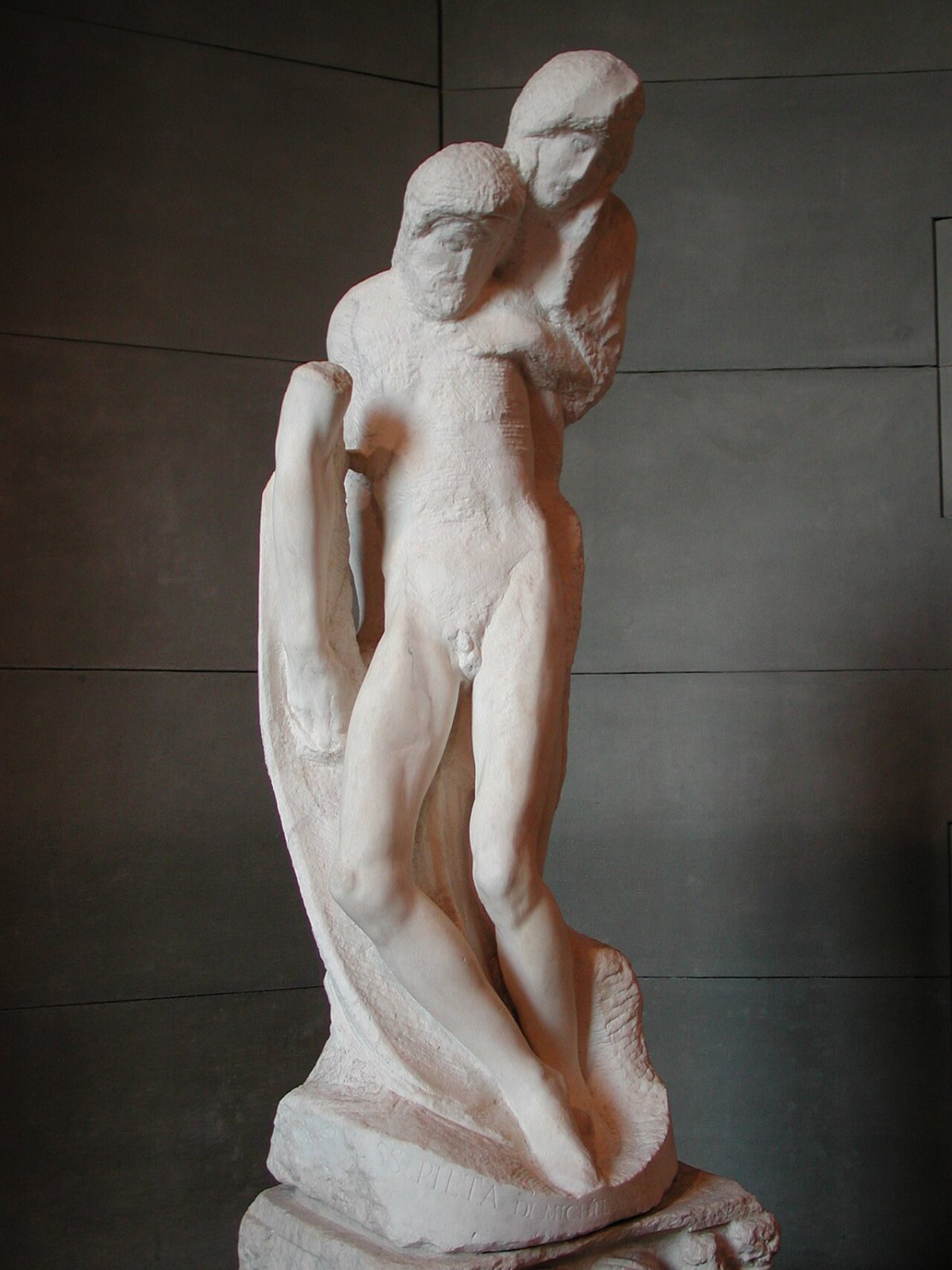
Pietà Rondanini
Pietà Rondanini — Michelangelo's final work
Michelangelo, Public domain, via Wikimedia Commons
The Pietà Rondanini is Michelangelo's final work — a block of marble he was reportedly still chiselling six days before his death in 1564, at the age of 88. The sculpture shows the Virgin supporting the body of the dead Christ, both figures standing — an unusual format for the Pietà — the Virgin almost merged with Christ in a single columnar mass.
The surface is deeply excavated: Michelangelo removed a first, more finished version of Christ's right arm (the severed arm still hangs beside the figure, polished and anatomically detailed, a fragment of an abandoned solution) and began recutting from deeper within the block, creating the spare, stripped figures we now see. The result is a meditation on dissolution: the body and the mother who holds it are being absorbed back into stone, as if sculpture were undoing itself.
Michelangelo worked on the Rondanini Pietà from approximately 1552, though he may have begun it earlier. It passed through several conceptual stages — the abandoned polished arm beside the figure is evidence of a more naturalistic, more finished version that he rejected in his late eighties in favour of an increasingly abstract and dematerialised solution.
The theological context was Michelangelo's intense old-age piety: he wrote religious poetry of great force in these final years, meditated on the Passion, and prepared for death. The Rondanini is his self-portrait as a dying man: the spare, worn figures reaching for each other across the boundary of death.
Stand close to the Rondanini and allow your eyes to adjust to its incompleteness. The two figures are barely differentiated: the Virgin's head is bowed over Christ's shoulder; their bodies are in near-complete contact, the boundary between them nearly dissolved.
The rough surface — chisel marks everywhere, no polishing, no detail — creates the impression of unfinishedness that is in fact Michelangelo's late aesthetic. The abandoned polished arm hanging beside the composition is the most moving detail: the perfect, finished, rejected solution, evidence of the sculptor refusing his own earlier answer. The feet are barely indicated; the forms emerge from and return to stone.
When standing before this work, look carefully: Pietà Rondanini — Michelangelo's final work. Give it time — what seems decorative often carries the central meaning.
When standing before this work, look carefully: The severed polished arm — the abandoned earlier solution. Give it time — what seems decorative often carries the central meaning.
When standing before this work, look carefully: The two figures — nearly dissolved into each other. Give it time — what seems decorative often carries the central meaning.
When standing before this work, look carefully: Castello Sforzesco, Milan. Give it time — what seems decorative often carries the central meaning.
Castello Sforzesco, Piazza Castello, Milan. The Pietà Rondanini is in a purpose-built room in the Rondanini Museum section of the Castello. The room is designed to allow close, intimate viewing of the sculpture — one of the most deeply personal works in the history of art.