
Pietà (Titian's last work)
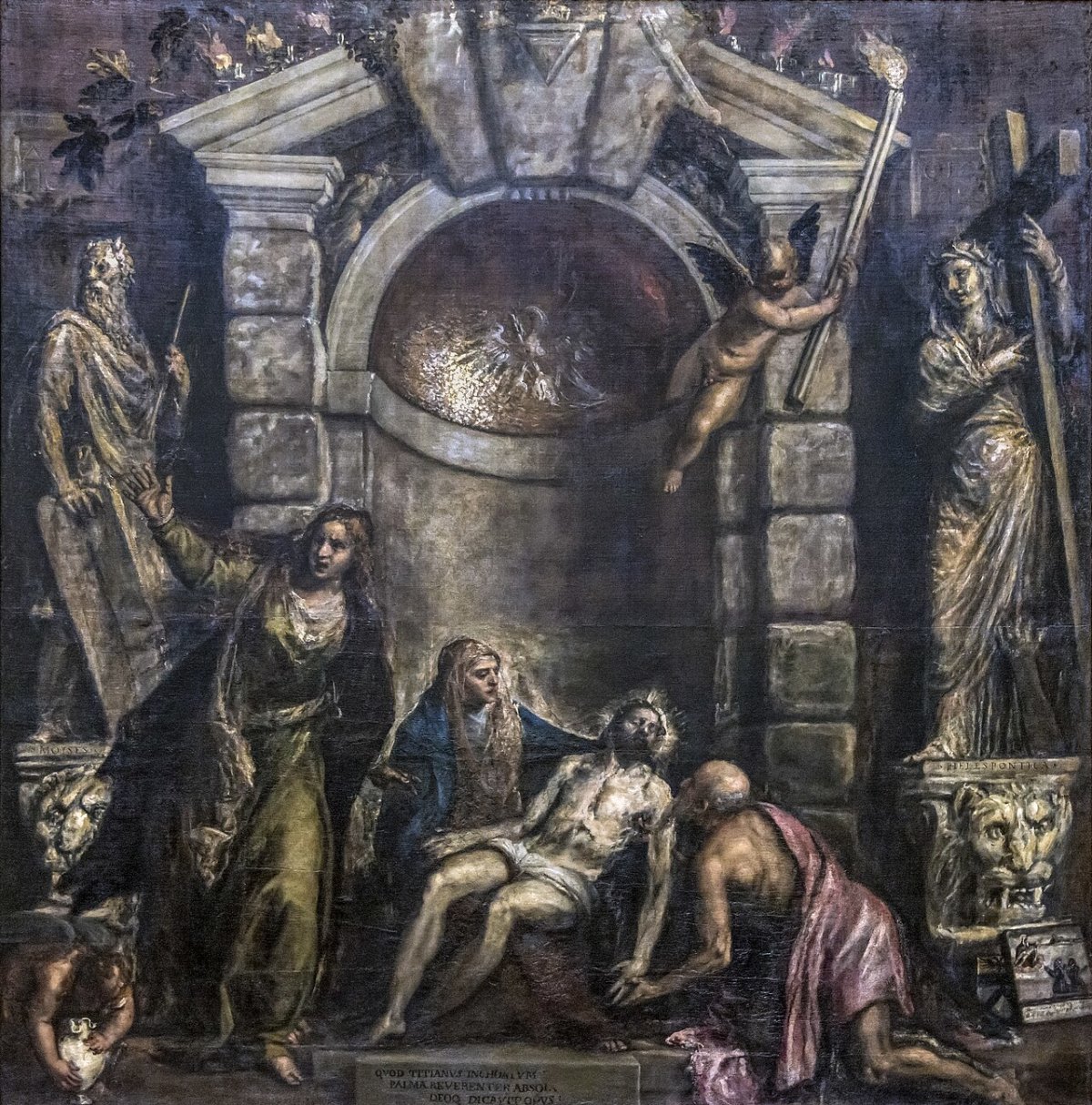
Pietà — Titian (completed by Palma il Giovane), c.1575-1576
Titian, Public domain, via Wikimedia Commons
Titian's Pietà is his last and most personal painting — left unfinished at his death in August 1576 (of the plague) and completed by Palma il Giovane, who added an inscription recording that he 'reverently completed what Titian left imperfect.' The large canvas (approximately 352 by 349 cm) was intended by Titian as his own memorial — he appears in the painting as the kneeling figure of Nicodemus supporting the dead Christ, his face pressed to the Christ's hand in a gesture of personal devotion. The composition is set in a massive rusticated apse of classical architecture, the niche surrounding the Pietà group like the entrance to a tomb.
The Magdalene rushes in from the right in a gesture of wild grief. The quality of the paint — loosely applied with both brush and fingers in Titian's extreme late style — is unlike anything else in 16th-century Italian painting: the forms dissolve into light and paint; the figures are built from flickering surfaces of color.
The Pietà was intended for the Frari church (where Titian's other major Venetian paintings are located — entry 55) and was apparently left incomplete at his death. The inscription added by Palma il Giovane is the primary biographical document for the painting's history. Titian's late style — increasingly free, loosely painted, dissolving form into atmosphere — was criticized in his own day (Boschini wrote that he finished his paintings with his fingers) and is now recognised as one of the most radical and influential late styles in the history of Western art, anticipating Rembrandt, Turner, and Monet.
The self-portrait as Nicodemus is the key biographical element: the aged Titian — he was approximately 90 years old when he painted this — depicts himself in the act of supporting the dead Christ, his face pressed to the Christ's hand. This is a prayer as much as a painting: Titian asking for the intercession of Christ for his own soul. The composition's architecture (the rusticated apse, the lion's head at the side, the ex-voto painted panel at the lower left) is a meditation on mortality and resurrection.
When standing before this work, look carefully: Pietà — Titian (completed by Palma il Giovane), c.1575-1576. Give it time — what seems decorative often carries the central meaning.
When standing before this work, look carefully: Nicodemus (Titian's self-portrait) pressing Christ's hand. Give it time — what seems decorative often carries the central meaning.
When standing before this work, look carefully: The Magdalene rushing in — wild grief. Give it time — what seems decorative often carries the central meaning.
When standing before this work, look carefully: The late style — forms dissolving into light and paint. Give it time — what seems decorative often carries the central meaning.
Gallerie dell'Accademia, Venice. See entry 240 for visiting details.