
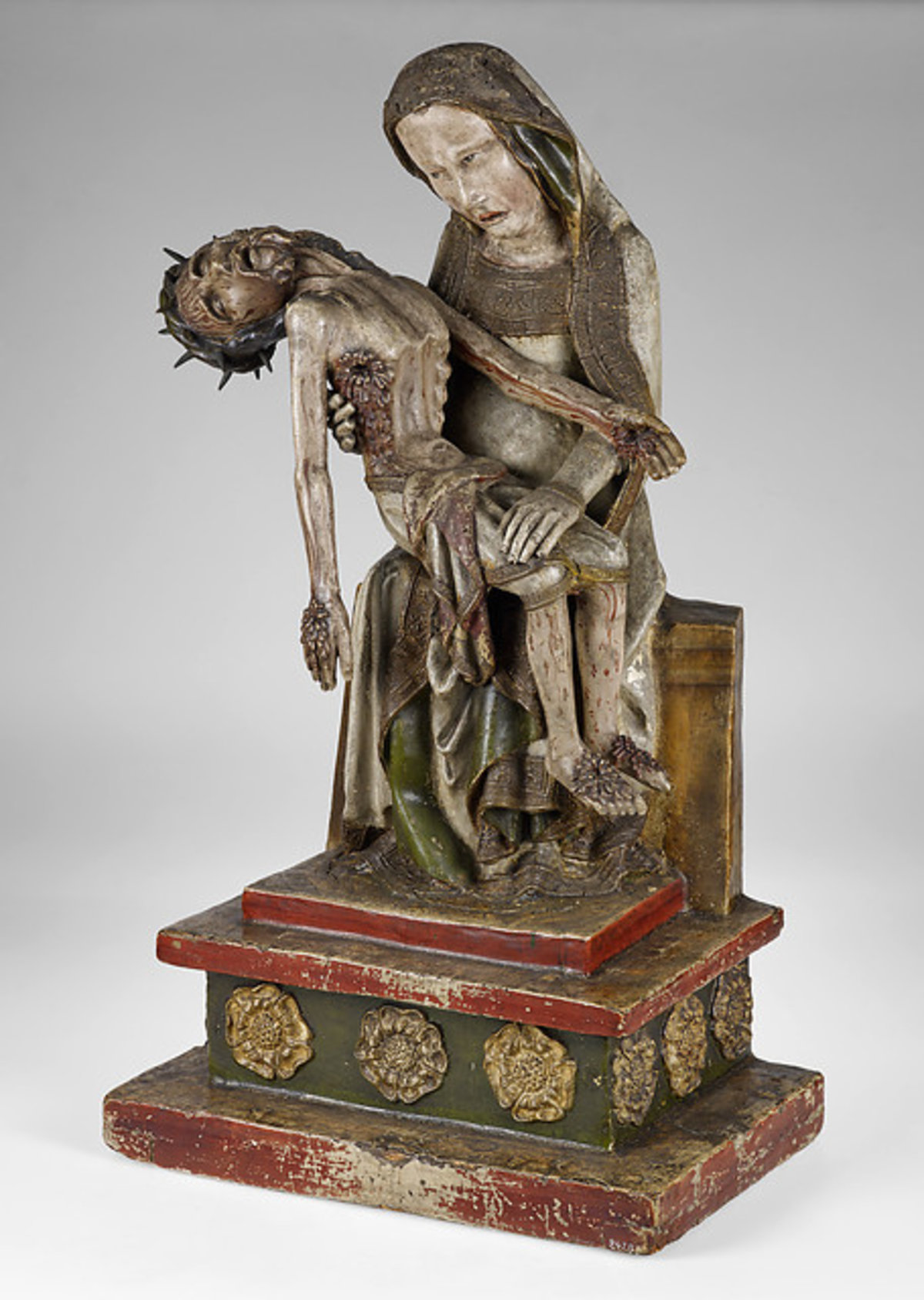
Pietà / Vesperbild (German Gothic)
Röttgen Pietà — Rhenish master, c.1300, Bonn
Public domain, via Wikimedia Commons
The German Gothic Pietà — called Vesperbild ('vesper image') in German — is a devotional sculpture type that first appeared in the Rhineland around 1300 and spread rapidly across German-speaking lands in the 14th century. It shows the Virgin seated, holding the dead body of Christ across her lap after the Deposition and before the Entombment — the moment of the mother holding her dead son.
Unlike Italian Pietàs (which would culminate in Michelangelo's marble of c.1499), German Gothic Vesperbilder are characterised by an extreme stylisation of grief: the bodies are elongated and stiffened (Christ's body is often too large for the Virgin's lap, creating a visual disjunction), the wounds are displayed with graphic specificity, and the Virgin's expression is one of controlled, formal grief rather than naturalistic weeping. The type served as a focus for affective meditation — the devotee was invited to share the Virgin's grief.
German Gothic Vesperbilder survive in large numbers across Germany, Austria, and Switzerland, in churches, regional museums, and national collections. Notable examples include the Röttgen Pietà (Rheinisches Landesmuseum Bonn, c.1300, see entry 270), the Seeon Pietà (Bayerisches Nationalmuseum, Munich, c.1400), and the Dangolsheim Pietà (Musée de l'Oeuvre Notre-Dame, Strasbourg). The type had a profound influence on German spirituality through the Devotio Moderna movement and the tradition of affective contemplation promoted by Thomas à Kempis and the Brethren of the Common Life.
When encountering a German Gothic Vesperbild, notice the deliberate formal exaggerations: Christ's body may be disproportionately large; the wounds may be shown with shocking specificity; the Virgin's expression may be mask-like in its formal grief. These are not failures of naturalism but a programme: the image is not intended to represent how such a scene would look but to communicate what it means — the full weight of the grief of the Mother of God and the full cost of human redemption.
When standing before this work, look carefully: Röttgen Pietà — Rhenish master, c.1300, Bonn. Give it time — what seems decorative often carries the central meaning.
When standing before this work, look carefully: Graphic wounds — affective devotion. Give it time — what seems decorative often carries the central meaning.
When standing before this work, look carefully: Virgin's formal grief — controlled expression. Give it time — what seems decorative often carries the central meaning.
When standing before this work, look carefully: German Gothic Vesperbild — typical example. Give it time — what seems decorative often carries the central meaning.
German Gothic Vesperbilder are in churches and museums throughout Germany, Austria, and Switzerland. The Rheinisches Landesmuseum Bonn (Colmantstraße 14-16, 53115 Bonn) has the most important example (the Röttgen Pietà). The Bayerisches Nationalmuseum, Munich holds fine examples from the Bavarian tradition.