
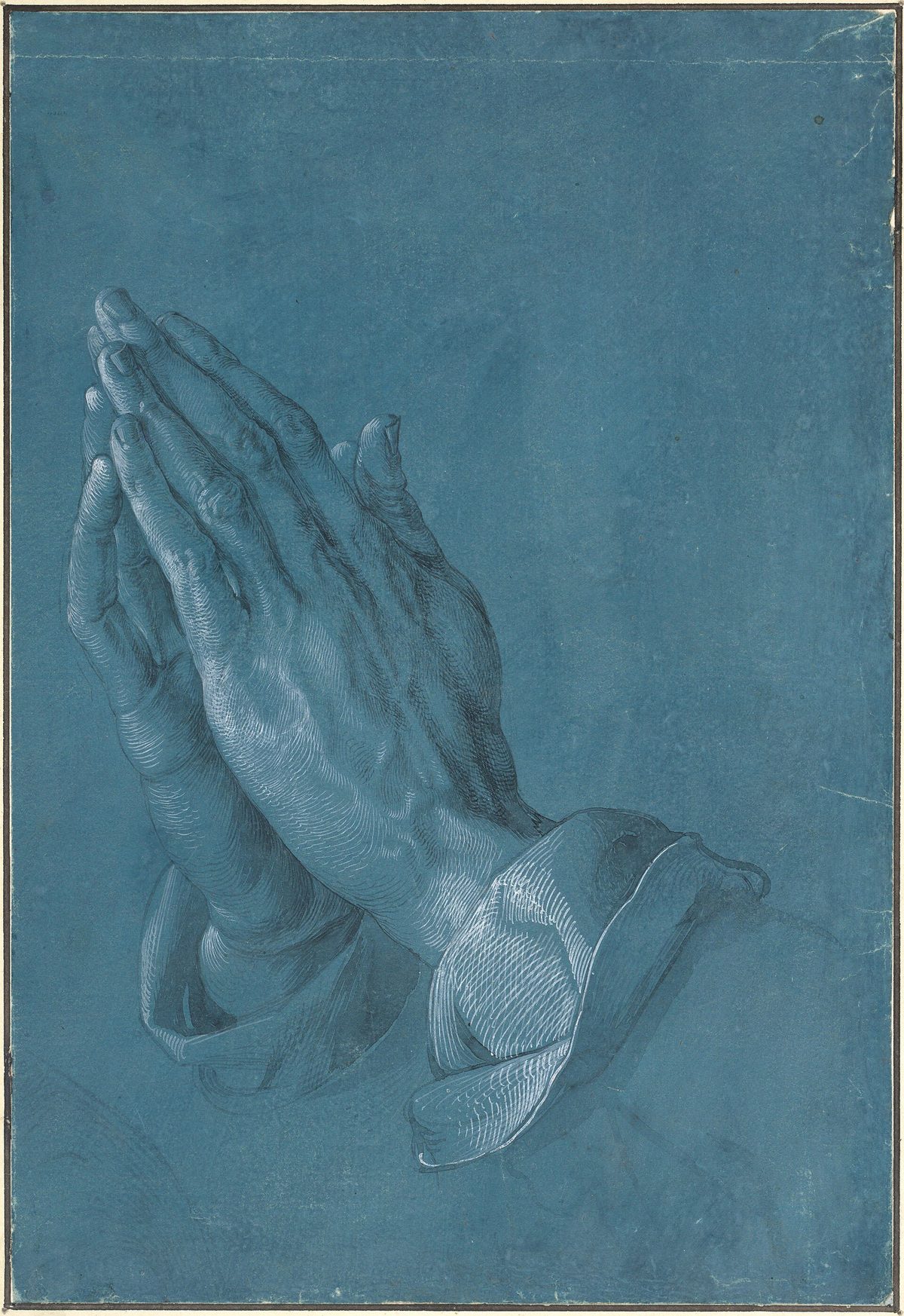
Praying Hands (Study of Hands)
Praying Hands — Dürer, 1508
Albrecht Dürer, Public domain, via Wikimedia Commons
Dürer's Praying Hands is the most reproduced devotional image in Christian art after Michelangelo's Sistine Chapel ceiling — a brush drawing (29.1 by 19.7 cm) executed in 1508 as a study for the Heller Altarpiece (now lost), showing a pair of hands in the attitude of prayer. The hands belong to an apostle (probably the apostle in the foreground of the central panel of the Heller Altarpiece); they are depicted from the outside of the right hand, the fingers pressed together, the wrists crossed at the base, the thumbs touching.
The quality of the rendering — individual skin folds, the veins on the back of the hand, the precise rendering of each knuckle — is extraordinary even by Dürer's standards. The drawing became one of the most influential images in the history of Christian art because its combination of technical virtuosity and devotional subject matter made it ideal for reproduction and domestic devotional use.
The Heller Altarpiece for which this drawing was a study was commissioned by Jakob Heller of Frankfurt and completed in 1509; the central panel (Dürer's most ambitious painting) was purchased by Maximilian I of Bavaria in 1615 and destroyed in a fire in 1729. Only Dürer's preparatory drawings survive.
The Praying Hands drawing was part of the preparatory material and entered the collection of Willibald Pirckheimer (Dürer's close friend) and eventually the Albertina in Vienna. The image was not widely reproduced until the 19th century, when technological reproduction made it one of the most recognisable images in Western popular Christianity.
The drawing is monochromatic in execution — blue ink on blue paper, with white highlights — but the tonal range achieved within this limitation is extraordinary. The hands are lit from the left: the lit surfaces (the outer edge of the right hand, the fingertips) are heightened with white; the shadows (the inner surfaces of the fingers, the spaces between them) are the bare blue paper. The crossed wrists at the base of the composition and the clasped thumbs at the top give the composition its characteristic silhouette — immediately recognisable because the outline has been reproduced billions of times.
When standing before this work, look carefully: Praying Hands — Dürer, 1508. Give it time — what seems decorative often carries the central meaning.
When standing before this work, look carefully: Knuckle detail — individual skin folds and veins. Give it time — what seems decorative often carries the central meaning.
When standing before this work, look carefully: Full drawing — blue ink on blue paper. Give it time — what seems decorative often carries the central meaning.
When standing before this work, look carefully: The Albertina Museum, Vienna. Give it time — what seems decorative often carries the central meaning.
Albertina Museum, Albertinaplatz 1, Vienna. The Praying Hands is one of the Albertina's most famous drawings; it is on display in the permanent collection but the display room may change.
Confirm location before visiting. Admission fee.