
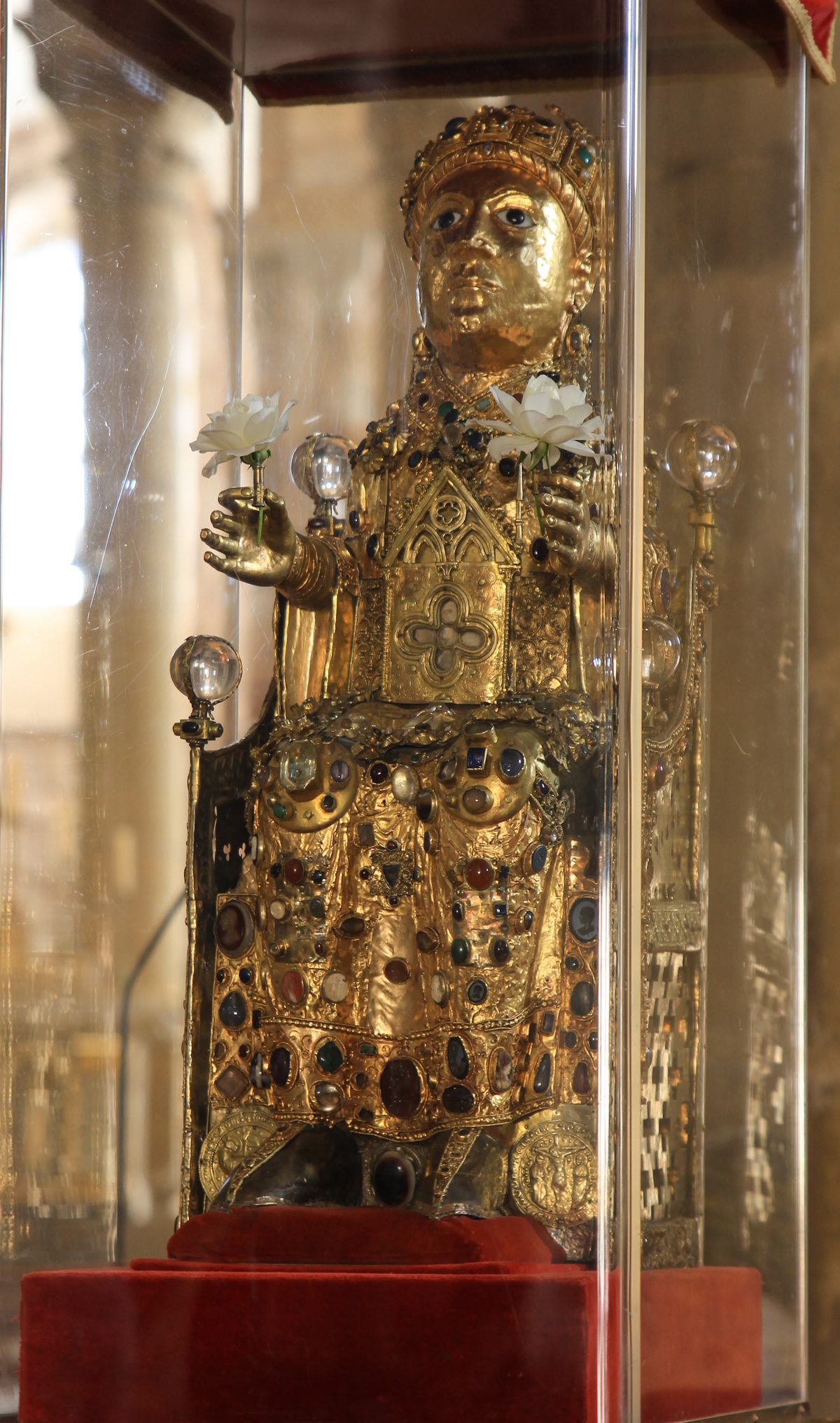
Reliquary of Sainte-Foy
Reliquary of Sainte-Foy — the golden statue
Public domain, via Wikimedia Commons
The Reliquary Statue of Sainte-Foy (Saint Faith) in the treasury of the Abbey of Conques is the oldest surviving reliquary statue in the Western world — a seated figure approximately 85 cm tall, covered in gold sheet, encrusted with approximately 640 gems, ancient cameos, intaglios, and enamel plaques, constructed around a 5th-century Roman imperial head. The figure sits on a throne, wearing a crown of gems, holding a small reliquary chest (the grail, containing her relics) in one hand.
The combination of ancient Roman imperial iconography (the head and seated authority-figure posture) with medieval goldwork decoration creates a figure of extraordinary hieratic power — simultaneously a Roman empress, a medieval idol, and a sacred relic container. Medieval pilgrims reported miraculous cures at the statue; contemporary writers documented that the statue was treated with a veneration normally reserved for living beings.
Sainte Foy (St Faith) was a 3rd or 4th-century child martyr from Agen, whose relics were stolen by the monks of Conques in 866 and brought to the abbey. The cult of Sainte-Foy at Conques became one of the most important in southern France, and the abbey (on the Via Podiensis, one of the four Santiago caminos) was a major pilgrimage destination. The statue was made over several centuries: the core is a late Roman imperial throne figure, probably adapted in the 9th-10th century for its reliquary function.
Subsequent abbots and pilgrims added gems, cameos (including Roman, Carolingian, and Byzantine examples), and enamel plaques. The crown, originally simpler, was elaborated in the 11th-12th centuries. The statue's eclectic surface — ancient cameos alongside Carolingian enamel alongside medieval gems — is a stratigraphic record of six centuries of devotion.
The statue should be viewed from close range in the treasury (guided viewing is possible). The face is the most studied element: the 5th-century Roman bronze head (reused) gives the figure an authority that is not conventionally medieval — the large eyes, the rigid frontal gaze, the quality of imperial presence are pre-medieval in character.
The combination of this face with the jewelled crown, the encrusted torso, and the ancient cameos creates a figure of absolute visual authority. The throne on which it sits is also elaborately decorated. The treasury at Conques is one of the finest collections of Romanesque and early medieval art in France.
When standing before this work, look carefully: Reliquary of Sainte-Foy — the golden statue. Give it time — what seems decorative often carries the central meaning.
When standing before this work, look carefully: The face — a 5th-century Roman head. Give it time — what seems decorative often carries the central meaning.
When standing before this work, look carefully: The gem and cameo encrustation. Give it time — what seems decorative often carries the central meaning.
When standing before this work, look carefully: The Abbey Church of Sainte-Foy, Conques. Give it time — what seems decorative often carries the central meaning.
Abbey of Sainte-Foy, Conques, Aveyron. The village of Conques is in the Aveyron département, approximately 60 km north of Rodez. The abbey church (also with an important Romanesque tympanum depicting the Last Judgment) and the treasury are open to visitors year-round.