
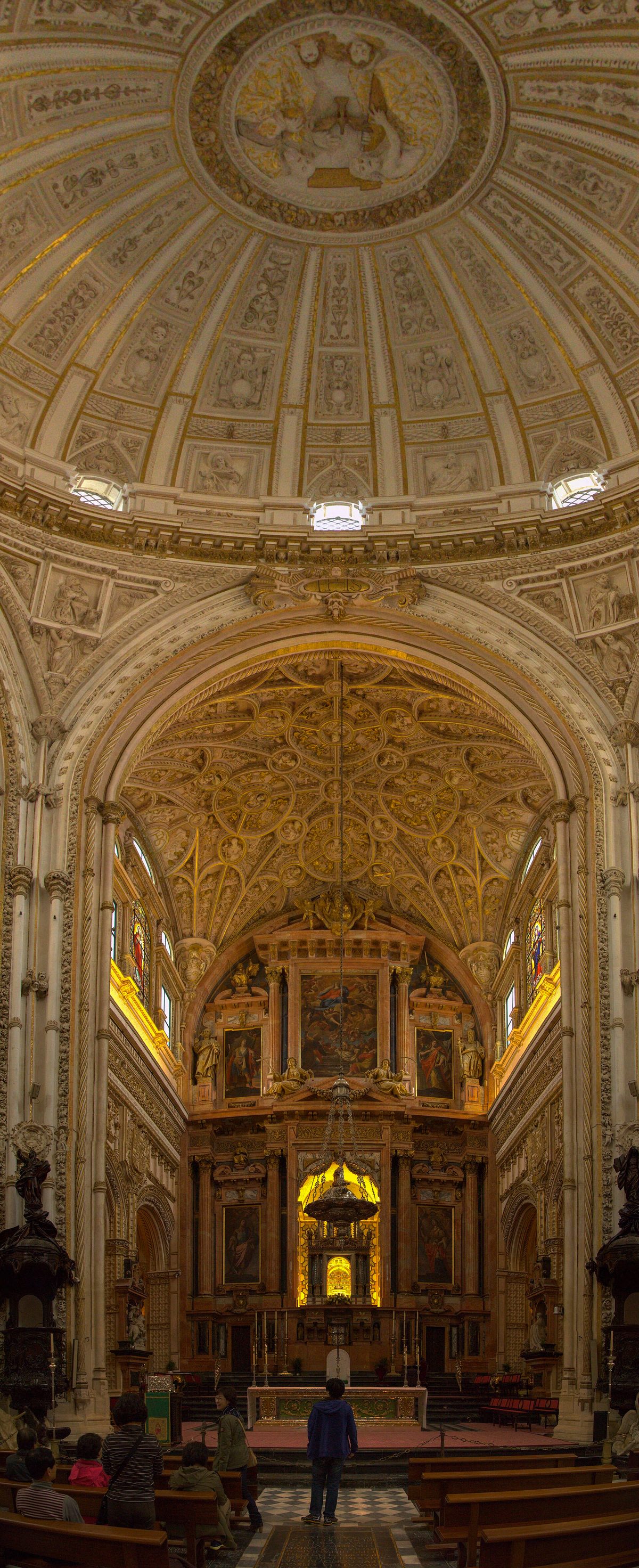
Retablo Mayor (High Altarpiece)
Retablo Mayor — Seville Cathedral
Public domain, via Wikimedia Commons
The Retablo Mayor of Seville Cathedral is the largest altarpiece in the world — a gilded wood structure approximately 20 metres tall and 18 metres wide, filling the entire apse of the cathedral's main chapel. It was begun in 1481 by the Flemish sculptor Pierre Dancart and continued over forty years by Spanish and Flemish masters; it contains forty-four scenes from the lives of Christ and the Virgin arranged in seven vertical registers and five horizontal rows, with thousands of small carved figures, gilded architectural elements, and painted panels. The overall effect is of an encyclopaedic visual theology in three dimensions — a golden mountain of sacred narrative that fills the viewer's entire field of vision and compels a physical response to its sheer scale and density.
The commission followed immediately from the cathedral chapter's decision to build 'a church so large that those who see it finished will think we were mad.' Seville Cathedral was indeed built to be the largest Gothic cathedral in the world (by volume, it remains so), and the Retablo Mayor was scaled to match. Dancart's original design established the Gothic architectural framework — the pinnacled canopies, the architectural niches, the overall proportioning system.
Spanish and Flemish workshops filled this framework with carved and painted scenes over four decades. The central panel — the Virgin of the Kings (Virgen de los Reyes), a polychrome wooden sculpture of the Virgin given to Ferdinand III of Castile by Louis IX of France in 1248 — is the devotional heart of the entire structure.
Standing before the Retablo Mayor is one of the most overwhelming visual experiences in Spain. The golden light reflects from the gilded wood surfaces and fills the main chapel with a warm, low radiance.
The scale of the individual carved figures (approximately 30-40 cm tall) is readable from close proximity: the narrative scenes are individually legible, with specific facial expressions and spatial settings, despite being embedded in a structure of cathedral scale. Look for the central panel — the Virgen de los Reyes — which occupies the central niche at approximately eye level. The flanking scenes of the Nativity, Epiphany, Crucifixion, and Resurrection are among the finest Gothic carved narrative reliefs in Spain.
When standing before this work, look carefully: Retablo Mayor — Seville Cathedral. Give it time — what seems decorative often carries the central meaning.
When standing before this work, look carefully: The Virgen de los Reyes — central panel. Give it time — what seems decorative often carries the central meaning.
When standing before this work, look carefully: Gilded carved detail — scenes from the life of Christ. Give it time — what seems decorative often carries the central meaning.
When standing before this work, look carefully: Seville Cathedral interior — the largest Gothic cathedral by volume. Give it time — what seems decorative often carries the central meaning.
Seville Cathedral, Avenida de la Constitución, Seville. Open Monday to Saturday.
The Retablo Mayor is visible from the nave through the choir screen; closer inspection requires entering the Capilla Mayor (included in the general admission ticket). The cathedral is also the burial site of Christopher Columbus.