
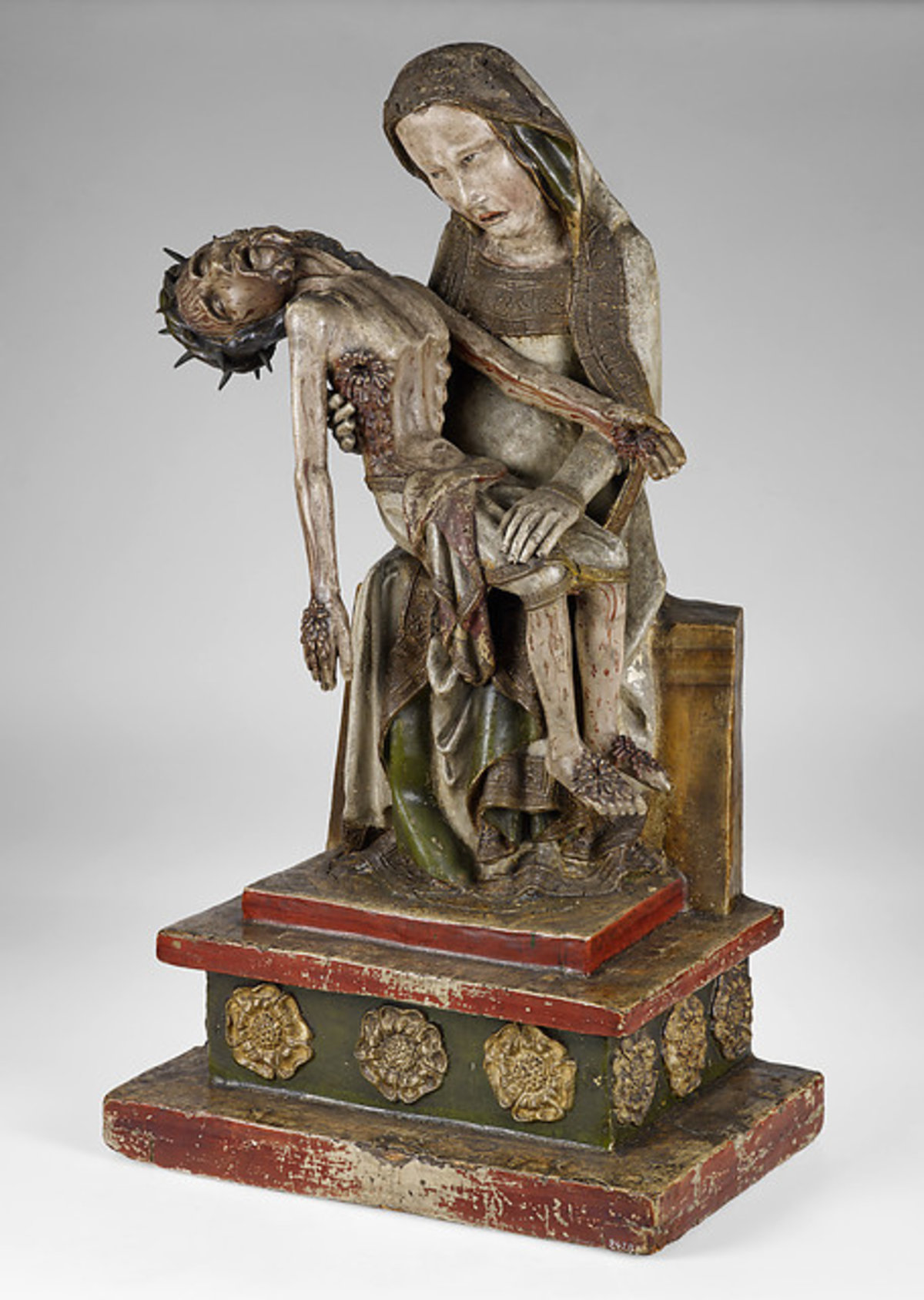
Röttgen Pietà
Röttgen Pietà — c.1300-1325, Rheinisches Landesmuseum Bonn
Public domain, via Wikimedia Commons
The Röttgen Pietà (named for the Röttgen estate near Bonn where it was found) is the earliest and most extreme surviving example of the German Gothic Vesperbild type. Carved in wood and originally painted, the sculpture shows the Virgin holding the dead Christ — but in this version the disproportion and graphic specificity of suffering are more extreme than in any comparable work.
Christ's body is rigid and over-large; his wounds (at the hands, feet, and side) are rendered as open sores of disturbing specificity, and his face carries an expression of post-mortem agony. The Virgin's face is small, mask-like in its grief, almost entirely concealed by her headdress. The Röttgen Pietà is the foundational document of German Gothic affective religious art and a direct predecessor of the Grünewald Crucifixion tradition.
The Röttgen Pietà dates from c.1300-1325, making it one of the earliest surviving Vesperbilder. Its extreme emotional register — the graphic wounds, the disproportion, the rigid Christ — places it at the beginning of a tradition of German devotional art that would run through the fourteenth and fifteenth centuries and reach its climax in Grünewald's Isenheim Altarpiece.
The image was made for private devotional use, probably in a monastic context. It entered the Rheinisches Landesmuseum Bonn from the Röttgen estate collection in the 19th century.
The Röttgen Pietà requires a willingness to look at a deliberately difficult image. The graphic specificity of Christ's wounds is not sadism but theology: the wounds are the evidence of a real Incarnation and a real death.
The disproportion — Christ's body is too large and too rigid for the Virgin's small lap — is not a failure of craft but an expression of the weight of grief. The Virgin's mask-like face is not expressionlessness but the formal representation of grief beyond naturalistic expression.
When standing before this work, look carefully: Röttgen Pietà — c.1300-1325, Rheinisches Landesmuseum Bonn. Give it time — what seems decorative often carries the central meaning.
When standing before this work, look carefully: Graphic wounds — theological specificity. Give it time — what seems decorative often carries the central meaning.
When standing before this work, look carefully: Virgin's face — formal mask of grief. Give it time — what seems decorative often carries the central meaning.
When standing before this work, look carefully: Full sculpture — disproportion and rigid Christ. Give it time — what seems decorative often carries the central meaning.
Rheinisches Landesmuseum Bonn, Colmantstraße 14-16, 53115 Bonn, Germany. Open Tuesday-Sunday 10:00-18:00. Admission fee applies.