
Sacred and Profane Love
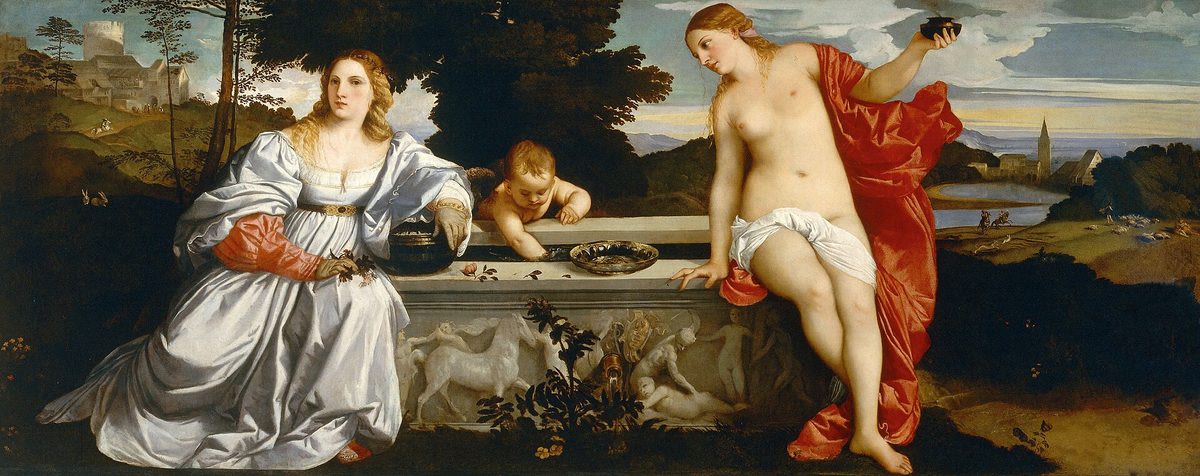
Sacred and Profane Love — Titian, c.1514
Titian, Public domain, via Wikimedia Commons
Titian's Sacred and Profane Love is among the most enigmatic paintings in the history of art — and its title, which dates only from 1693, may be entirely wrong. It depicts two women, one clothed and one nearly nude, seated on either side of a stone cistern in which a cupid stirs the water; behind them a landscape of hunting and a tower at sunset.
The painting was made for the wedding of Niccolò Aurelio and Laura Bagarotto in 1514 — their coats of arms appear on the cistern — and was likely an allegorical programme relating to Neoplatonic ideas of earthly versus heavenly beauty, or to the union of Venus with the bride. But what each figure represents, and which is 'sacred' and which 'profane,' remains disputed.
Titian (c.1488/90–1576) was in his mid-twenties when he painted Sacred and Profane Love and already demonstrating the qualities that would make him the dominant painter of Venice for sixty years: the radiant quality of the landscape light, the warmth and tactile precision of the flesh, the compositional intelligence. The painting's programme may derive from a passage in the Hypnerotomachia Poliphili (1499), a Venetian Neoplatonic dream allegory, in which the hero encounters two versions of Venus. The clothed figure corresponds to Venus Vulgaris (earthly love) and the nude to Venus Coelestis (celestial love) — a reversal of conventional associations between clothing and modesty.
The landscape behind the two figures is a Venetian pastoral — gentle hills, a lake, figures hunting, a castle tower. The late-afternoon light gives the whole scene a warm golden quality.
The clothed woman holds roses and wears a white dress with gold details; the nude holds a lamp or urn. The cupid between them stirring the cistern water may symbolise the intermingling of earthly and celestial love, or the transformation of erotic desire into spiritual ascent. Look at the quality of the silk of the clothed woman's sleeve — one of the most virtuosic passages of fabric painting in the Renaissance.
When standing before this work, look carefully: Sacred and Profane Love — Titian, c.1514. Give it time — what seems decorative often carries the central meaning.
When standing before this work, look carefully: The clothed figure — earthly or heavenly?. Give it time — what seems decorative often carries the central meaning.
When standing before this work, look carefully: The pastoral landscape at sunset. Give it time — what seems decorative often carries the central meaning.
When standing before this work, look carefully: The Villa Borghese — exterior. Give it time — what seems decorative often carries the central meaning.
Galleria Borghese, Piazza Scipione Borghese 5, Rome. Visits must be booked in advance; the museum operates a timed-entry system with a maximum of 360 visitors at a time in two-hour slots. The painting is in Room 20.