
Sacrifice of Isaac / Zuccone (Prophets)
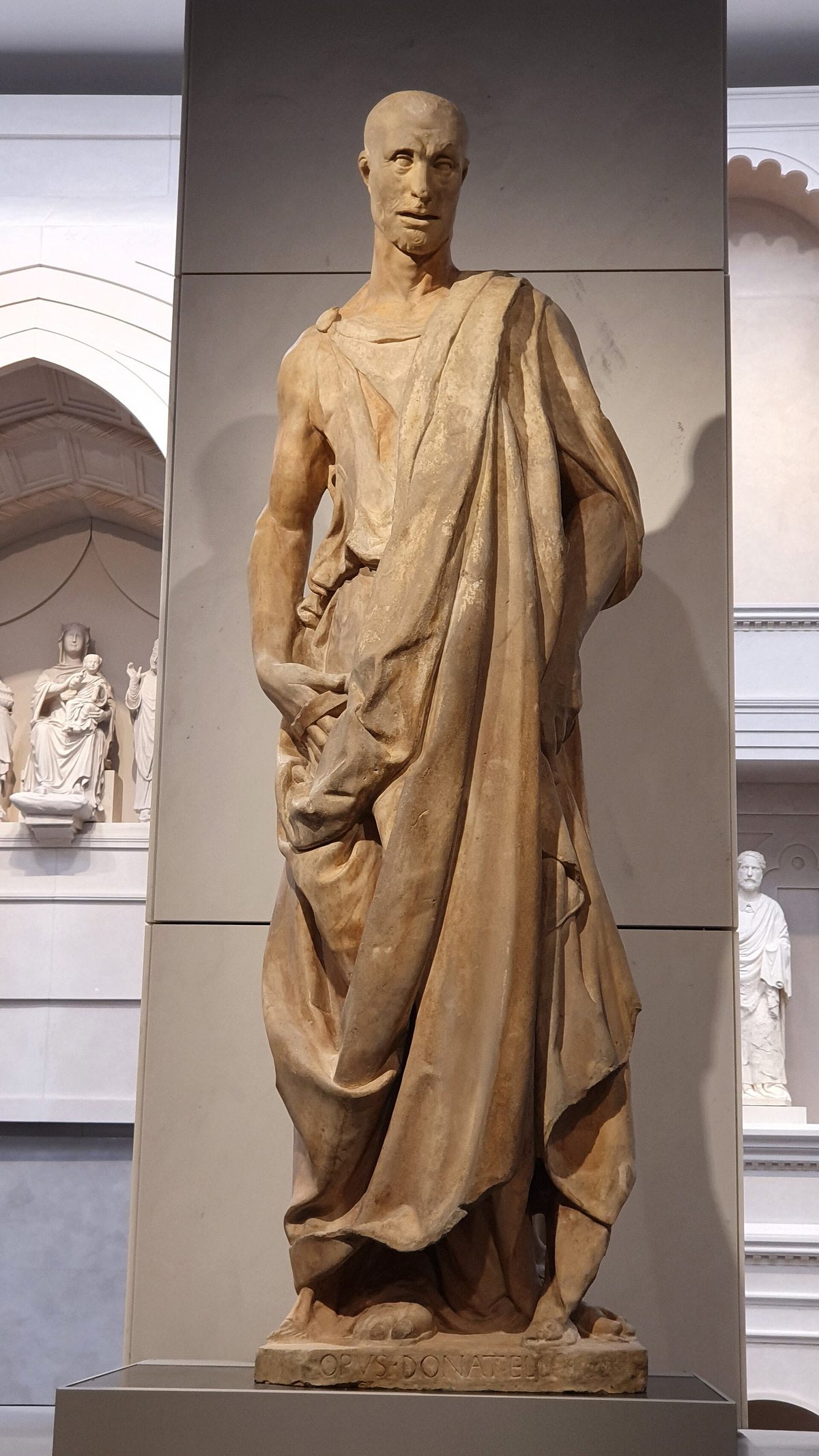
Zuccone (Habakkuk) — Donatello, c.1423-1425, Museo dell'Opera
Donatello, Public domain, via Wikimedia Commons
Donatello's contributions to the sculptural programme of Florence Cathedral's Campanile (bell tower) include the marble statue known as the 'Zuccone' (Baldpate, c.1423-1425) — a figure of a prophet with a shaved or bald head, whose expression of intense psychological concentration is the most powerful single figure in 15th-century Italian sculpture. The Zuccone (sometimes identified as Habakkuk) was one of four prophet figures Donatello carved for the Campanile niches.
Vasari records that Donatello was so pleased with the figure that he would address it during carving: 'Speak! Why won't you speak!' The Abraham and Isaac group (1421, also for the Campanile) shows Abraham about to sacrifice Isaac — a bronze group of fierce psychological intensity. Both are now in the Museo dell'Opera del Duomo.
Donatello (1386-1466) is the greatest sculptor of the Italian Renaissance before Michelangelo — the artist who established the vocabulary of Renaissance figure sculpture: contrapposto stance, psychological individualism, expressive intensity. His work for the Cathedral and Campanile of Florence (1410s-1430s) was the laboratory in which this vocabulary was established. The Zuccone's expressive head — with its deep-set eyes, contracted brow, and open mouth in an attitude of prophetic speech — is Donatello's most radical break with the classical ideal of serene beauty: this figure is not beautiful but is overwhelmingly psychologically present.
The Zuccone is best experienced as a contrast with its predecessors and contemporaries: compared with the classical serenity of Nanni di Banco's prophets or Luca della Robbia's choir boys, the Zuccone's intensity is almost violent. Donatello seems to be asking what psychological truth looks like in marble, and the answer is not calm beauty but internal fire. The figure anticipates Michelangelo's Moses by a full century.
When standing before this work, look carefully: Zuccone (Habakkuk) — Donatello, c.1423-1425, Museo dell'Opera. Give it time — what seems decorative often carries the central meaning.
When standing before this work, look carefully: The Zuccone's face — prophetic intensity. Give it time — what seems decorative often carries the central meaning.
When standing before this work, look carefully: Abraham and Isaac group — fierce psychological intensity. Give it time — what seems decorative often carries the central meaning.
When standing before this work, look carefully: Campanile prophet figures — Museo dell'Opera installation. Give it time — what seems decorative often carries the central meaning.
Museo dell'Opera del Duomo, Piazza del Duomo 9, Florence. Open Monday-Saturday 9:00-19:00, Sunday 9:00-13:45.
Admission fee applies. The Zuccone and other Campanile prophets are displayed in the museum's main sculpture room.