
Francisco de Zurbarán, Public domain, via Wikimedia Commons
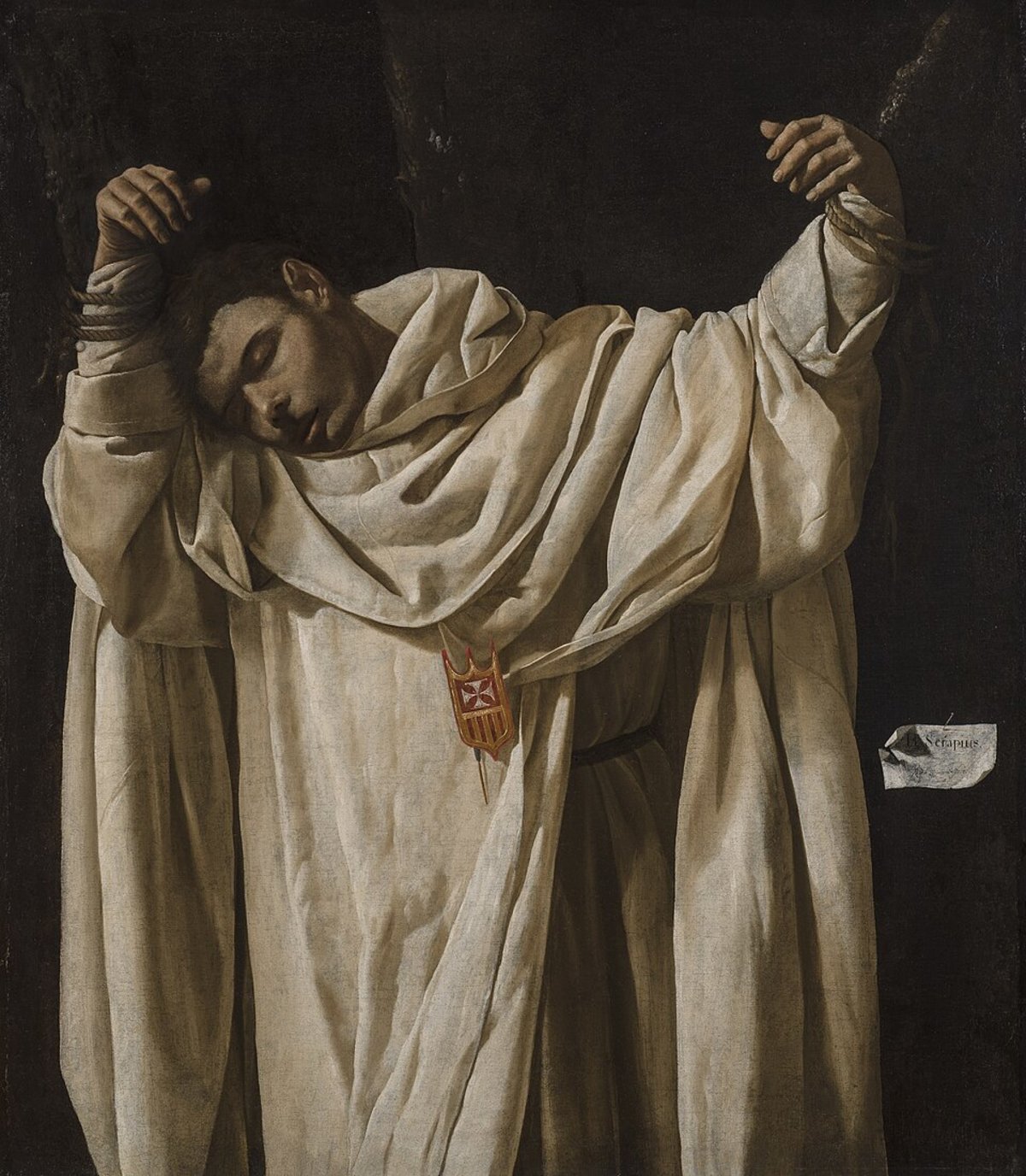
Zurbarán's Saint Serapion is the most powerful and disturbing of his religious paintings — a large canvas (approximately 120 by 103 cm) showing the Mercedarian friar St Serapion (d.1240) who was martyred by pirates while volunteering to be a hostage for the release of Christian captives. He is shown hanging by his bound wrists from two ropes, his white habit splattered with blood, his head slumped forward, his face (the only part visible above the collar) turned toward the viewer with an expression that is simultaneously dead and attentive.
The image is relentless in its focus: no background, no angel, no symbol of triumph or resurrection — only the white of the habit against a dark ground and the specific form of the suffering body. The painting was made for the mortuary chapel of the Mercedarian convent in Seville — it would have been seen in the context of the veneration of the convent's own martyred members.
Francisco de Zurbarán (1598-1664) was the most distinctive religious painter of 17th-century Spain — his work characterised by an austere palette (black, white, grey, and occasional deep colour), a sculptural quality in his rendering of fabric (the Mercedarian white habits and Dominican black-and-white habits that fill his paintings have the quality of carved stone), and a devotional intensity that reflects the reformed religious orders of Counter-Reformation Spain. He worked primarily for monasteries and convents in Seville and Extremadura, making devotional images for specific liturgical contexts.
The painting is best described by what it lacks: there is no architectural setting, no symbolic object, no Baroque theatrical gesture, no crowd of witnesses. There is only the hanging figure, the white habit, the bound wrists, and the face turned toward the viewer.
The dark ground behind Serapion is not a room or a setting but an absence — the void into which he has entered. The two parchment labels (bearing words illegible in most reproductions but reading 'SERAPION' and dates related to his martyrdom) attached to his habit are the only identifying elements.
When standing before this work, look carefully: Saint Serapion — Zurbarán, 1628. Give it time — what seems decorative often carries the central meaning.
When standing before this work, look carefully: The face of Serapion — death and attentiveness. Give it time — what seems decorative often carries the central meaning.
When standing before this work, look carefully: The bound wrists and white habit detail. Give it time — what seems decorative often carries the central meaning.
When standing before this work, look carefully: The parchment labels on the habit. Give it time — what seems decorative often carries the central meaning.
Wadsworth Atheneum Museum of Art, 600 Main Street, Hartford, Connecticut. Open Wednesday-Sunday; admission fee. The Wadsworth holds this work as one of its most celebrated paintings.