
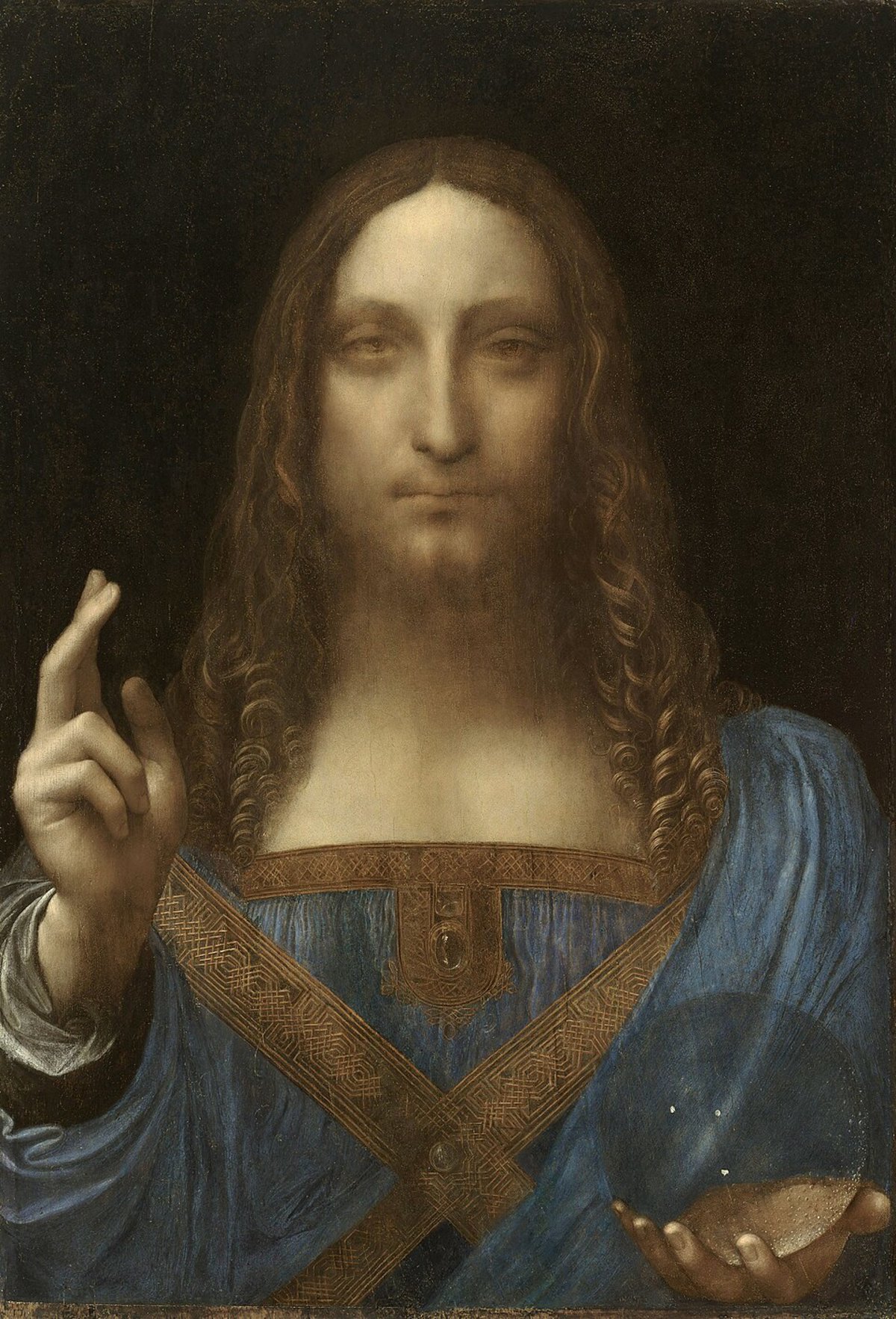
Salvator Mundi
Salvator Mundi — attributed Leonardo da Vinci, c.1499-1510
Leonardo da Vinci (attributed), Public domain, via Wikimedia Commons
The Salvator Mundi is a painting of Christ as 'Saviour of the World' — holding an orb in his left hand and raising his right in blessing — that sold at Christie's New York in November 2017 for USD 450.3 million, making it the most expensive painting ever sold at auction. Its attribution to Leonardo da Vinci — proposed after its rediscovery and restoration in the early 2000s — was accepted by a substantial portion of the scholarly community (it was exhibited at the National Gallery London in 2011-2012 as a Leonardo) but has never achieved universal acceptance: some scholars attribute it to an assistant or a composite work. The painting's provenance before the early 17th century is uncertain; its current location is private (reportedly in Saudi Arabia) and it has not been publicly displayed since 2017.
The debate over the attribution of the Salvator Mundi is the most contested attribution question in the history of Western art. Those who accept the Leonardo attribution note: the sfumato modelling, the specific quality of the hands and face, the complex crystal orb (transparent and reflecting the landscape behind Christ, yet also showing refracted light as it would through a hollow glass ball), and stylistic parallels with the London Virgin of the Rocks and the Louvre St John the Baptist. Those who doubt note: the quality of certain passages, the evidence of extensive restoration, and the uncertainty of the pre-17th-century provenance.
The painting was last publicly displayed at the Louvre Abu Dhabi for a planned exhibition in 2018, which was cancelled. Its current location is undisclosed.
The National Gallery London's 2011-2012 exhibition catalogue, the Christie's auction catalogue (2017), and the subsequent scholarly literature provide the best documentation of the attribution question. High-quality reproductions are available in print and online for study.
When standing before this work, look carefully: Salvator Mundi — attributed Leonardo da Vinci, c.1499-1510. Give it time — what seems decorative often carries the central meaning.
When standing before this work, look carefully: The crystal orb — optical observations by Leonardo. Give it time — what seems decorative often carries the central meaning.
When standing before this work, look carefully: The blessing hand — sfumato modelling. Give it time — what seems decorative often carries the central meaning.
When standing before this work, look carefully: The face of Christ — contested Leonardo attribution. Give it time — what seems decorative often carries the central meaning.
Current location: private collection (undisclosed). Not publicly accessible. Last publicly exhibited: National Gallery, London, 2011-2012.