
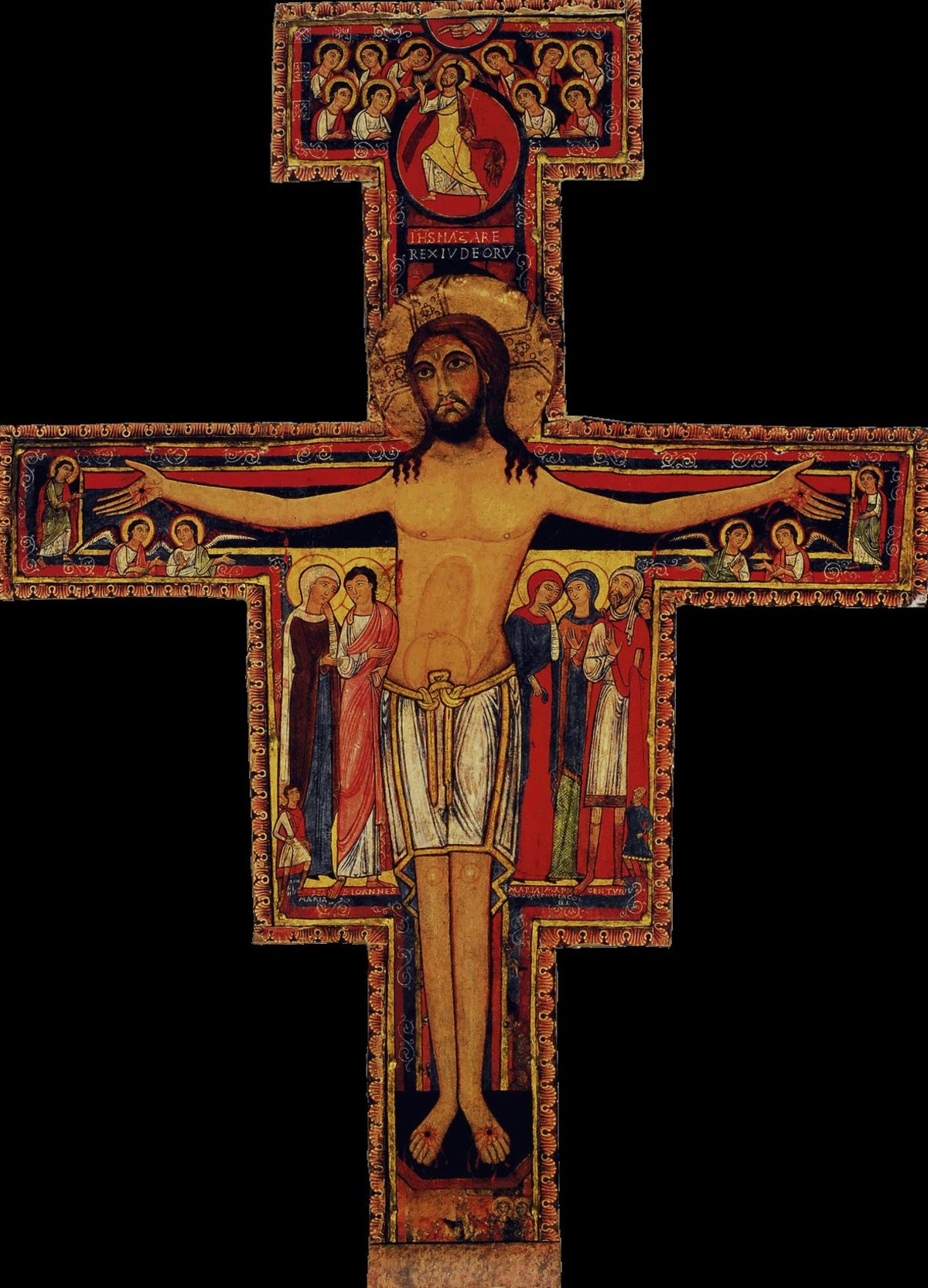
San Damiano Crucifix (type)
The San Damiano Crucifix — Umbrian school, c.1100
Public domain, via Wikimedia Commons
The original San Damiano Crucifix — the painted crucifix before which St Francis of Assisi heard the voice of Christ saying 'Francis, go and repair my house which, as you can see, is falling into ruin' (the foundational event of his conversion, c.1206) — is preserved in the Basilica of Santa Chiara in Assisi, where it has been since 1257. The crucifix is a large painted panel (approximately 195 by 105 cm) of the Umbrian school, c.1100 — one of the oldest surviving Italian painted crucifixes.
The iconographic type is the Christus Triumphans (Christ Triumphant) rather than the later Christus Patiens (Christ Suffering): Christ's eyes are open, his posture erect, his expression serene — this is the Byzantine tradition of the Crucifixion as Resurrection, death as victory. Around the figure of Christ, a series of small narrative scenes depicts events of the Passion and Resurrection; the registers above show the Ascension.
The San Damiano Crucifix was the image before which the Franciscan movement was born. It was kept in the church of San Damiano for half a century; when St Clare founded her community of Franciscan women (the Poor Ladies, later Poor Clares) at San Damiano in 1212, it became the central devotional object of the first Franciscan community.
When Clare moved the community to Santa Chiara in 1257 (shortly after her death), the crucifix went with them. The Franciscan devotional tradition of the 13th century transformed European religious art: the emphasis on Christ's humanity and suffering that characterises the Christus Patiens type (the suffering Christ — replacing the triumphant Christ of this Umbrian crucifix) was directly stimulated by Francis's own devotional practice.
The San Damiano Crucifix is displayed in the Oratory of the Crucifix within the Basilica of Santa Chiara — a side chapel specially built to house it. The original is behind glass in controlled conditions.
The iconographic type (open eyes, erect posture) is unusual in the post-Franciscan tradition — Francis himself prayed before a triumphant Christ, but the movement he founded transformed European art's representation of the Crucifixion toward the suffering Christ type. The paradox is historical: the man who most deeply influenced the representation of Christ's suffering prayed before an image that denied that suffering.
When standing before this work, look carefully: The San Damiano Crucifix — Umbrian school, c.1100. Give it time — what seems decorative often carries the central meaning.
When standing before this work, look carefully: Christ Triumphant — open eyes, serene expression. Give it time — what seems decorative often carries the central meaning.
When standing before this work, look carefully: Narrative scenes around the cross. Give it time — what seems decorative often carries the central meaning.
When standing before this work, look carefully: Basilica of Santa Chiara, Assisi. Give it time — what seems decorative often carries the central meaning.
Basilica di Santa Chiara, Piazza Santa Chiara, Assisi. Open daily (restricted hours during services).
Free admission. The Oratory of the Crucifix is off the right nave of the church.