
San Zaccaria Altarpiece
San Zaccaria Altarpiece — Bellini, 1505
Giovanni Bellini, Public domain, via Wikimedia Commons
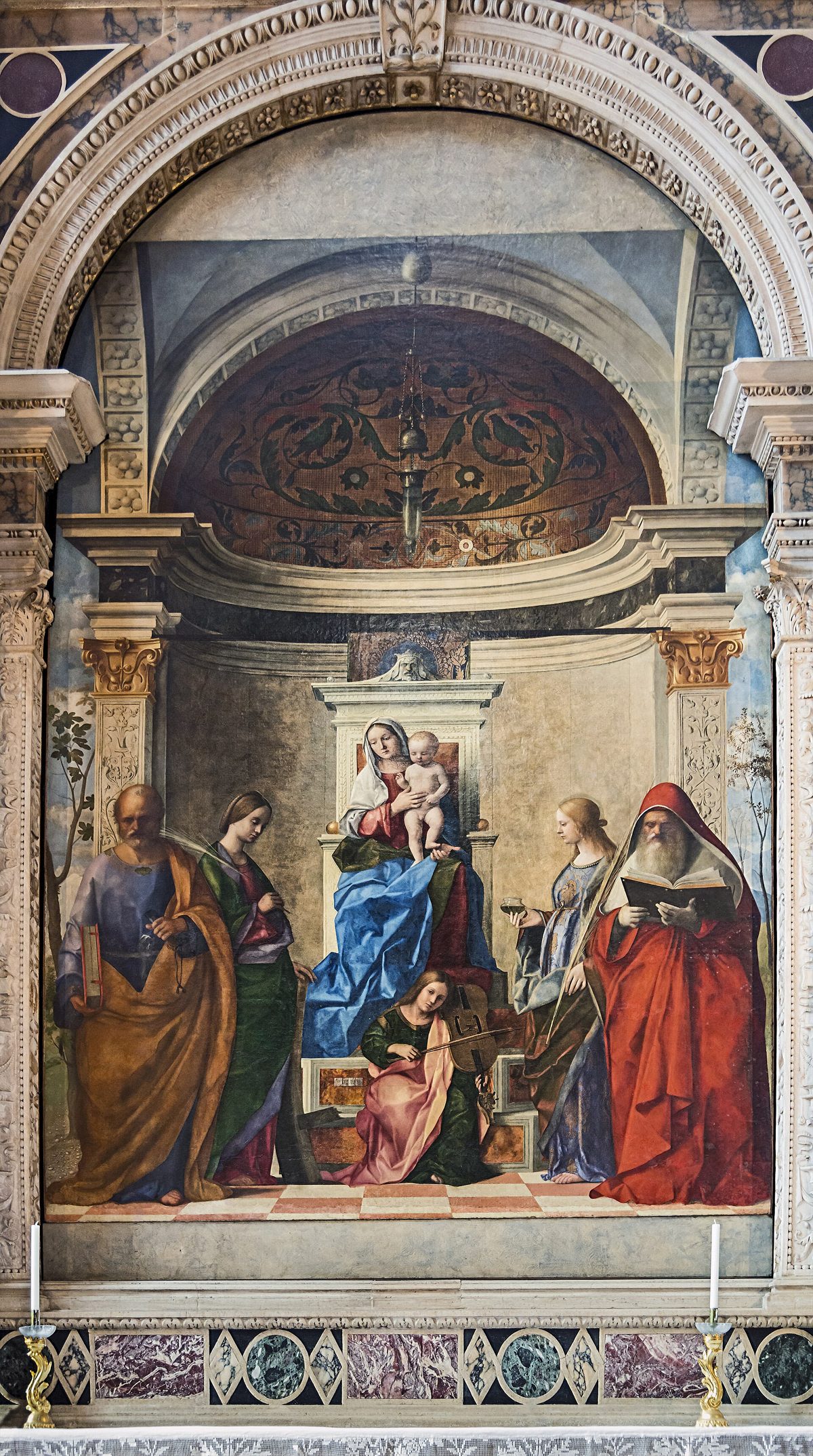
Giovanni Bellini's San Zaccaria Altarpiece, painted in 1505 when the artist was approximately 75 years old, is the supreme example of his Sacra Conversazione format — and one of the most serene paintings in Venice. It shows the Virgin and Child enthroned in a semi-circular apse niche, flanked by four saints (Peter, Catherine, Lucy, and Jerome) with an angel playing a lute at the base of the throne.
The painting is still in situ in the church for which it was made, in the church of San Zaccaria, in the position and lighting conditions Bellini designed for it. A window to the right of the painting allows natural light to enter from the same direction as the painted light source — one of the few cases in Venice where a Renaissance altarpiece can still be experienced in its original context.
Giovanni Bellini (c.1430-1516) was the dominant painter in Venice for most of his career and the teacher of both Giorgione and Titian. His contribution to the development of Italian painting was the introduction of oil painting technique from Flemish models (learned partly from Antonello da Messina, who brought Flemish oil methods to Venice in 1475) and the development of the warm, atmospheric light that characterises Venetian painting for the next century. The San Zaccaria Altarpiece, made three years before his death, shows his complete mastery: the painted apse niche continues the real architecture of the church with absolute conviction, the figures are warmly illuminated, and the total mood is one of contemplative peace.
The apse niche Bellini paints is not a real apse but a painted one — the continuation of the church's nave space into a fictive chapel that opens behind the frame. Stand directly in front of the altarpiece and allow the painted architecture to fuse with the real architecture around it.
The Madonna's expression — gentle, slightly melancholy, aware of what this Child will undergo — is Bellini's most characteristic feature. The lute-playing angel at the base (a detail he used repeatedly) adds a quality of celestial music to the contemplative atmosphere. The four saints are individually characterised: Jerome reads, Peter holds his keys, Catherine and Lucy stand with their martyr's attributes.
When standing before this work, look carefully: San Zaccaria Altarpiece — Bellini, 1505. Give it time — what seems decorative often carries the central meaning.
When standing before this work, look carefully: The Virgin and Child — Bellini's signature serenity. Give it time — what seems decorative often carries the central meaning.
When standing before this work, look carefully: The lute-playing angel at the throne base. Give it time — what seems decorative often carries the central meaning.
When standing before this work, look carefully: Church of San Zaccaria, Venice. Give it time — what seems decorative often carries the central meaning.
Church of San Zaccaria, Campo San Zaccaria, near Riva degli Schiavoni, Venice. The altarpiece is on the left side of the nave.
There is a small admission fee for the church. This is one of the only major Venetian altarpieces that can still be seen in its original position.