
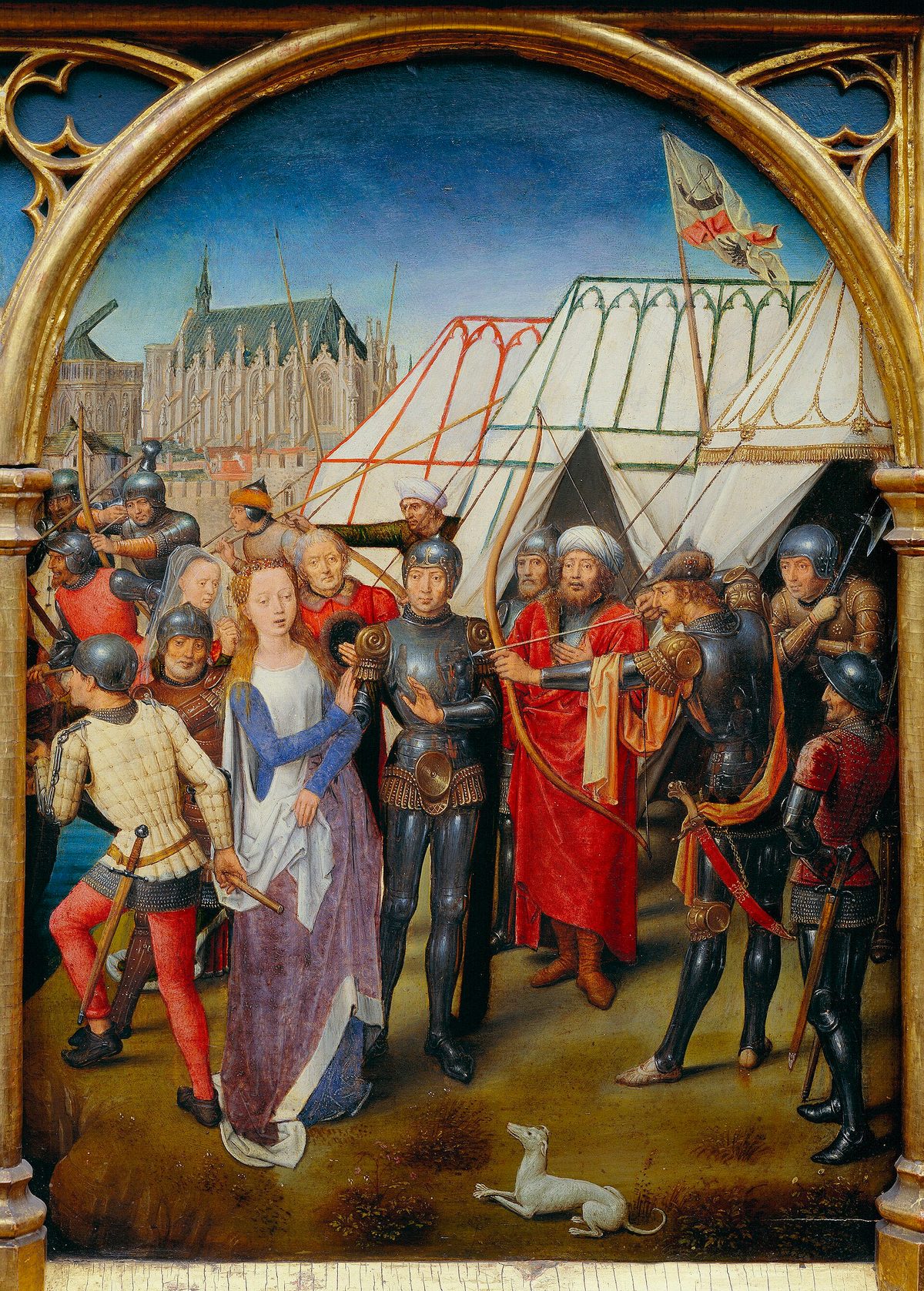
Shrine of St Ursula
Shrine of St Ursula — Memling, 1489
Hans Memling, Public domain, via Wikimedia Commons
Hans Memling's Shrine of St Ursula is the most perfect small-scale painting programme of the 15th-century Flemish school — a gilded wooden reliquary (approximately 87 cm long, shaped like a small Gothic chapel) whose six oak panels and two end panels are painted with scenes from the lives of St Ursula and her eleven thousand virgins and the Martyrdom at Cologne. The reliquary was commissioned by the Sisters of St John's Hospital in Bruges for the remains of St Ursula; it has been in the hospital — now the Memling Museum — ever since.
The six side panels show (reading both sides): the arrival of Ursula and her companions at Cologne, their journey to Rome, their audience with Pope Cyriacus, their return to Cologne, and the Martyrdom. The end panels show the Virgin and Child with donor portraits of two sisters and two brothers of the hospital.
Hans Memling (c.1430/40-1494) was the dominant painter in Bruges in the late 15th century — a Flemish master of exquisite refinement who combined van Eyck's jewel-like surface precision with a gentler, more lyrical emotional quality. The Shrine commission required him to paint a narrative programme in miniature: each panel is approximately 35 by 25 cm, and the scene depicted must compress crowd, landscape, architecture, and narrative into that space. Memling's mastery of this compression — the quality of the individual faces, the precision of the cityscape backgrounds (Cologne, Rome, and Bruges appear in the backgrounds with documentary specificity), the organisation of crowd movement in tiny scale — gives the Shrine a quality of infinite patience and craft.
The Martyrdom panels (on one long side) are the emotional climax: Ursula kneels before the Hunnic king who has demanded she abandon Christianity; he raises his bow; she is shown both kneeling and falling. The crowd of virgins around her on the boats in the Rhine await their own martyrdom with various expressions of acceptance and fear.
Look at the cityscapes in the backgrounds: Bruges's characteristic late-medieval skyline, the towers of Cologne Cathedral (not yet finished in 1489 but shown in Memling's time), and a generic Roman cityscape. Each is a piece of documentary observation translated to miniature scale.
When standing before this work, look carefully: Shrine of St Ursula — Memling, 1489. Give it time — what seems decorative often carries the central meaning.
When standing before this work, look carefully: The Martyrdom — Ursula before the Hunnic king. Give it time — what seems decorative often carries the central meaning.
When standing before this work, look carefully: The Cologne cityscape — documentary background. Give it time — what seems decorative often carries the central meaning.
When standing before this work, look carefully: The Memling Museum in the former St John's Hospital. Give it time — what seems decorative often carries the central meaning.
Memling Museum (former St John's Hospital), Mariastraat 38, Bruges. The Shrine is the centrepiece of the museum's collection, displayed in the old hospital ward alongside Memling's other Bruges commissions. Bruges is easily reached from Brussels by train (approximately one hour).