
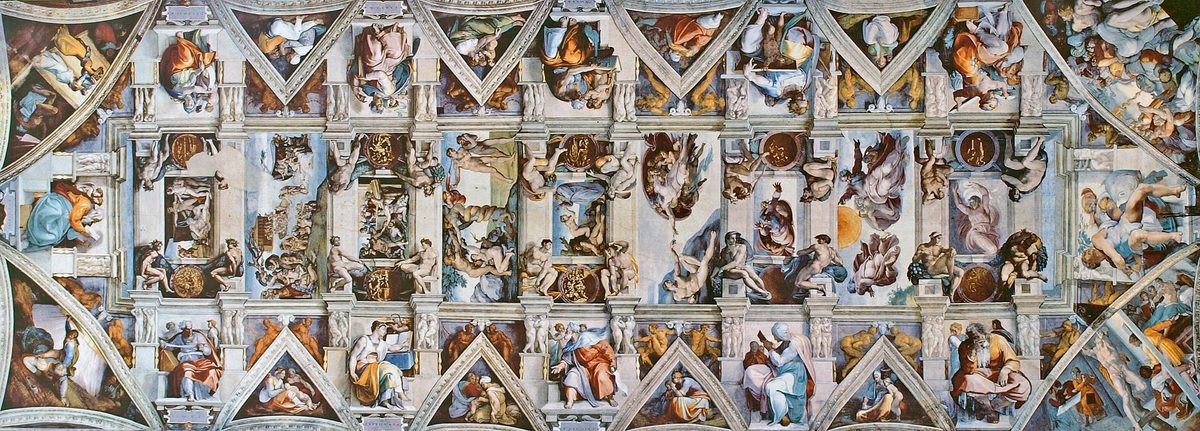
Sistine Chapel Ceiling
The supreme achievement of Western painting — over 300 figures across 520 square metres of papal vault.
Vatican Museums / Wikimedia Commons
The Sistine Chapel ceiling is the supreme achievement of Western painting — a 520-square-metre fresco covering the barrel vault of the papal chapel, painted by Michelangelo almost entirely alone over four years.
Pope Julius II commissioned the work in 1508, initially requesting only the twelve apostles in the pendentives. Michelangelo renegotiated the brief and produced instead a comprehensive theological programme spanning nine central Genesis scenes flanked by prophets, sibyls, ancestors of Christ, and dramatic corner spandrels — a total of over 300 figures that redefined what painting could be.
The ceiling was unveiled on November 1, 1512, and immediately recognised as unprecedented. Raphael, on seeing it, reportedly changed his own style. Giorgio Vasari wrote that it was so perfect that there was nothing left for painting to achieve.
Michelangelo di Lodovico Buonarroti Simoni (1475–1564) was primarily a sculptor — he accepted the ceiling commission reluctantly and insisted he was not a painter. He had already produced the Pietà (1499) and the David (1501–04) before Julius II summoned him to Rome.
His working method on the ceiling was physically punishing: he designed and cut his own cartoons, mixed his own plaster, and worked on scaffolding in extreme discomfort, painting wet plaster section by section (giornata by giornata). His genius lay not in conventional fresco technique but in the sculptural quality of his figures — every figure on the ceiling reads as a body in three-dimensional space, viewed from below.
The nine central panels move from the Separation of Light from Darkness (at the altar end) to the Drunkenness of Noah (above the entrance). The most famous image — God giving life to Adam — is in the fourth bay. Around the edges, seven Old Testament prophets alternate with five pagan sibyls who were understood to have prophesied Christ.
In the corner spandrels, four dramatic Old Testament salvation scenes: David and Goliath, Judith and Holofernes, the Brazen Serpent, and the Punishment of Haman. Look also at the ignudi — the twenty nude athletic figures flanking the Genesis panels — who are among the most purely sculptural painted figures ever made. The entire programme repays hours of looking; bring binoculars.
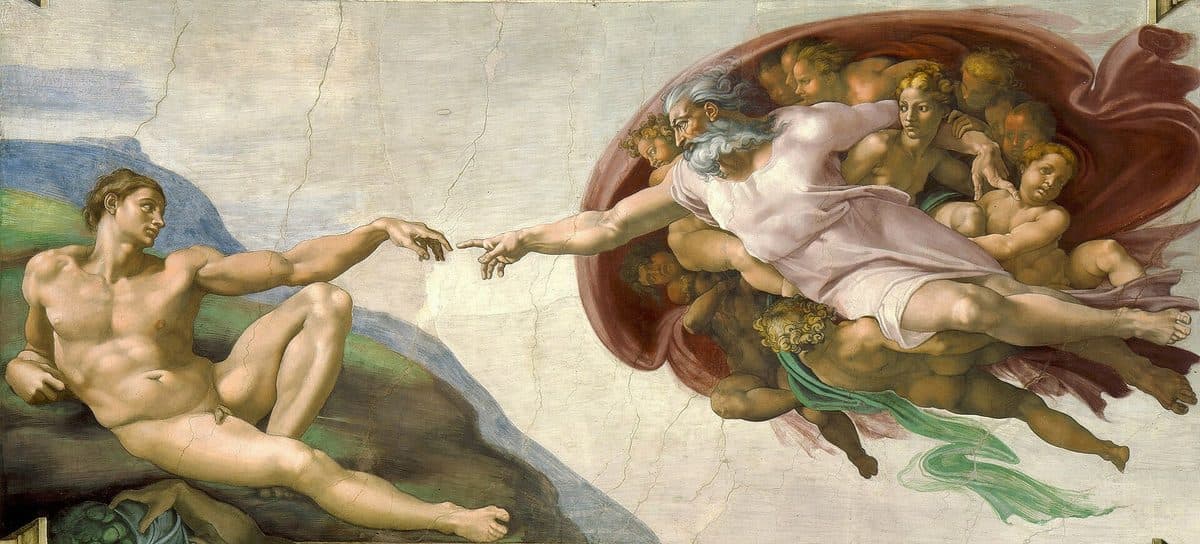
Located in the fourth bay of the ceiling, this is the most reproduced image in Western art. Notice the gap between the two index fingers — it is never touching. The space between Creator and creation is the theological subject of the entire composition. God arrives from the right in a billowing cloak, energised; Adam reclines to the left, languid, receiving.
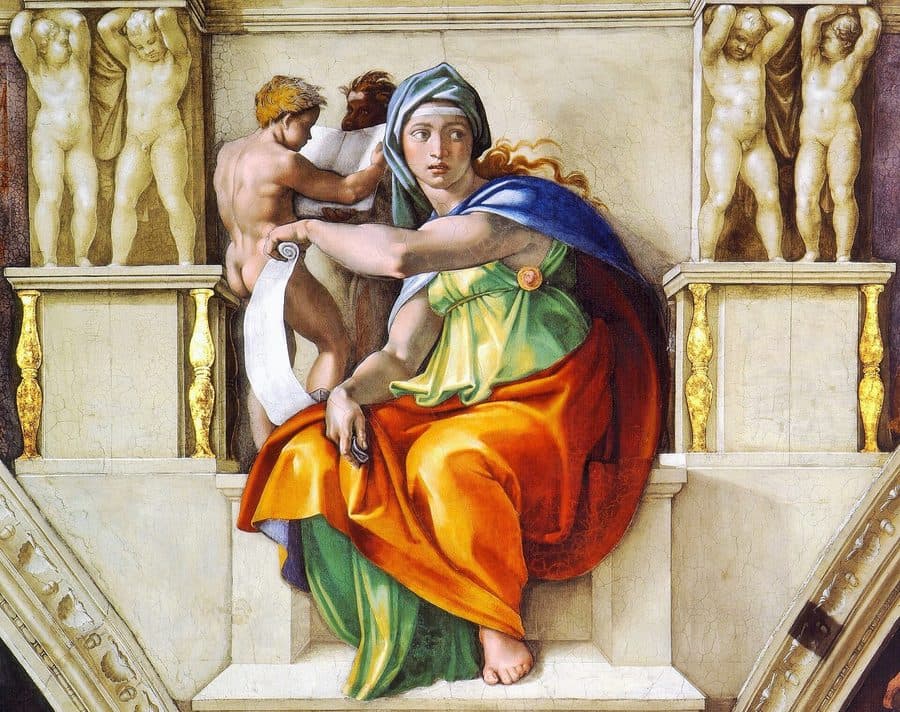
Painted in 1509, the Delphic Sibyl is the first sibyl encountered above the main entrance and is considered the most beautiful of the five. She holds a partially unrolled scroll — the oracle through which she prophesied Christ's coming — and turns with an expression of startled, visionary alertness. The seven prophets and five sibyls alternate around the central Genesis panels, facing inward toward them like witnesses.
When you enter the Sistine Chapel and look up, the full scale of the composition becomes immediately disorienting — the vault is 20 metres above the floor. The nine central panels recede in perspective from the altar to the entrance. Michelangelo deliberately made the figures larger toward the altar end to compensate for the greater viewing distance. Stand at different positions along the room and watch how the scenes shift in apparent scale. Binoculars or a high-resolution app transform the experience.
The Sistine Chapel is inside the Vatican Museums; entry requires a timed ticket booked in advance at museivaticani.va. The chapel itself is the last room of the museum circuit and is heavily crowded; arrive at opening or on late evenings (Friday evenings have extended hours in season). Photography is officially prohibited inside the chapel, though widely practiced.
The ceiling is approximately 20 metres above the floor; the famous vault paintings are best seen without craning — walk slowly and use the mirrors sometimes provided. Allow at least two hours for the museum circuit before the chapel.