
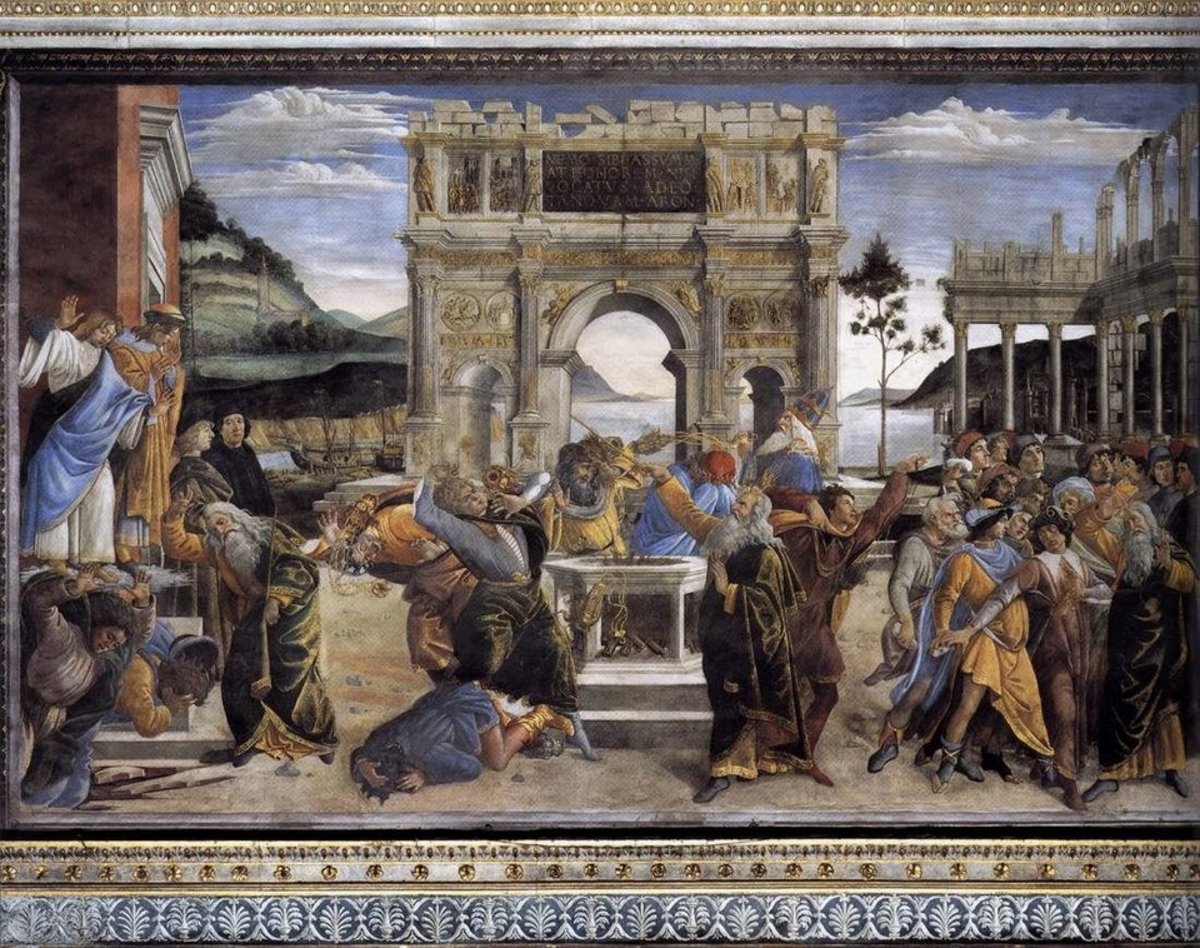
Sistine Chapel Narrative Frescoes (Botticelli, Ghirlandaio, Rosselli)
Temptation of Christ — Botticelli, Sistine Chapel
Sandro Botticelli, Public domain, via Wikimedia Commons
The first campaign of Sistine Chapel frescoes (1481-1483), commissioned by Pope Sixtus IV, involved six major painters working simultaneously: Perugino (the leader), Botticelli, Ghirlandaio, Rosselli, Signorelli, and Pinturicchio. Together they painted twelve large narrative scenes (six from the Life of Moses on the north wall, six from the Life of Christ on the south wall), plus a series of papal portraits above the narrative zone.
Botticelli contributed three scenes (The Punishment of the Sons of Core, The Temptation of Christ, and Moses and the Daughters of Jethro); Ghirlandaio painted the Calling of the First Apostles; Rosselli contributed the Last Supper and other scenes. The cycle as a whole is a theological argument linking the Old Covenant (Moses) with the New Covenant (Christ) and establishing the continuity of sacred history.
Sandro Botticelli (1445-1510) was at the height of his career when he worked in the Sistine Chapel — his Primavera and The Birth of Venus date from the same decade. His three Sistine frescoes show the full range of his abilities: narrative complexity, landscape, portraiture (the Temptation includes a self-portrait), and crowd scenes.
Domenico Ghirlandaio (1449-1494) was the leading Florentine fresco painter of his generation — his Calling of the First Apostles is a masterpiece of spatial organisation and figure characterisation. Cosimo Rosselli (1439-1507) was a competent painter whose Last Supper fresco was reportedly gilded so thickly that Sixtus IV (who reportedly preferred gold to painting) selected it as the finest.
The narrative frescoes are usually overlooked by visitors focused on Michelangelo's ceiling and the Last Judgment. The cycle is on both side walls of the Sistine Chapel above the tapestry hangings zone.
Botticelli's Temptation of Christ (south wall) is the most immediately rewarding — it contains a panoramic landscape and a crowd scene of great complexity, and includes a self-portrait of Botticelli himself in the crowd. Ghirlandaio's Calling of the First Apostles (south wall) shows the Lake of Galilee with remarkable spatial depth.
When standing before this work, look carefully: Temptation of Christ — Botticelli, Sistine Chapel. Give it time — what seems decorative often carries the central meaning.
When standing before this work, look carefully: Calling of the First Apostles — Ghirlandaio. Give it time — what seems decorative often carries the central meaning.
When standing before this work, look carefully: Moses and the Daughters of Jethro — Botticelli. Give it time — what seems decorative often carries the central meaning.
When standing before this work, look carefully: Side wall frescoes — 1481-1483 cycle overview. Give it time — what seems decorative often carries the central meaning.
Sistine Chapel, Vatican Museums, Vatican City. Admission via Vatican Museums. The narrative frescoes are on the side walls above the tapestry zone, best viewed from the centre of the chapel or from the choir screen.