
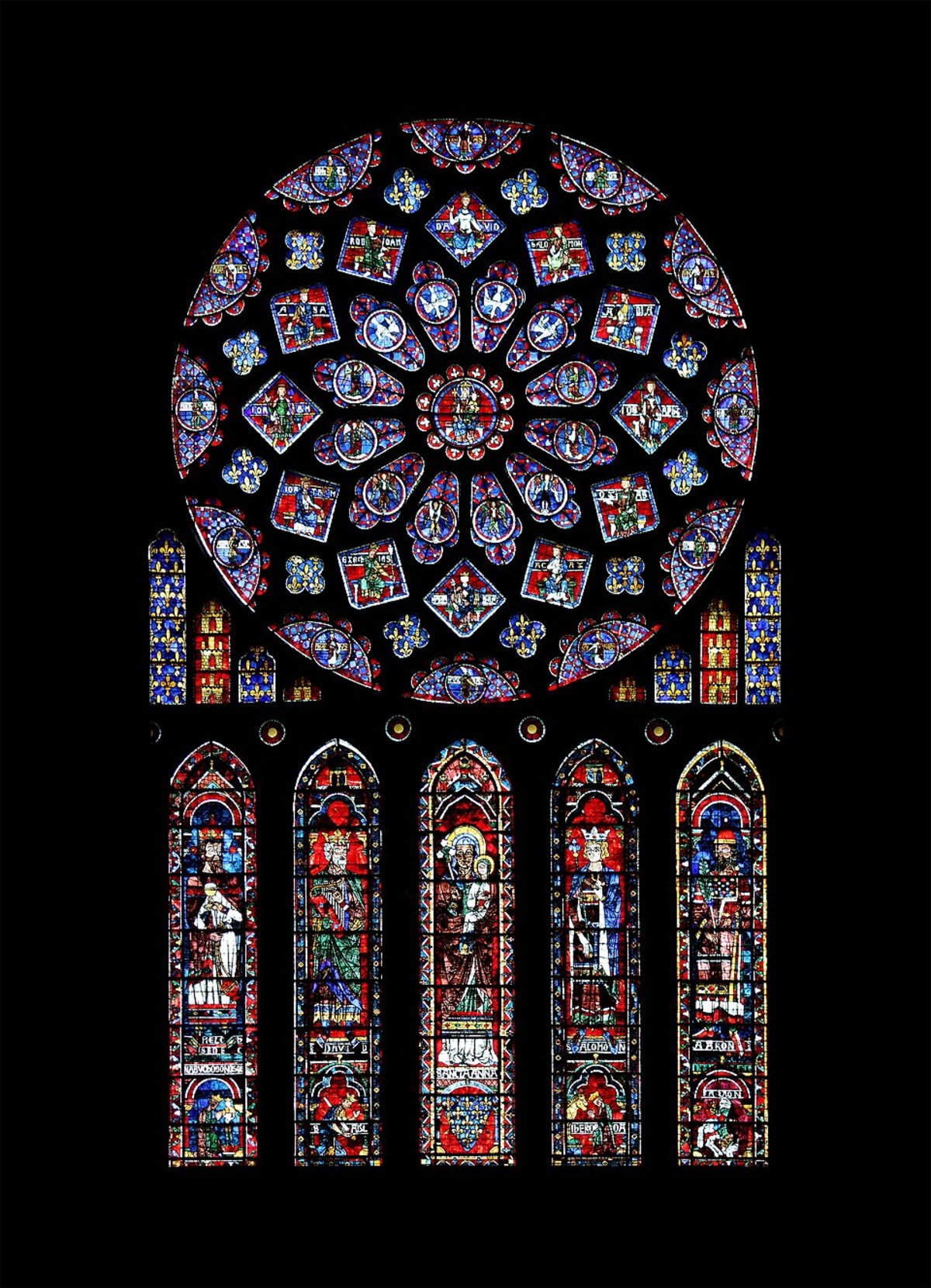
Stained Glass and Sculpture of Chartres Cathedral
Royal Portal — Chartres Cathedral, c.1135-1180
Public domain, via Wikimedia Commons
Chartres Cathedral is the supreme achievement of Gothic architecture and the finest ensemble of medieval art in the world. Two major building campaigns (after fires in 1134 and 1194) produced the cathedral as it now stands: the western facade (Royal Portal) with its three sculptural portals and two towers (c.1135-1180), and the main body of the cathedral (c.1194-1220).
The Royal Portal carries the earliest surviving programme of monumental Gothic sculpture — three tympana depicting the Ascension (left), the Virgin in Majesty (centre), and the Second Coming (right), with jamb figures of Old Testament kings and prophets that are among the finest works of 12th-century European sculpture. The 172 stained-glass windows — approximately 150 of them surviving from the 12th and 13th centuries — constitute the most complete collection of medieval glass in the world, covering approximately 2,600 square metres of surface.
Chartres was the principal pilgrimage site in northern France throughout the medieval period — the goal of pilgrims venerating the Sancta Camisia (the tunic of the Virgin, the most important Marian relic in France). The cathedral's construction after the 1194 fire was supported by donations from across France; the windows were donated by guilds, nobles, and bourgeois of Chartres (donor portraits appear in the bases of many windows). The sculptural programme and the window programme were conceived together as a unified theological statement: the windows illustrate biblical and hagiographic narratives, while the sculpture mediates between the interior sacred space and the exterior public world.
The Royal Portal sculpted figures (the kings and queens of Judah on the jambs — identified with the kings and queens of France by medieval viewers) have a quality of spiritual serenity and physical dignity that is new in medieval sculpture: the faces are individuated, the drapery is rhythmic but not abstract, the postures are calm. The window of Notre-Dame de la Belle Verrière (the Blue Virgin window, 12th century) is one of the most famous windows in the world — a deep, saturated blue of a colour quality never precisely replicated in later glass. The Chartres blue (charte or Chartres blue) is a specific glass colour achieved by a medieval formula now partially lost.
When standing before this work, look carefully: Royal Portal — Chartres Cathedral, c.1135-1180. Give it time — what seems decorative often carries the central meaning.
When standing before this work, look carefully: The Blue Virgin window — Notre-Dame de la Belle Verrière. Give it time — what seems decorative often carries the central meaning.
When standing before this work, look carefully: Interior — the glass light of Chartres. Give it time — what seems decorative often carries the central meaning.
When standing before this work, look carefully: The Royal Portal jamb figures — Old Testament kings. Give it time — what seems decorative often carries the central meaning.
Chartres Cathedral is approximately 90 km southwest of Paris by train (1 hour 20 minutes from Montparnasse). The cathedral is open every day; admission is free.
Guided tours in English are available. A full visit requires 2-3 hours.