
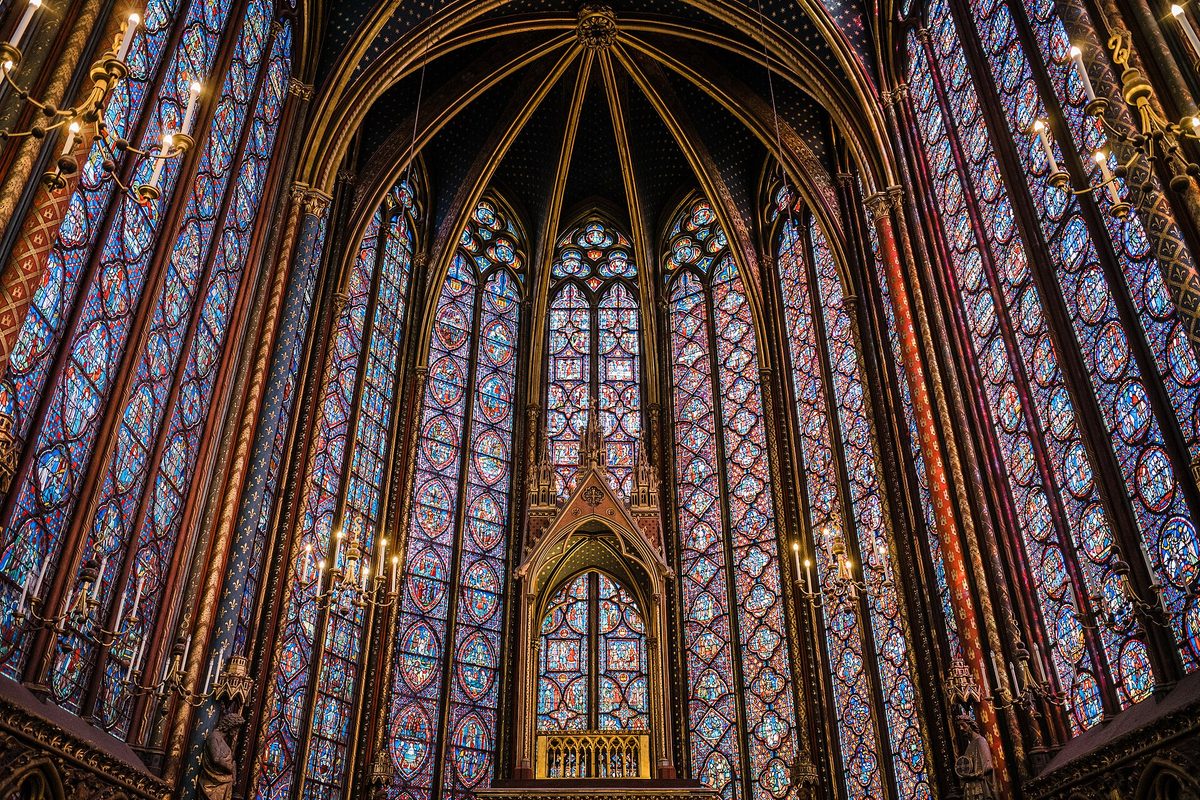
Stained-Glass Windows of Sainte-Chapelle
Sainte-Chapelle upper chapel — the walls of glass
Public domain, via Wikimedia Commons
The stained-glass windows of Sainte-Chapelle are the most extraordinary ensemble of medieval glass in the world — 1,113 individual scenes covering approximately 600 square metres of glass in a royal chapel built by Louis IX (St Louis) of France in 1248 to house the Crown of Thorns and other Passion relics purchased from Baudouin II, Emperor of Constantinople. The upper chapel (the royal chapel, used by Louis and his court) has walls that are almost entirely glass: fifteen window bays rise from floor to vault, each filled with hundreds of individual narrative panels in a red-and-blue colour field that transforms the interior into a lantern of coloured light. The programme is an encyclopaedic visual Bible — Old Testament narratives from Genesis through the Machabees, New Testament narratives from the Passion, and the history of the Passion relics' acquisition at the end.
Louis IX purchased the Crown of Thorns from Baudouin II of Constantinople in 1239-1241 for 135,000 livres — three times the cost of building the Sainte-Chapelle itself. The chapel was built to enshrine this supreme relic: it is, in a sense, a reliquary made of architecture and glass. The stained-glass programme was completed in approximately nine years (1239-1248) by a Parisian workshop working at extraordinary speed and quality.
Of the fifteen windows, twelve are original 13th-century glass (among the finest surviving in the world); three were restored in the 19th century. The large rose window at the west end (14th-century) depicts the Apocalypse. The entire upper chapel is one of the most powerful surviving expressions of the theology of light in the medieval Church: the light that enters is literally filtered through images of sacred history.
The experience of the upper chapel on a sunny day is one of the most intense visual encounters in Europe: the walls dissolve into fields of red and blue glass light, the stone elements are almost invisible, and the colour transforms the air itself. The individual panels require close attention (binoculars help) to read the narrative scenes: each panel is approximately 70 by 40 cm, with figures of about 30 cm, and the number of scenes — 1,113 — makes the programme encyclopaedic. The sequence of the windows follows a liturgical reading order: the Old Testament windows on the north and south walls, with the Life of Christ and the Passion at the east end above the altar, and the Relics of the Passion in the last window of the programme.
When standing before this work, look carefully: Sainte-Chapelle upper chapel — the walls of glass. Give it time — what seems decorative often carries the central meaning.
When standing before this work, look carefully: Window detail — individual narrative panels. Give it time — what seems decorative often carries the central meaning.
When standing before this work, look carefully: The west rose window — the Apocalypse. Give it time — what seems decorative often carries the central meaning.
When standing before this work, look carefully: The colour light transforming the interior. Give it time — what seems decorative often carries the central meaning.
Sainte-Chapelle, Île de la Cité, 8 Boulevard du Palais, Paris. The lower chapel (public, free) has more modest decoration; the upper chapel requires a ticket and often a queue.
Avoid visiting on heavily overcast days. Classical concerts are regularly held in the upper chapel in the evenings.