
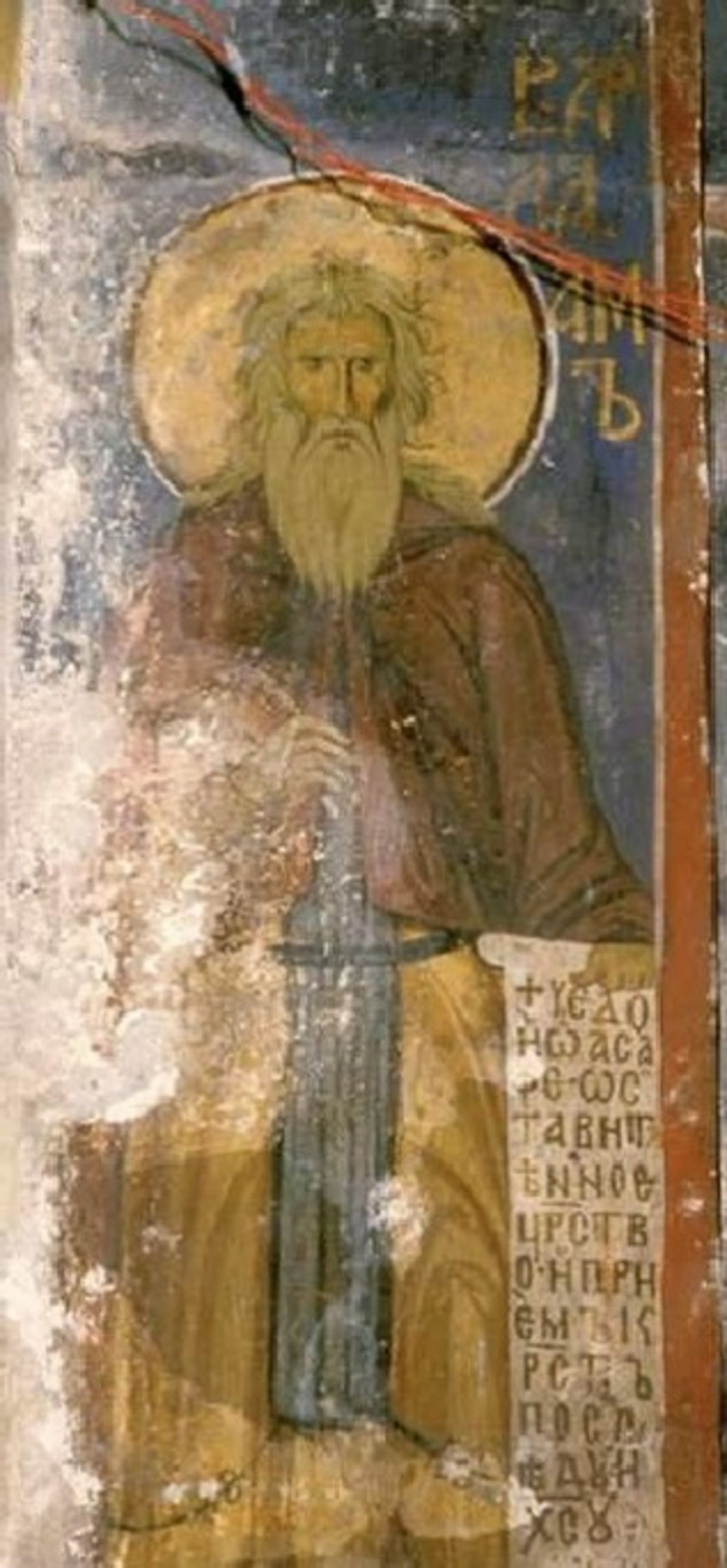
Studenica and Gračanica Monastery Frescoes
Crucifixion fresco — Studenica, 1209
Public domain, via Wikimedia Commons
The Serbian medieval monastery frescoes — particularly those at Studenica (c.1209) and Gračanica (c.1320) — represent the Serbian Nemanjić dynasty's royal patronage of Byzantine fresco painting at its most ambitious. Studenica Monastery (founded by Stefan Nemanja, c.1190) contains frescoes of 1209 in the Church of the Annunciation (the inner church, also called the Virgin's Church) including the Crucifixion, the Dormition, and the Holy Rulers — a cycle of exceptional quality.
Gračanica Monastery (founded by King Stefan Milutin, 1321) contains a complete programme of Palaeologan-style frescoes in its cruciform church — among the finest of the early 14th-century Serbian painting tradition. Together, the Serbian monastery frescoes form a corpus of late Byzantine painting second in importance only to the great Byzantine centres of Constantinople, Thessaloniki, and Mount Athos.
The Nemanjić dynasty (c.1166-1371) ruled medieval Serbia and was one of the great patrons of Byzantine art — building a series of monasteries and commissioning fresco programmes that drew on Byzantine masters and developed a distinctive Serbian variant of the Byzantine tradition. The 13th and 14th centuries were the golden age of Serbian medieval art; both Studenica and Gračanica are UNESCO World Heritage Sites. The Serbian Patriarchate of Peć (Kosovo), also a World Heritage Site, contains additional important fresco cycles.
Studenica: the 1209 frescoes are in the main church (Virgin's Church); the most important individual composition is the Crucifixion (west wall) — a large-scale three-scene composition that integrates the Crucifixion with the Deposition and the Lamentation. Gračanica: the complete Palaeologan programme covers the entire interior; the narrative cycles in the upper zones and the donor portrait of King Milutin in the narthex are the highlights.
When standing before this work, look carefully: Crucifixion fresco — Studenica, 1209. Give it time — what seems decorative often carries the central meaning.
When standing before this work, look carefully: Gračanica frescoes — Palaeologan style, c.1320. Give it time — what seems decorative often carries the central meaning.
When standing before this work, look carefully: Studenica Monastery exterior. Give it time — what seems decorative often carries the central meaning.
When standing before this work, look carefully: Gračanica Monastery exterior, Kosovo. Give it time — what seems decorative often carries the central meaning.
Studenica Monastery, Studenica, Raška, Serbia. Open daily; free admission (donations accepted).
Gračanica Monastery, Gračanica, Kosovo. Both are UNESCO World Heritage Sites. Studenica is approximately 3 hours south of Belgrade.