
Supper at Emmaus
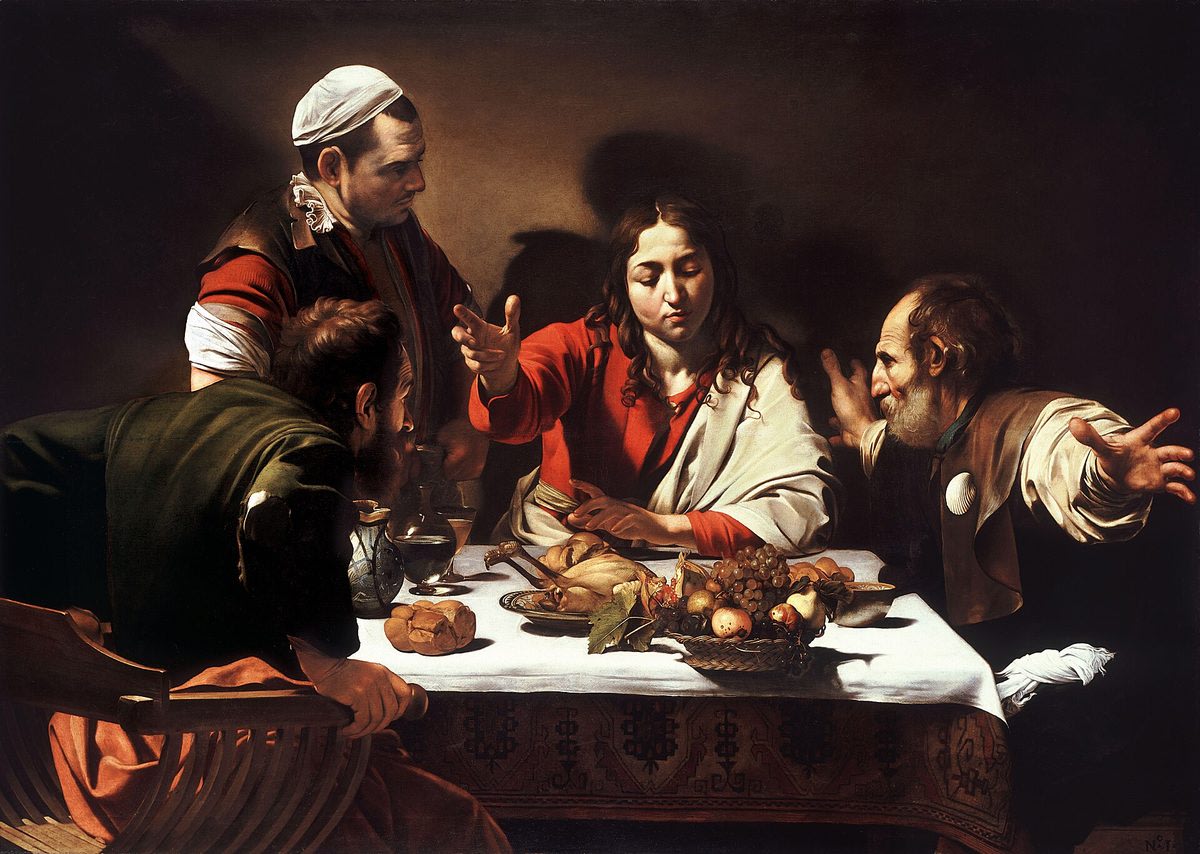
Supper at Emmaus — Caravaggio, 1601, Brera
Caravaggio, Public domain, via Wikimedia Commons
Caravaggio's Supper at Emmaus (1601) in the Brera is one of two versions of the same subject he painted — the other (c.1606) is in the National Gallery, London. The Brera version is the earlier and more theatrical: it depicts the moment when the risen Christ, unrecognised by the disciples Cleopas and Luke at Emmaus, breaks the bread and is suddenly identified.
The disciple on the right flings his arms wide in a gesture of astonished recognition; the one on the left pushes back from the table; the innkeeper and his wife stand at the sides, observing with bewilderment. Christ himself is shown young and beardless — deliberately provocative in the tradition of Italian art, where Christ was almost always shown bearded after the post-baptismal period.
The commission came from Cardinal Francesco Maria Del Monte, Caravaggio's principal patron, in 1601. It is contemporary with the Cerasi Chapel paintings and the Contarelli Chapel cycle — Caravaggio's period of maximum creative intensity.
The still life on the table — a bowl of fruit, a roast chicken, a loaf of bread — is among the most celebrated still-life passages in Baroque painting: the overhanging basket of fruit at the table's edge, apparently about to fall into the viewer's space, is a trompe-l'oeil device that had no precedent in Italian painting. The composition is explicitly designed to include the viewer: the outstretched arms of the left disciple reach into the viewer's space; the table edge addresses the viewer directly.
The moment of recognition is rendered in the most physical, least mystical terms possible. The disciples are not shown in devotional awe; they are shown in the shock of sudden comprehension — the body's response to being surprised. The right disciple's arms flung wide is a pose Caravaggio borrowed from the Lamentation tradition (the same gesture as Mary of Clopas in the Vatican Entombment), inverted from grief into astonishment.
Christ blesses the bread with absolute calm — the only figure not in motion. Look at the still life on the table: the fish and bread are Eucharistic symbols; the overhanging fruit basket is vanitas; the roast chicken is simply reality. All levels of meaning coexist.
When standing before this work, look carefully: Supper at Emmaus — Caravaggio, 1601, Brera. Give it time — what seems decorative often carries the central meaning.
When standing before this work, look carefully: The overhanging fruit basket — trompe-l'oeil still life. Give it time — what seems decorative often carries the central meaning.
When standing before this work, look carefully: The disciple's outstretched arms. Give it time — what seems decorative often carries the central meaning.
When standing before this work, look carefully: The later version — National Gallery, London, c.1606. Give it time — what seems decorative often carries the central meaning.
Pinacoteca di Brera, Milan. Room XXIX. The Brera version should be compared (mentally or in reproduction) with the National Gallery version (c.1606) — the later version is darker, quieter, and more inward, demonstrating Caravaggio's stylistic evolution after his flight from Rome.