
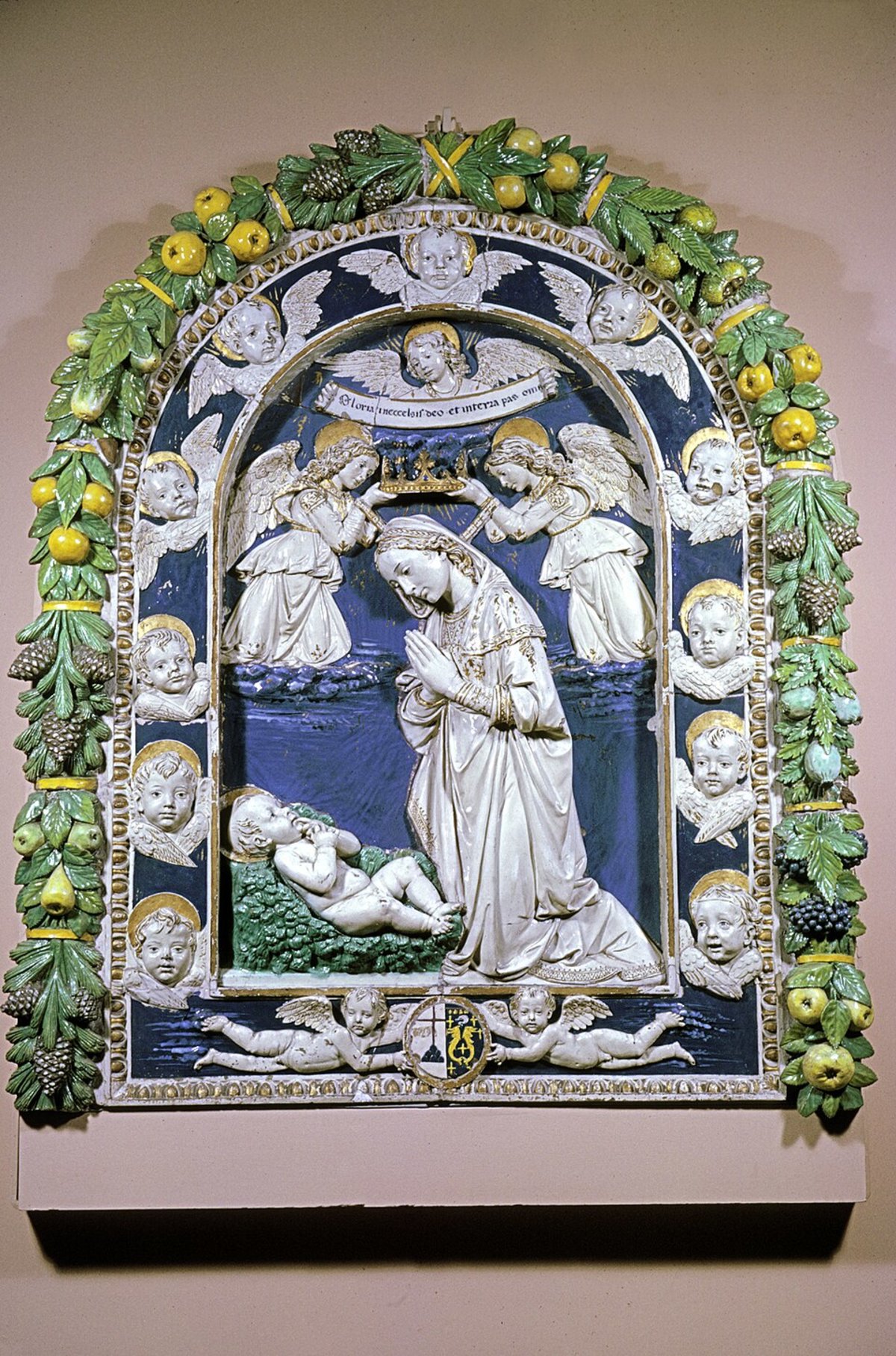
Tabernacle of the Madonna delle Carceri (glazed terracotta)
Della Robbia Madonna — glazed terracotta, blue and white
Della Robbia workshop, Public domain, via Wikimedia Commons
The della Robbia workshop — founded by Luca della Robbia (1399/1400-1482) and continued by his nephew Andrea (1435-1525) and Andrea's sons (Giovanni, Girolamo, and others) — produced a distinctive form of glazed terracotta sculpture in white and blue (sometimes with additional colours) that became the characteristic decorative art of Tuscan churches and institutions in the 15th and early 16th centuries. The technique: terracotta clay modelled in relief or in the round, coated with a lead-tin glaze that produced a vitreous white and blue surface.
The subjects are predominantly Madonnas with Child, Annunciations, devotional roundels, lunette reliefs over doorways, and altarpieces. The tabernacle of the Madonna delle Carceri in Prato, made for the pilgrimage shrine of the Virgin delle Carceri (Our Lady of the Prisons), is one of the most important Della Robbia works in situ.
Luca della Robbia invented the glazed terracotta technique in the 1440s as a cheaper, more durable, and weather-resistant alternative to marble for architectural sculpture. The vitreous blue and white surface was distinctive and immediately recognisable; the technique became the signature product of the workshop across several generations. Della Robbia works are found throughout Tuscany — in churches, orphanages (the Ospedale degli Innocenti roundels are by Andrea della Robbia), and civic buildings — and were exported across Italy and beyond.
Della Robbia works are among the most accessible early Renaissance sculptures: they are in churches at standing or kneeling eye level, their subjects are immediately comprehensible, and the blue-white colour scheme has a freshness and luminosity that makes them visually distinctive. Look for the characteristic almond-shaped mandorla (glory) of the Virgin figures, the swags of fruit and flowers that frame many of the reliefs (a Della Robbia signature), and the expressions of the Virgin and Child — which tend toward a warmth and accessibility quite different from marble altarpiece sculpture.
When standing before this work, look carefully: Della Robbia Madonna — glazed terracotta, blue and white. Give it time — what seems decorative often carries the central meaning.
When standing before this work, look carefully: Ospedale degli Innocenti roundels — Andrea della Robbia. Give it time — what seems decorative often carries the central meaning.
When standing before this work, look carefully: Annunciation relief — Della Robbia workshop. Give it time — what seems decorative often carries the central meaning.
When standing before this work, look carefully: Glazed terracotta technique — white and blue glaze. Give it time — what seems decorative often carries the central meaning.
Della Robbia works are distributed throughout Tuscany. The Ospedale degli Innocenti, Piazza della Santissima Annunziata, Florence, has Andrea della Robbia's famous infant roundels in the portico loggia. The Museo Nazionale del Bargello, Florence, has Luca della Robbia's marble Cantoria casts and glazed terracotta works.