
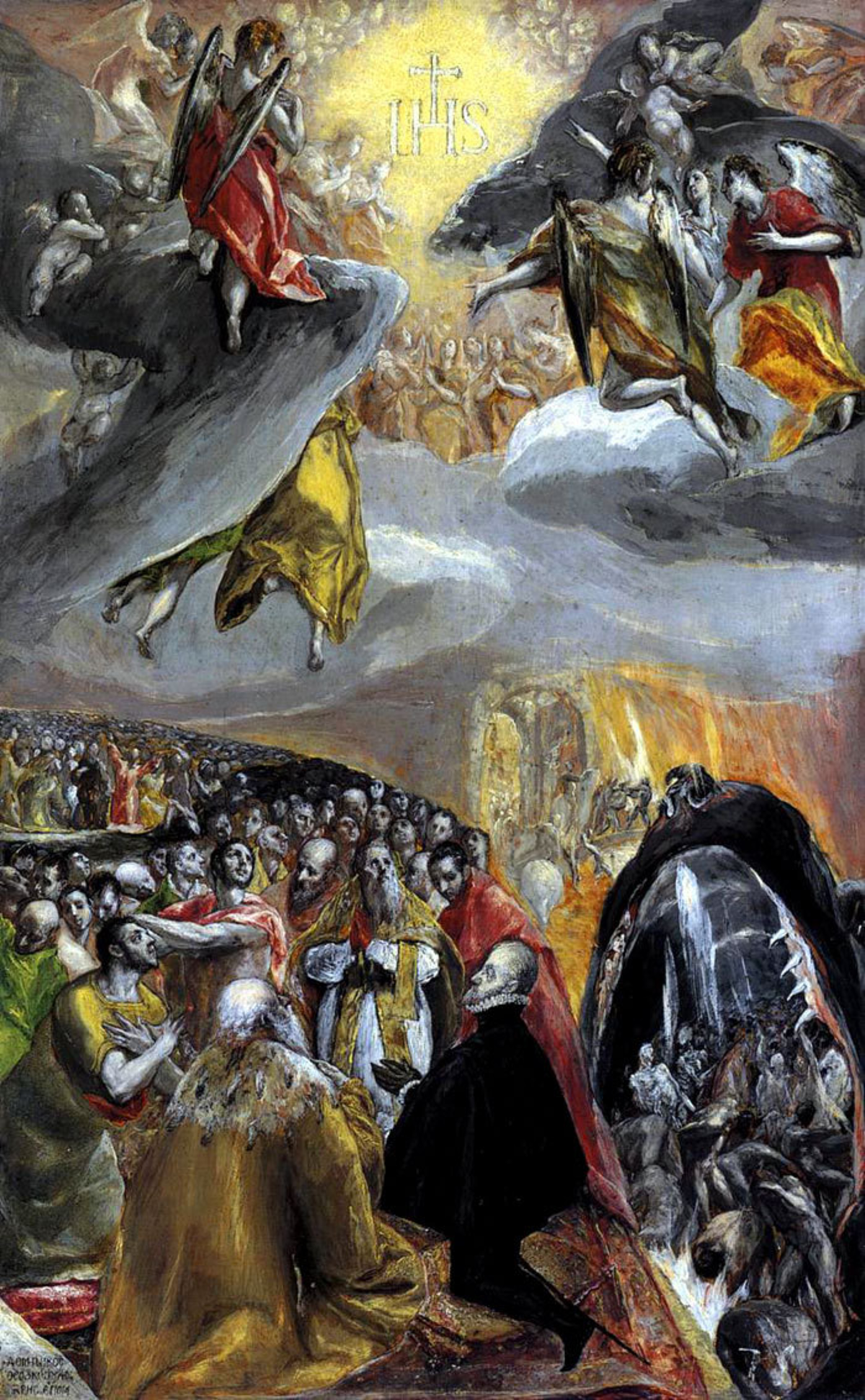
The Adoration of the Name of Jesus (Dream of Philip II)
Adoration of the Name of Jesus — El Greco, c.1577-1579
El Greco, Public domain, via Wikimedia Commons
El Greco's Adoration of the Name of Jesus (also known as the Allegory of the Holy League or the Dream of Philip II) is one of the most unusual and ambitious paintings in the Spanish royal collection — a large canvas (approximately 140 by 109.6 cm) painted for Philip II of Spain around 1577-1579, combining a vision of the Name of Jesus in heaven (in the upper zone, the monogram 'IHS' surrounded by angels and the heavenly court) with a representation of the earthly powers who adore it (in the lower zone: Philip II kneeling at the left, followed by Pope Pius V, the Doge of Venice, and Don John of Austria — the commanders of the Holy League that defeated the Turks at Lepanto in 1571). Below this political allegory, the damned souls of the lost descend into the open maw of Hell at the lower right — the Leviathan swallowing the damned.
The painting was one of El Greco's first major commissions in Spain — he hoped to receive the commission for the decorations of El Escorial from Philip II. The Adoration of the Name of Jesus was apparently well received; Philip commissioned a second painting (The Martyrdom of St Maurice and the Theban Legion, also at El Escorial), but that second work was refused. Philip did not appreciate El Greco's mature style, and the hope of royal patronage was disappointed.
The three zones of the painting — heaven (the Name of Jesus and the celestial court), earth (the Holy League leaders adoring), and hell (the Leviathan mouth) — create a vertical cosmological structure inherited from Late Gothic and Byzantine painting but treated in El Greco's early Venetian-influenced style. The monogram 'IHS' in the upper zone radiates golden light that illuminates the figures below in descending intensity.
When standing before this work, look carefully: Adoration of the Name of Jesus — El Greco, c.1577-1579. Give it time — what seems decorative often carries the central meaning.
When standing before this work, look carefully: The heavenly zone — the 'IHS' monogram in golden light. Give it time — what seems decorative often carries the central meaning.
When standing before this work, look carefully: Philip II kneeling — with Pope and Holy League. Give it time — what seems decorative often carries the central meaning.
When standing before this work, look carefully: Leviathan swallowing the damned — hell zone. Give it time — what seems decorative often carries the central meaning.
Monastery of El Escorial (Real Sitio de San Lorenzo de El Escorial), San Lorenzo de El Escorial, Community of Madrid. Open Tuesday-Sunday; admission fee. Approximately 1 hour from Madrid by train (Renfe) or by bus.