
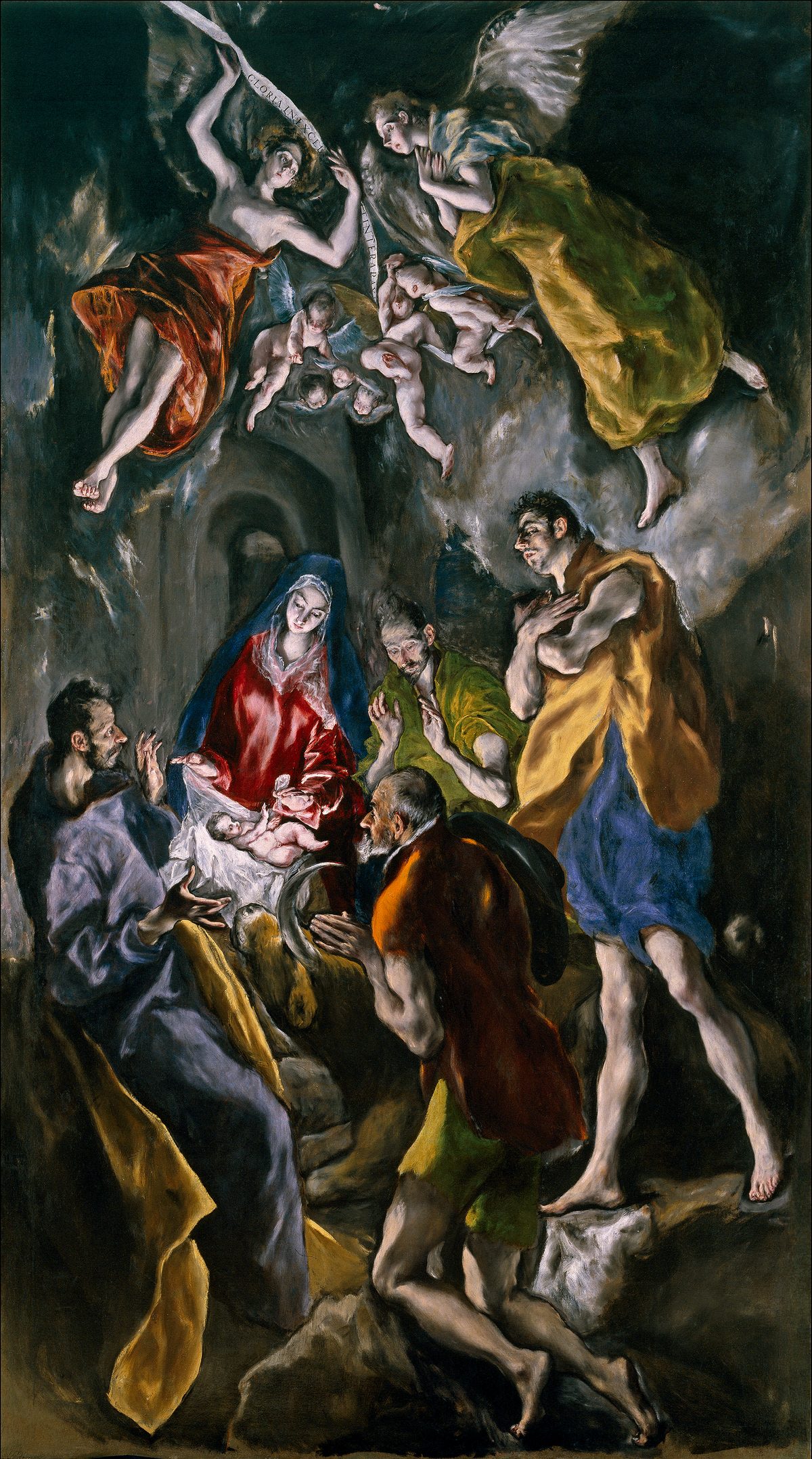
The Adoration of the Shepherds
Adoration of the Shepherds — El Greco, c.1612-1614
El Greco, Public domain, via Wikimedia Commons
El Greco's Adoration of the Shepherds in the Prado is his final large altarpiece — painted for his own funerary chapel in the church of Santo Domingo el Antiguo in Toledo, begun c.1612 and probably finished just before his death in April 1614. It shows the Virgin and Child in the manger surrounded by shepherds and angels in El Greco's fully mature style: the figures are intensely elongated, their pale faces suffused with interior spiritual light, the space dreamlike and anti-naturalistic, the colour of extraordinary luminous energy.
The Christ child at the centre is a source of light — he illuminates the figures around him from within. The adoring shepherds are El Greco's most expressively charged crowd — their faces combining awe, recognition, and transparent joy in equal measure.
The Adoration of the Shepherds represents the complete development of El Greco's mature idiom: the elongated figures with their attenuated proportions (sometimes bodies twice the natural height-to-width ratio), the cold silvery-white highlights against deep blue-green shadows, the dreamlike space that neither recedes in conventional perspective nor asserts a flat Byzantine surface but occupies a kind of ecstatic middle territory. The painting was made for his own tomb — his personal statement of faith, the image he chose to surround his death. The self-portrait figure (the shepherd at the left with a red cloak) is an identification with the adoring shepherds that echoes Michelangelo's inclusion of himself in the Bandini Pietà.
The Christ child as a light source — his luminous body illuminating the faces around him in a way no external light source would — is El Greco's most theologically daring pictorial innovation. In the painting, Christ is physically luminous: the shepherds' faces are lit from below and from within the crib, not from a natural light source above.
This is a painted theology of the Incarnation: God entering matter as light. The angel on the cloud above and the angels at the crib level create a vertical axis from heaven to earth that the shepherds' gaze also follows. The painting is simultaneously an altarpiece, a self-portrait, and a personal credo.
When standing before this work, look carefully: Adoration of the Shepherds — El Greco, c.1612-1614. Give it time — what seems decorative often carries the central meaning.
When standing before this work, look carefully: The luminous Christ child — light from the crib. Give it time — what seems decorative often carries the central meaning.
When standing before this work, look carefully: The shepherd faces — El Greco's mature expressionism. Give it time — what seems decorative often carries the central meaning.
When standing before this work, look carefully: Self-portrait as a shepherd — the red-cloaked figure. Give it time — what seems decorative often carries the central meaning.
Museo Nacional del Prado, Madrid. Room 10B (El Greco). This is the late-period El Greco room; the Burial of the Count of Orgaz (entry 90) is in Toledo but can be visited on the same day.