
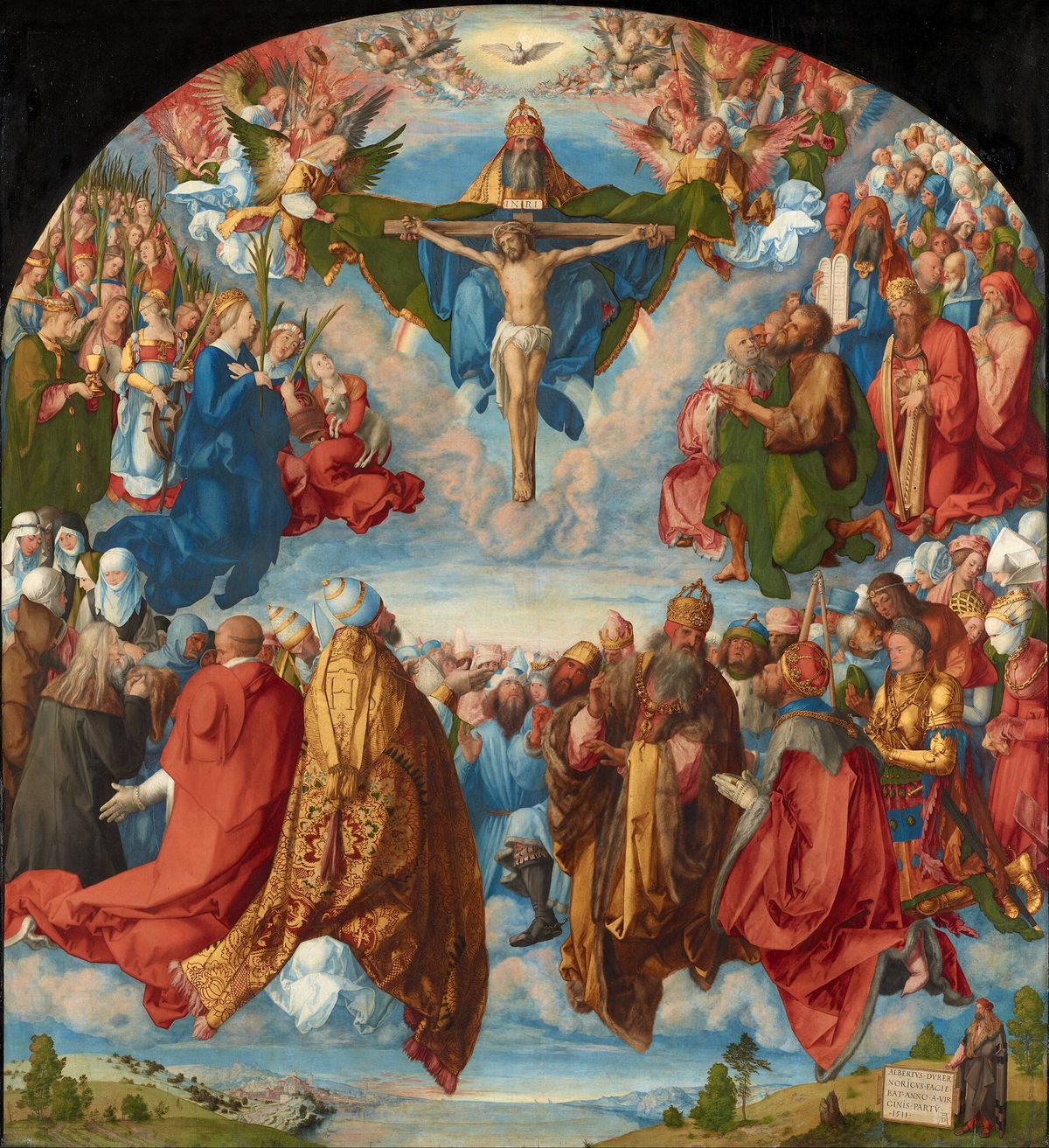
The Adoration of the Trinity (Landauer Altar)
Adoration of the Trinity — Dürer, 1511
Albrecht Dürer, Public domain, via Wikimedia Commons
Dürer's Landauer Altar (The Adoration of the Trinity) is his most ambitious religious painting — a large panel (approximately 135 by 123.4 cm) painted in 1511 for the private chapel of the Twelve Brothers Foundation in Nuremberg, founded and funded by the merchant Matthäus Landauer. The composition shows the Trinity at the apex of a cosmic space: God the Father sits at the top, holding the crucified Christ before him, while the dove of the Holy Spirit hovers between them; around them, the entire company of heaven is arranged in concentric groups — angels, martyrs, Old Testament patriarchs and kings (including popes and emperors), and the Virgin.
At the bottom, in the earthly zone, Matthäus Landauer himself (the donor) kneels with an angel; to the right, a figure in a landscape (Dürer's self-portrait, according to tradition) holds a tablet with the inscription identifying the painting and the artist. The composition is based on van Eyck's Ghent Altarpiece (entry 44) but transformed by Dürer's German Reformation-period religiosity.
The Landauer Altar was Dürer's own most prized painting: he maintained a detailed record of its production and cost, and the self-portrait figure in the lower right has been identified as a self-portrait since the 16th century. The painting is unusual in the German tradition for its Italian-influenced compositional structure (the circular arrangement of heavenly figures around the Trinity has no direct German precedent) and for its theological programme: the adoration of the Trinity by all of humanity, from the angels through the Old Testament figures through the contemporary church hierarchy to the common faithful, is a visual exposition of Luther's (and Erasmus's) conception of the priesthood of all believers — though the painting predates the Reformation.
The composition rewards reading from the bottom up: the earthly zone (Landauer, Dürer) at the bottom; then the figure groups of the saved (popes, emperors, knights, commons) in the middle zone; then the inner circle of the blessed (martyrs, Apostles, the Virgin) closer to the Trinity; and finally the Trinity itself at the apex. The concentric structure creates a visual theology of heaven as centripetal — all of creation drawn toward the divine centre.
When standing before this work, look carefully: Adoration of the Trinity — Dürer, 1511. Give it time — what seems decorative often carries the central meaning.
When standing before this work, look carefully: The Trinity at the apex — Father, Spirit, and crucified Son. Give it time — what seems decorative often carries the central meaning.
When standing before this work, look carefully: Matthäus Landauer kneeling with angel — donor portrait. Give it time — what seems decorative often carries the central meaning.
When standing before this work, look carefully: Dürer's self-portrait in the landscape zone. Give it time — what seems decorative often carries the central meaning.
Kunsthistorisches Museum, Vienna. See entry 178 for visiting details. The original frame (designed by Dürer and carved by craftsmen to his specifications) is in the Germanisches Nationalmuseum in Nuremberg.